IBM quantum computing looks simple from the outside: submit a circuit, wait for a result, maybe claim you are future-proof. In production, that framing breaks almost immediately.
A web3 compute marketplace, AI inference network, or video infrastructure system does not need another hype layer. It needs predictable job state, clean ownership, bounded spend, reproducible outputs, and a way to decide when specialized hardware is worth routing to at all.
Teams think the problem is access to quantum hardware. The real problem is orchestration around a backend that is scarce, probabilistic, queue-driven, and usually only useful as one step inside a larger classical workflow.
That changes the conversation. IBM quantum computing is not a replacement for GPUs, CPUs, FFmpeg workers, or inference nodes. It is a specialized execution target. The practical question is how to design your compute architecture so quantum jobs can be tested, routed, paid for, validated, and supported without turning the rest of the system into a science project.
Table of contents
- Why IBM quantum computing is an orchestration problem
- What IBM quantum computing actually adds to your stack
- The workload architecture classical in quantum kernel classical out
- Build a quantum-ready job router
- Developer workflow for IBM quantum computing experiments
- What breaks in practice
- Security identity and custody boundaries
- Operating metrics for quantum-adjacent compute
- Where c0mpute.com fits in a quantum-adjacent compute workflow
- Practical implementation checklist for 2026
Why IBM quantum computing is an orchestration problem
The wrong abstraction is a faster computer
The mistake teams make is treating quantum as a faster version of a server. That model is comfortable because it maps to existing infrastructure thinking: choose an instance type, upload a workload, get a deterministic result, scale horizontally when demand rises.
IBM quantum computing does not behave like that. A quantum processing unit is not a general-purpose replacement for a CPU or GPU. It is a backend for specific algorithms, experiments, and hybrid workflows where part of the computation is expressed as circuits and part remains classical.
If your mental model is cloud VMs, you will design the wrong interface. You will expect immediate execution, simple retries, normal validation, and predictable throughput. What breaks in practice is not usually the Python code. It is the product assumption that a quantum run can be treated like a normal stateless API call.
The useful abstraction is a constrained backend
A useful way to think about it is this: IBM quantum computing is a constrained backend behind an asynchronous job boundary.
That means your platform needs to answer operational questions before it answers quantum questions:
- Who is allowed to submit the job?
- What budget or quota does the run consume?
- Which backend was selected, and why?
- What classical preprocessing produced the circuit?
- What result confidence is acceptable?
- What happens if the queue time exceeds the product SLA?
- How is the output stored, explained, and disputed?
Those are marketplace and workflow questions. They matter whether the workload is AI inference, FFmpeg transcoding, or a quantum circuit.
Practical rule: Treat a quantum backend like a scarce asynchronous worker, not like a low-latency function call.
What changes for decentralized compute builders
For decentralized compute builders, this is more interesting than it first appears. Decentralized compute networks already deal with untrusted workers, heterogeneous capabilities, payment boundaries, job validation, and delayed settlement. Quantum backends add another specialized execution tier, but the control-plane problems are familiar.
The difference is that quantum work has tighter constraints around experiment design, result interpretation, and provider credentials. You may not run the quantum hardware yourself. You may route through a provider account, a broker, or an approved worker. So the architecture needs clean custody boundaries.
This is where web3 patterns can be useful without pretending blockchain solves physics. Identity, payments, reputation, and auditable job state help when buyers, workers, validators, and backend providers are not the same party.
What IBM quantum computing actually adds to your stack
Hybrid execution not replacement compute
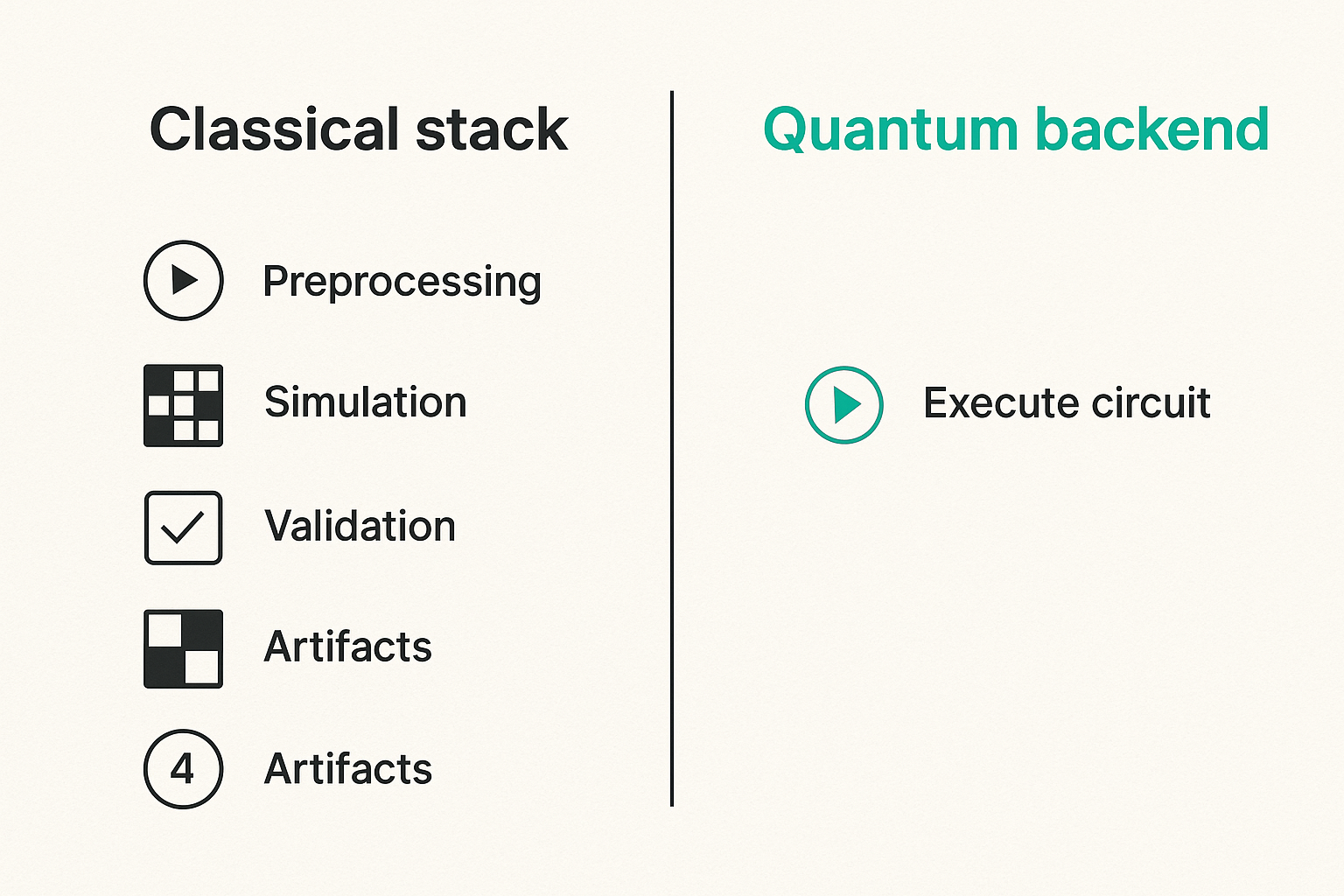
IBM quantum computing adds a hybrid execution path. Most useful workflows still look like this:
- Classical code prepares data, parameters, and constraints.
- A quantum circuit or quantum-inspired kernel is generated.
- The job is submitted to a simulator or hardware backend.
- Measurement results are returned as distributions, samples, or expectation values.
- Classical code post-processes the output and decides the next step.
The important part is not the circuit alone. It is the loop around the circuit.
For AI infrastructure builders, that could mean research experiments around optimization, sampling, or future model components. For video infrastructure engineers, quantum is not going to replace FFmpeg. But the same marketplace that routes video transcodes to CPU or GPU workers can route specialized experiments to quantum-capable backends if the control plane is designed correctly.
Qiskit jobs queues and result artifacts
IBM's developer workflow is commonly associated with Qiskit, circuits, transpilation, backends, jobs, and result objects. From an application architecture perspective, those are not just SDK concepts. They are state transitions.
A minimal state model might look like this:
created -> simulated -> approved -> submitted -> queued -> running -> completed -> validated -> settled
                         \-> rejected
                         \-> expired
                         \-> failed
That state machine is more important than the button that launches the experiment. Without it, support cannot answer where the job is, finance cannot explain spend, and developers cannot reproduce what happened.
The practical question is not whether a CLI can call a quantum SDK. It can. The practical question is whether the workflow survives retries, provider latency, partial failures, and result ambiguity.
Where quantum fits beside GPUs and FFmpeg
Quantum should be modeled as one backend class among several, with different constraints.
| Backend type | Good for | Bad for | Operational shape |
|---|---|---|---|
| CPU worker | General jobs, scripts, validation, lightweight transforms | Massive parallel inference | Broad availability, lower specialization |
| GPU worker | AI inference, embeddings, rendering, accelerated media tasks | Cheap idle experiments | Capacity-sensitive, model and driver dependent |
| FFmpeg worker | Transcoding, packaging, media normalization | Non-media compute | Deterministic jobs, clear artifacts |
| Quantum simulator | Circuit testing, debugging, small experiments | Proving hardware behavior | Local or cloud execution, useful before hardware spend |
| IBM quantum backend | Specialized quantum experiments | General compute, synchronous UX | Queue-driven, probabilistic, provider-mediated |
That table changes how you design routing. You do not ask which backend is newest. You ask which backend is valid for this job and what evidence is required before money moves.
The workload architecture classical in quantum kernel classical out
Define the job envelope
A quantum-ready workload needs a job envelope that is broader than the circuit. If the only stored artifact is a notebook, the system is not production-ready.
A practical job envelope includes:
- requester identity
- job type and version
- input hash or dataset reference
- classical preprocessing version
- circuit source or generated circuit hash
- backend preference and constraints
- simulator result if available
- budget limit
- timeout policy
- result schema
- validation method
- settlement rule
In CLI terms, it should be possible to create a job spec that can be reviewed before execution:
job_type: quantum_experiment
version: 2026-06
requester: did:example:buyer123
inputs:
  dataset_ref: ipfs://example-input-hash
  preprocessing_image: registry.local/qprep:1.4.2
quantum:
  framework: qiskit
  circuit_ref: ./circuits/optimizer.py
  backend_policy: ibm_or_simulator
  max_queue_minutes: 120
  shots: 4000
budget:
  max_usd_equivalent: 25
validation:
  method: distribution_threshold
  baseline_ref: ./baselines/simulated.json
settlement:
  release_on: validated
This is not bureaucracy. It is how you stop quantum experiments from becoming untraceable API calls with no owner.
Keep state outside the quantum provider
Do not outsource your workflow state to the provider dashboard. Provider job IDs matter, but they are not enough. Your system needs its own canonical record of the job, linked to provider IDs as external references.
The marketplace should own:
- user-facing job ID
- payment or escrow state
- worker assignment
- provider submission metadata
- validation status
- logs and artifacts
- dispute history
The provider owns execution of the quantum backend. Your system owns the business workflow.
Practical rule: Store provider job IDs as references, not as your source of truth.
This matters when you add multiple backends later. If the IBM job ID is baked into your application model, every new provider or simulator becomes a special case. If your platform owns a generic job state machine, providers become adapters.
Treat results as probabilistic artifacts
Classical infrastructure teams are used to outputs that are either correct or incorrect. Quantum results are often distributions. You may compare histograms, expectation values, confidence intervals, or application-specific thresholds.
That changes validation. A validator cannot simply hash the output and compare it with a golden file. It needs to understand acceptable variance, simulator baselines, backend noise, and the purpose of the experiment.
A basic result record might include:
{
  "job_id": "job_8f31",
  "backend": "ibm_backend_alias",
  "shots": 4000,
  "result_type": "counts_distribution",
  "baseline": "simulator_run_9ac2",
  "validation": {
    "method": "threshold_distance",
    "status": "accepted",
    "notes": "within configured distribution tolerance"
  }
}
Avoid pretending this is the same as validating an FFmpeg output file. Media jobs can often be validated by duration, codec, checksum, and playback probes. Quantum jobs need statistical context.
Build a quantum-ready job router
Route by capability not brand
IBM quantum computing may be the named backend in your architecture, but your router should not hard-code brand as the first decision. Route by capability.
A router can evaluate:
- job class
- required framework
- circuit size constraints
- simulator availability
- budget
- requester permissions
- expected queue tolerance
- validation method
- provider policy
The output might be local_simulator, managed_simulator, ibm_quantum_backend, or reject_requires_review.
The mistake teams make is adding a menu that says run on IBM and calling that orchestration. That is not orchestration. That is a manual switch. Real orchestration means the system can explain why a job was routed, why it was denied, or why it stayed in simulation.
Separate scheduling from execution
Scheduling decides whether a job should run and where. Execution submits it. Keep those separate.
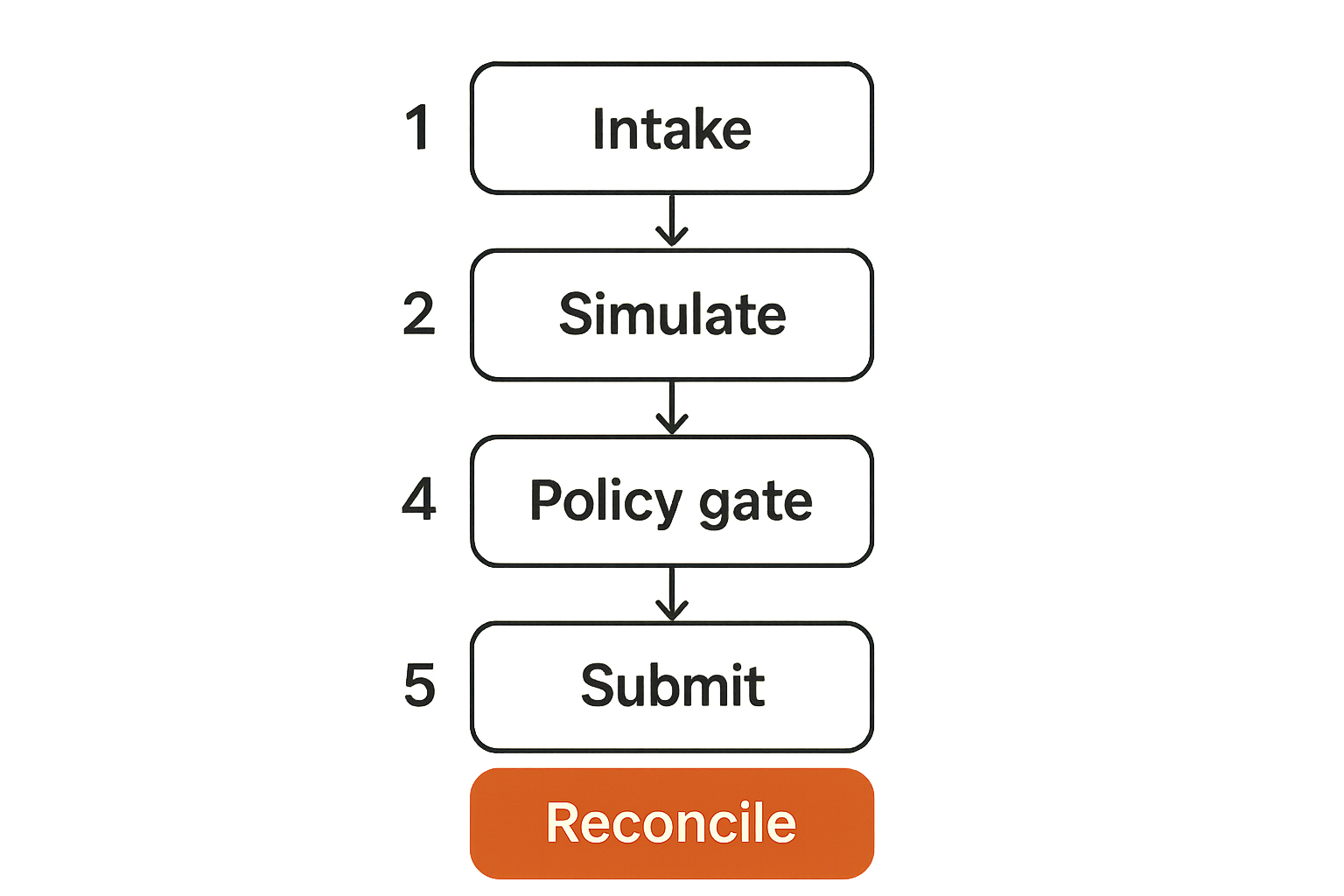
A simple implementation sequence:
- Ingest the job spec and assign a marketplace job ID.
- Validate schema, identity, budget, and policy constraints.
- Run local or managed simulation if required.
- Compare simulation artifacts against promotion rules.
- Select an execution backend and lock budget.
- Submit through a provider adapter.
- Poll or receive status updates.
- Store result artifacts and validation output.
- Release payment, refund, or escalate.
This separation lets you test most of the workflow without touching quantum hardware. It also lets you keep support, billing, and validation logic stable when provider APIs change.
Related reading from our network: teams designing autonomous local routing face similar ask, offer, trust, and follow-up problems in AI agents asks and offers, even when the workloads are not quantum.
Add policy gates before spend
Quantum experiments can be expensive in attention even when direct spend is bounded. They consume queue slots, developer time, and support cycles. Add gates before the job reaches hardware.
Policy gates can include:
- simulation must complete successfully
- requester must have approved role
- budget must be locked
- circuit size must be within configured limits
- job must include validation criteria
- queue tolerance must exceed current estimate
- manual approval required for new algorithms
Practical rule: Hardware execution should be a promotion step, not the default first run.
This is especially important in marketplaces. A buyer may want the prestige of a hardware run, but the operator needs a reason to route it there. The job router should enforce that reason.
Developer workflow for IBM quantum computing experiments
Start with simulation
The developer workflow should begin with simulation because simulation is where you debug interface, schema, and algorithm problems cheaply.
A CLI-first workflow might look like this:
compute quantum init optimizer-demo
compute quantum simulate ./optimizer-demo/job.yaml
compute quantum inspect job_8f31 --artifacts
compute quantum promote job_8f31 --target ibm --max-budget 25
compute quantum watch job_8f31
compute quantum validate job_8f31
The exact commands are less important than the shape. Developers need the ability to create, simulate, inspect, promote, watch, and validate. If the only workflow is a notebook with embedded credentials, the system will not survive handoff to other developers or operators.
For adjacent decentralized execution patterns, the architecture issues are similar to agent workloads: queueing, validation, payments, and routing need to be explicit. We covered that broader pattern in AI agents cloud computing and decentralized execution.
Promote to hardware only with budgets
Promotion should be explicit. A simulated job can be promoted to IBM quantum hardware only when the budget and policy checks pass.
Example promotion policy:
promotion_policy:
  require_simulation: true
  require_baseline_distance_below: 0.08
  max_hardware_runs_per_day: 3
  require_manual_approval_for:
    - new_circuit_family
    - budget_over_50
    - unknown_requester
This prevents a research loop from quietly becoming a production cost center. It also gives operators a clean explanation when a job is denied.
That changes the conversation with users. Instead of saying quantum is unavailable, you can say the job is still eligible for simulation, but not yet eligible for hardware promotion because it lacks validation rules or exceeds budget.
Capture every run as a reproducible artifact
Every run should produce artifacts that another developer can inspect later:
- original job spec
- normalized job spec after policy defaults
- code version or container digest
- simulation output
- backend selection decision
- provider job reference
- raw result object
- validation report
- settlement event
This is where notebooks are dangerous. They are useful for exploration, but weak as production records. If a notebook cell mutates state, pulls hidden credentials, and submits a job, you may not know what actually ran.
The practical pattern is notebook for research, job spec for execution. Convert exploratory work into a portable spec before it touches shared infrastructure.
What breaks in practice
Queue times break synchronous UX
The first failure mode is user experience. Product teams often design a run button that waits for an answer. That can work for local simulation. It is fragile for quantum hardware.
Queue times vary. Backend availability changes. Jobs may sit, fail, or need resubmission. If your UI or API assumes synchronous completion, users will refresh, resubmit, and create duplicate work.
Use asynchronous UX:
- submit returns a job ID
- status is pollable
- webhooks or events notify changes
- artifacts appear as they are produced
- timeout and cancellation policies are visible
This is the same lesson video infrastructure learned with long transcodes. The UI is not the system. The state machine is the system.
Results break naive validation
The second failure mode is validation. Teams try to treat quantum results like deterministic output. Then they either reject valid results because they are different, or accept bad results because they do not know what difference matters.
Validation needs to be declared per job class. For example:
| Job class | Bad validation | Better validation |
|---|---|---|
| Circuit smoke test | Exact output match | Distribution within tolerance against simulator |
| Optimization experiment | Single best value only | Best value plus run metadata and convergence context |
| Research benchmark | Screenshot of notebook | Stored raw results, backend details, and reproducible spec |
| Marketplace job | Worker says completed | Validator report tied to settlement policy |
What breaks in practice is trust. Buyers do not know whether they got what they paid for. Workers do not know what evidence is enough. Operators get pulled into disputes that should have been prevented by job design.
Cost controls break when experiments become products
The third failure mode is gradual productization. A team starts with experiments. Then internal users depend on them. Then customers ask for access. Suddenly a research script is part of a paid workflow.
If budgets, quotas, and approvals were not designed early, you get operational debt:
- shared provider credentials
- unclear billing ownership
- manual spreadsheet tracking
- no per-user quota
- no reliable refund path
- no way to throttle demand
The fix is not heavy process. The fix is a small amount of structure before the first external user touches the workflow.
Security identity and custody boundaries
Credentials are a control plane asset
IBM quantum computing access usually involves provider credentials, account permissions, and backend access policies. In a decentralized compute environment, those credentials should not leak into worker code casually.
Treat credentials as control-plane assets:
- store them in a managed secret system
- scope them to provider adapters
- avoid embedding them in notebooks
- rotate them when workers or maintainers change
- log provider submissions without exposing secrets
- separate requester identity from provider account identity
If a worker can both alter a circuit and spend from a provider account without policy checks, you do not have a compute marketplace. You have a shared credential with extra steps.
DID-based payment can separate buyers and workers
DID-based identity and payment flows are useful because they separate roles. A requester can sign a job. A worker can claim execution. A validator can attach evidence. A payment module can release funds when the agreed state transition occurs.
That does not make quantum validation easy, but it makes responsibility explicit. The system can answer who requested the job, who executed the classical steps, which provider backend was used, which validator accepted the result, and why payment moved.
For decentralized compute, that is the core architecture. Trust is not a slogan. It is a set of signed events and state transitions.
Related risks from autonomous tooling
Many teams will put agents around these workflows: agents that generate circuits, tune parameters, submit runs, summarize results, or open pull requests. That is useful, but it increases the blast radius of bad permissions.
Related reading from our network: CI/CD teams face a similar boundary problem when autonomous systems can trigger privileged workflows, as discussed in AI agents GitHub Actions security.
For quantum-adjacent compute, the risk is not just secret leakage. It is an agent submitting expensive or invalid jobs, overwriting baselines, or approving its own outputs. Keep generation, submission, validation, and settlement as separate permissions.
Operating metrics for quantum-adjacent compute
Metrics that matter before quantum speedup
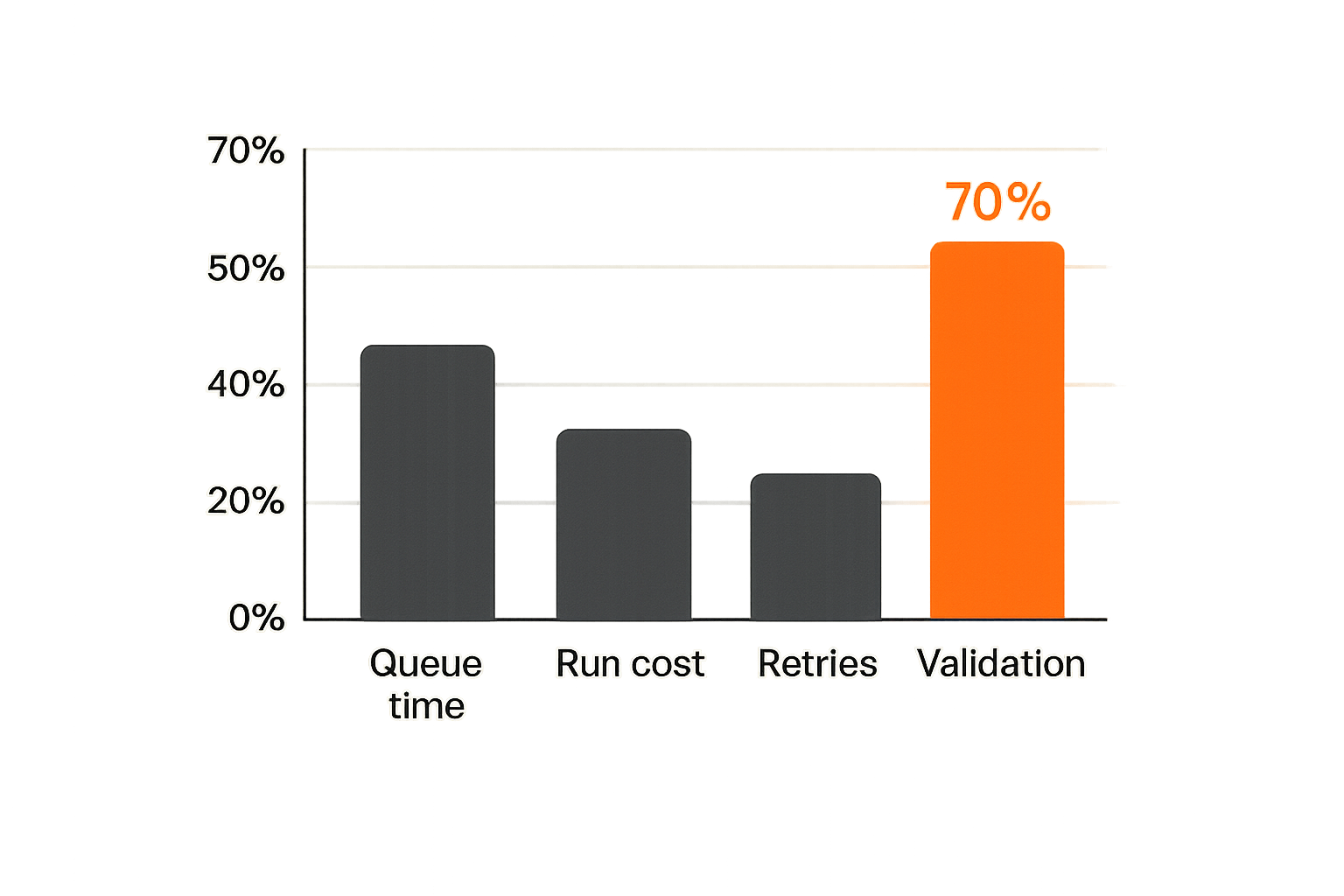
Before arguing about speedup, measure the workflow. Many teams skip this because quantum sounds like a research topic. Operators cannot skip it.
Useful metrics include:
- simulation pass rate
- promotion rate from simulation to hardware
- queue wait time
- execution time
- validation acceptance rate
- cost per accepted result
- retry rate
- timeout rate
- dispute rate
- artifacts missing per job
These metrics tell you whether the system is working before they tell you whether the algorithm is impressive.
Practical rule: If you cannot measure the job lifecycle, you are not ready to measure quantum advantage.
Compare backend choices honestly
A backend comparison should include operational constraints, not just theoretical capability.
| Decision factor | Simulator | IBM quantum backend | Other specialized worker |
|---|---|---|---|
| Latency | Usually lower | Queue-dependent | Varies |
| Cost control | Easier | Needs gates | Depends on supply |
| Reproducibility | Stronger | Noise and calibration matter | Depends on worker image |
| Validation | Easier baseline | Statistical and contextual | Job-specific |
| Product fit | Development and QA | Selected experiments | Production workloads if stable |
This table is intentionally boring. Good infrastructure decisions are often boring. They avoid routing work to specialized systems unless there is a reason.
For analytics-heavy marketplace operators, the same discipline applies across job states, workers, validation, and payments. If you want the operational analytics angle, the prior c0mpute discussion of Sigma Computing for decentralized compute marketplace operations maps well to this kind of job lifecycle tracking.
Alert on workflow drift not just failures
Do not only alert when a provider call fails. Alert when the workflow drifts.
Examples:
- promotion rate suddenly increases
- average queue wait exceeds user-facing tolerance
- validation acceptance drops below expected range
- jobs are missing simulation artifacts
- budget locks remain open too long
- one requester consumes disproportionate hardware runs
- retries cluster around one backend adapter
These are early warnings. By the time users complain, the system has already lost predictability.
Where c0mpute.com fits in a quantum-adjacent compute workflow
Decentralized workers as the classical layer
c0mpute.com is not trying to turn every worker into a quantum computer. That would be the wrong abstraction. The useful fit is the classical layer around specialized workloads: preprocessing, simulation, artifact handling, validation helpers, FFmpeg jobs, AI inference, and payment-aware execution.
In a quantum-adjacent architecture, decentralized workers can handle the parts that do not require direct access to quantum hardware:
- prepare datasets
- generate circuits from versioned code
- run simulations
- package artifacts
- compare outputs against baselines
- run AI summaries of result reports
- transcode or process related media assets
- execute validation scripts
The quantum backend remains specialized. The marketplace provides the surrounding execution fabric.
CLI-first execution and documentation
CLI-first matters because builders need workflows they can automate, inspect, and reproduce. A dashboard can be useful later, but the core path should be scriptable.
A practical stack might use a local CLI to create a job spec, submit it to a decentralized marketplace, run simulation on available workers, and promote only selected jobs to an IBM quantum backend through a controlled adapter.
Builders who want to model this kind of workflow can start with the c0mpute CLI patterns in the c0mpute documentation, especially around workers, jobs, health checks, and execution modules.
Related reading from our network: local AI agent builders run into similar workflow design issues around credentials, events, testing, and interoperable tools in Mac tools for AI agent workflow architecture.
Payment and reputation around specialized workloads
Specialized workloads need better market signals than available or unavailable. A worker or adapter should build reputation around the work it actually performs:
- simulation correctness
- artifact completeness
- validation reliability
- average turnaround time
- failure handling
- dispute rate
- policy compliance
Payment should follow state. A requester should not pay merely because a job was submitted. A worker should not wait forever because validation is undefined. The settlement rule should be attached to the job spec before execution starts.
That is where DID-based payments and decentralized reputation become practical. They do not replace provider trust. They make marketplace trust observable.
Practical implementation checklist for 2026
What works
For teams experimenting with IBM quantum computing inside decentralized compute systems, the pattern that works is boring and explicit:
- Define job classes before building UI.
- Start every workflow with simulation.
- Store a canonical job record outside the provider.
- Route by capability and policy, not brand.
- Require validation rules before hardware promotion.
- Separate requester, worker, validator, and payer roles.
- Track queue time, promotion rate, cost, and disputes.
- Treat provider credentials as privileged control-plane assets.
- Make artifacts downloadable and reproducible.
- Keep the CLI path first so automation stays clean.
This gives you room to experiment without making the rest of your infrastructure depend on unstable assumptions.
What fails
The patterns that fail are also predictable:
- notebook-only workflows with hidden state
- shared provider credentials across developers and workers
- synchronous APIs wrapped around queue-based hardware
- direct hardware submission without simulation
- no budget lock before execution
- validation by screenshot or vague human approval
- payment release based only on claimed completion
- provider job IDs used as the marketplace source of truth
- agentic systems allowed to submit and approve their own work
The common thread is missing ownership. When nobody owns the state machine, everybody owns the incident.
Closing view on IBM quantum computing
IBM quantum computing is worth tracking, but not because it magically replaces your existing compute network in 2026. The near-term value for most builders is learning how to integrate a specialized, probabilistic, queue-driven backend into a real system without breaking product, payments, validation, or support.
That is the architecture lesson. If your decentralized compute marketplace can route classical jobs, AI inference, FFmpeg transcoding, simulations, and selected quantum experiments through the same job-state discipline, you have something durable. If quantum is bolted on as a demo button, it will stay a demo.
The practical question is not whether IBM quantum computing is important. It is whether your workflow can use it responsibly when it is the right backend, and ignore it when it is not.
Try c0mpute.com
c0mpute.com is for technical builders interested in decentralized compute, AI inference, FFmpeg transcoding, and DID-based payments. If you are designing specialized compute workflows with real job state, routing, validation, and settlement, Try c0mpute.com.