Computing in the 1970s sounds like a history topic until you try to run a decentralized compute marketplace in production.
You have jobs arriving from unknown clients, workers with uneven capacity, scarce GPUs or CPUs, flaky networks, delayed settlement, and users who only care whether their inference result or FFmpeg output arrives correctly. The hardware is different. The workflow problem is familiar.
Teams think the problem is finding cheaper compute. The real problem is coordinating work across machines you do not fully control, while preserving state, trust, payment, and debuggability.
That changes the conversation. Computing in the 1970s was full of constraints: limited memory, expensive CPU time, batch jobs, terminals, operators, queues, accounting, and explicit ownership. Those constraints forced architecture discipline. For web3 developers, AI infrastructure builders, video engineers, and CLI-first operators, the useful part is not nostalgia. It is the operating model.
Table of contents
- Why computing in the 1970s still matters
- Computing in the 1970s was an operating model, not nostalgia
- Scarcity shaped better compute architecture
- What decentralized compute can borrow from 1970s workflows
- Scheduling is the real marketplace engine
- Identity, trust, and accounting before wallets
- Design a 1970s-inspired decentralized compute workflow
- What breaks when teams implement this badly
- What works for AI inference and FFmpeg transcoding
- Measure the system like an operator
- Product fit for c0mpute.com builders
Why computing in the 1970s still matters
The pain was scarcity
Computing in the 1970s was defined by scarcity. CPU time was expensive. Memory was limited. Storage was slow. Networks were narrow. Users did not casually spin up disposable capacity because capacity was a budget line, a scheduling problem, and often a political problem inside the organization.
That sounds distant until you run AI inference on constrained GPUs, coordinate video transcoding across heterogeneous workers, or ask independent node operators to complete jobs with real payment at stake.
The mistake teams make is assuming abundance is the default. In production, abundance is usually a local illusion. One model needs a specific accelerator. One video profile needs a certain FFmpeg build. One worker has bandwidth but not disk. Another has disk but fails long jobs. Scarcity moves around the system.
The useful lesson is operating discipline
The 1970s did not produce elegant systems because engineers loved friction. It produced disciplined systems because sloppy work was expensive. Jobs had clear inputs. Outputs were inspected. Operators had runbooks. Accounting records mattered.
A useful way to think about it is this: old systems forced engineers to name the workflow. Modern decentralized compute often hides the workflow behind an API call, then gets surprised when payments, retries, provenance, and support become hard.
For a deeper architecture framing of the same historical pattern, we previously covered computing in the 1970s as a decentralized compute architecture lesson. This article goes more operational: how to use those lessons when designing job flows, worker markets, inference pipelines, and transcoding systems now.
Practical rule: if compute is scarce, untrusted, or paid per job, design the workflow before you design the interface.
Computing in the 1970s was an operating model, not nostalgia
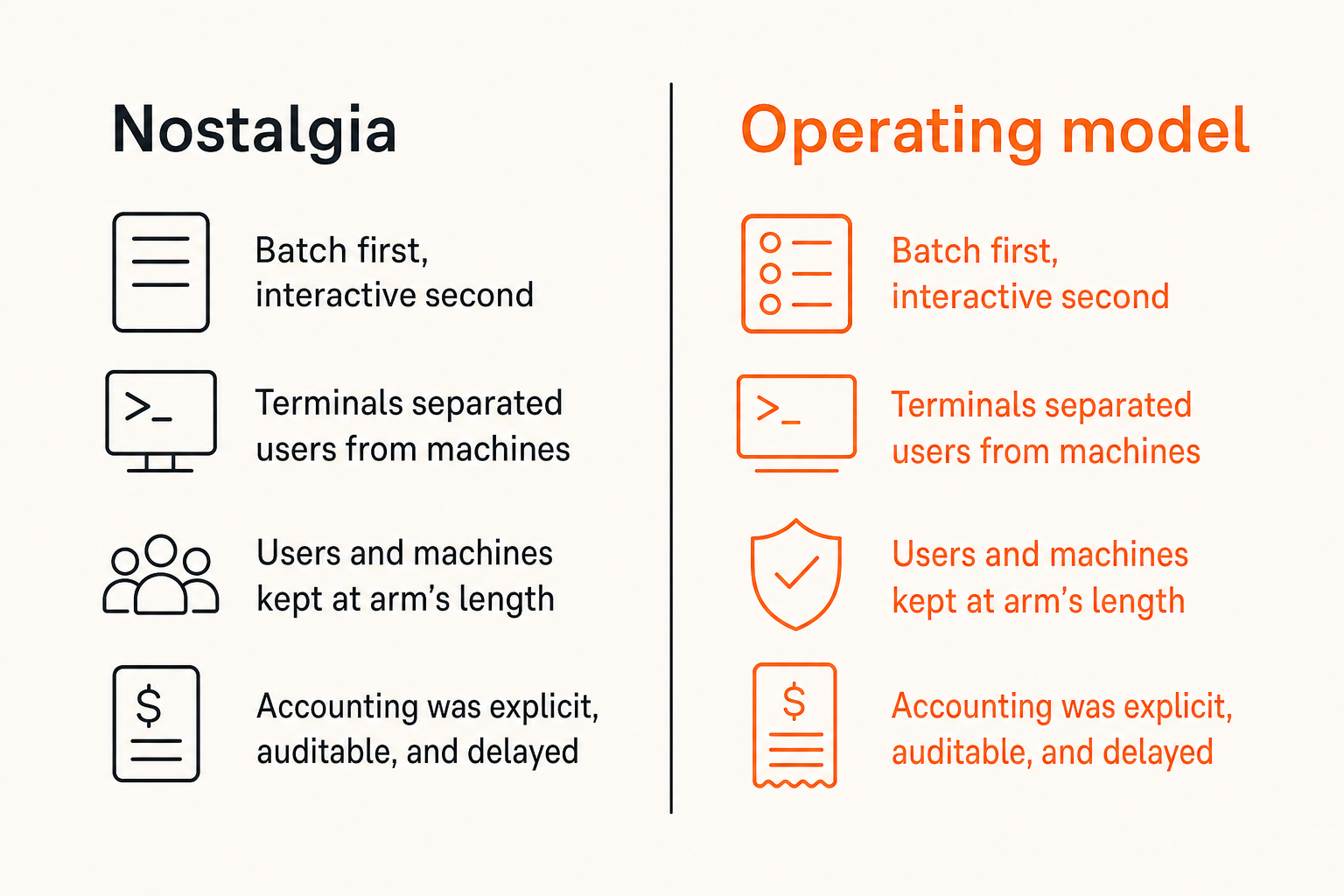
Batch first, interactive second
The defining pattern of many 1970s systems was batch processing. A user submitted a job. The system queued it. A scheduler assigned resources. The job ran. Output came back later. This was not convenient, but it was explicit.
That explicitness is useful for decentralized compute. Many workloads are naturally asynchronous: transcoding a file, running a batch of inference prompts, generating embeddings, validating a model output, rendering frames, or compressing media. Treating those as fake real-time operations creates avoidable complexity.
The practical question is not whether users like waiting. Nobody likes waiting. The question is whether your system can honestly represent waiting, retrying, failing, validating, and paying.
Terminals separated users from machines
Terminals gave users access without giving them the machine. That separation matters. In a decentralized marketplace, clients should not need to know every worker detail, and workers should not need full access to client context.
The terminal pattern maps cleanly to CLI-first compute. A CLI can submit a job manifest, stream status, download artifacts, and verify receipts without exposing raw infrastructure. It is not a toy interface. For technical users, the CLI is often the cleanest contract between intent and execution.
The mistake teams make is treating the user interface as the product. The real product is the state machine behind it.
Operators were part of the system
In 1970s environments, human operators mounted tapes, monitored queues, restarted failed jobs, and enforced procedure. Modern systems automate more of that, but the operator role did not disappear. It moved into observability, policy, support, validation, and incident response.
For decentralized compute, you need to decide who owns stuck jobs, bad artifacts, worker disputes, payment delays, and version mismatches. If nobody owns those states, the marketplace becomes a pile of optimistic assumptions.
Related reading from our network: teams building secure communication systems face a similar problem where the visible app is only a thin layer over identity, metadata, retention, and device state; see this practical guide to secure messaging apps architecture.
Scarcity shaped better compute architecture
Queues made demand visible
A queue is not just a buffer. It is a measurement surface. It tells you what users want, what the system cannot currently serve, which capabilities are scarce, and where pricing should move.
In a decentralized compute marketplace, the queue is where demand becomes operational. A good queue records job type, resource requirements, expected runtime, payment terms, timeout, retry policy, validation method, and artifact destination.
A bad queue stores a blob and a status field.
Practical rule: the queue should explain why a job is waiting, not just that it is waiting.
Accounting made cost real
Mainframe and timesharing systems often had accounting baked into usage. CPU seconds, storage, connect time, and print output could matter. That sounds bureaucratic, but it prevented a common failure: treating shared compute as free until the invoice or outage arrives.
Decentralized compute needs accounting even more. Every job crosses an economic boundary. Someone requested work. Someone provided capacity. Someone may validate output. Someone settles payment. If those events are not tied together, disputes become guesswork.
Related reading from our network: the same ownership problem appears outside infrastructure too; budgeting teams need workflows that connect approval, variance, and accountability, as described in this guide to budgeting software workflows.
Capacity planning was not optional
Old compute teams planned because procurement was slow and machines were expensive. Marketplace teams need planning for a different reason: supply is not uniform.
You may have many workers, but only a subset can run a large language model with acceptable latency. You may have plenty of CPUs, but not enough bandwidth for high-bitrate video inputs. You may have cheap nodes, but not enough trusted nodes for jobs that require stronger validation.
Capacity planning in decentralized compute means tracking capability inventory, not just node count.
| Architecture habit | 1970s version | Decentralized compute version | What it prevents |
|---|---|---|---|
| Job control | JCL, batch cards, scripts | Job manifests and CLI submissions | Ambiguous execution |
| Queue discipline | Batch queues by priority | Capability-aware job queues | Random worker assignment |
| Accounting | CPU time and storage records | Job cost, escrow, receipts | Payment disputes |
| Operator runbooks | Console procedures | Incident and retry playbooks | Silent stuck states |
| Output handling | Printouts, tapes, files | Artifacts, hashes, logs | Unverifiable results |
What decentralized compute can borrow from 1970s workflows
Treat every job as a contract
A job is not just a function call. It is a contract between requester, network, worker, validator, and payment rail.
For AI inference, the contract includes model, parameters, input, expected output shape, timeout, privacy constraints, and cost. For FFmpeg transcoding, it includes source, codec profile, resolution, bitrate, container, segmenting rules, output location, and validation checks.
If the contract is implicit, support becomes painful. Two parties can both be honest and still disagree about what was requested.
Separate submission from execution
Submission should be durable before execution starts. This is one of the strongest lessons from batch systems. The system should know what was requested, when, by whom, under what terms, before any worker picks it up.
That separation gives you retries, auditing, cancellation, repricing, and better worker matching. It also lets CLI users submit work from unreliable environments. The client should not need to keep a laptop open for the job to exist.
What breaks in practice is the shortcut: an API call directly invokes a worker, the worker streams something back, and only later does the team add persistence. At that point the state model is already messy.
Make settlement observable
Payment should not be a separate mystery system. It should follow job state.
A clean marketplace can answer basic questions quickly: was the job accepted, funded, assigned, started, completed, validated, disputed, paid, refunded, or expired? Each transition should have a timestamp and actor.
This is especially important when using DID-based payments or crypto settlement, where users expect cryptographic receipts but still need normal operational support.
Practical rule: if support cannot explain payment state from job state, your settlement model is too detached.
Scheduling is the real marketplace engine
Do not route only on price
The cheapest worker is often not the cheapest outcome. A low-price node that fails long video jobs, returns slow inference, or lacks the right model cache creates retries and user-visible delay.
Scheduling should consider price, capability, reputation, current load, data locality, expected runtime, validation cost, and payment risk. That does not mean building an overcomplicated optimizer on day one. It means refusing to pretend that price alone is enough.
A simple weighted scheduler with clear inputs usually beats a clever marketplace with hidden assumptions.
Use capability classes
Capability classes are a practical bridge between total abstraction and per-worker micromanagement. Instead of letting requesters pick random nodes, define classes such as cpu-transcode-small, gpu-infer-llm-8b, gpu-infer-vision, or video-hls-high-bitrate.
Workers advertise capabilities. The network verifies or scores them over time. Jobs target a class. The scheduler chooses among eligible workers.
This keeps the user workflow simple without erasing operational reality.
Design for retries before failures happen
Retries are not an error feature. They are part of the execution model.
A decentralized compute job can fail because the worker disconnects, the input fetch fails, the output upload times out, the validator rejects the artifact, the payment authorization expires, or the requester cancels. Each failure needs a policy.
Useful retry policies include maximum attempts, backoff, worker exclusion after failure, partial artifact cleanup, and escalation to manual review for expensive jobs.
Identity, trust, and accounting before wallets
Identity binds work to responsibility
Wallets identify payment control. They do not automatically identify operational responsibility. A DID or identity layer can bind jobs, workers, reputation, receipts, and policy in a way that survives key rotation and supports more nuanced trust.
For decentralized compute, identity should answer: who submitted this job, who accepted it, what worker identity executed it, what validator checked it, and which account should receive settlement?
If those answers are spread across logs, wallet events, and application database rows with no shared model, incident response slows down.
Trust is accumulated evidence
Trust should be built from evidence, not vibes. Evidence includes successful jobs, validated artifacts, failure rates, dispute outcomes, response times, hardware attestations where available, version consistency, and operator behavior.
This is where 1970s-style accounting meets modern decentralized networks. The system should record enough history to make future routing better.
Reputation does not need to be perfect to be useful. It needs to be specific. A worker may be excellent for short CPU tasks and poor for large video jobs. Another may be reliable for one model family and untested for another.
Payments should follow state transitions
The clean pattern is escrow or authorization at submission, lock at assignment, release after validation, and dispute or refund on defined failure states. The exact payment rail can vary, but the state machine should be explicit.
Do not let workers start expensive jobs with unclear funding. Do not release payment before output is accepted unless the buyer has intentionally chosen that risk. Do not make refunds a manual database edit.
Related reading from our network: product teams selling digital goods face similar checkout and delivery coupling issues, where payment success must connect to fulfillment and support; this guide explains the workflow for selling digital products without a fragile launch machine.
Design a 1970s-inspired decentralized compute workflow
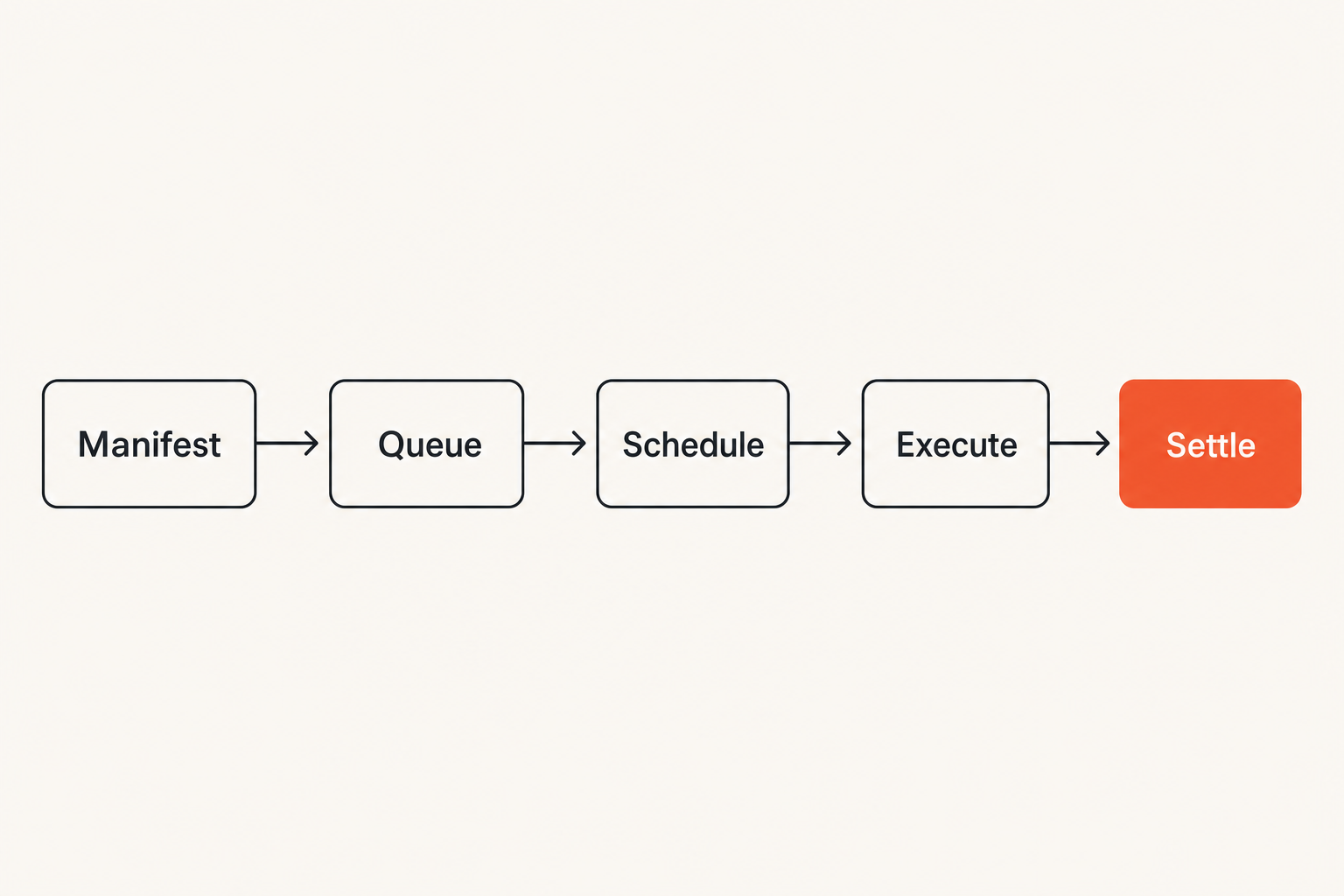
A practical job lifecycle
A good lifecycle is boring in the best way. It names each state and limits ambiguity.
- Requester creates a job manifest with inputs, requirements, price limit, timeout, and validation policy.
- Network records the job, checks funding or authorization, and places it in the appropriate queue.
- Scheduler selects an eligible worker based on capability, reputation, load, and price.
- Worker accepts the job, fetches inputs, executes, and uploads artifacts or inference results.
- Validator checks output against the policy and records pass, fail, or needs-review.
- Settlement releases payment, refunds, or opens a dispute based on final state.
- Logs, receipts, hashes, and metrics remain available for audit and support.
This sequence is not glamorous. It is how you avoid losing state between components.
A minimal job manifest
The manifest does not need to be huge, but it should be explicit. A CLI-first workflow benefits from a file users can inspect, version, and reproduce.
job_type: transcode
input_uri: ipfs://source-video
output_profile: hls-1080p
max_price: 12.50
timeout_seconds: 3600
worker_class: cpu-transcode-large
validation:
  require_probe: true
  require_hash: true
  min_duration_match: 0.99
payment:
  mode: escrow
  currency: usdc
For inference, the same structure changes shape but not philosophy: model, prompt or input reference, sampling parameters, output constraints, timeout, and validation method.
Builders who want concrete command patterns can use the c0mpute CLI reference and cookbook to map these ideas onto identity, workers, transcode jobs, inference jobs, reputation, plugins, and health checks.
Validation is not a bolt-on
Validation must be part of the job contract. If you decide how to validate after the worker returns output, you have already lost the cleanest enforcement point.
For FFmpeg, validation may include ffprobe checks, duration match, codec match, segment availability, output hash, and playback smoke tests. For inference, validation is harder, but you can still check schema, token limits, model identity, safety filters, duplicate execution, latency bounds, and deterministic settings where applicable.
The practical question is not whether every output can be perfectly verified. It is whether validation is explicit enough to drive payment and reputation.
What breaks when teams implement this badly
The queue becomes a junk drawer
A weak queue accepts anything, stores little, and provides no operational leverage. Jobs pile up with vague statuses such as pending, running, failed, or complete. Nobody knows whether pending means unfunded, unscheduled, waiting for GPU, blocked on input, or paused by policy.
That breaks pricing, support, and scheduling. It also trains users to resubmit jobs because they cannot distinguish slow from dead.
The fix is not more dashboard color. The fix is better state.
Workers lie without meaning to
Not every bad worker is malicious. Many are simply misconfigured. They report capabilities they cannot consistently deliver. They have the wrong FFmpeg build. They run a model with different weights. They have insufficient disk. They throttle under load. Their network path is worse than expected.
If your marketplace treats capability claims as facts, it will route badly. Workers should earn trust by completing typed jobs under observed conditions.
This is where small test jobs, health checks, version probes, and class-specific reputation matter.
Support cannot reconstruct history
The ugliest failure mode is not a failed job. It is a failed job with no reconstructable history.
A requester says the output is wrong. A worker says the job completed. The payment rail shows settlement. The logs expired. The artifact was overwritten. The scheduler decision is not recorded. Nobody can prove what happened.
At that point, the team stops operating a marketplace and starts negotiating anecdotes.
Practical rule: keep enough job history to answer who did what, when, under which contract, and with what artifact.
What works for AI inference and FFmpeg transcoding
Inference needs deterministic envelopes
AI inference is often probabilistic, but the execution envelope should not be vague. Pin the model identifier. Record parameters. Track context limits. Capture worker class. Store latency and token counts. Decide whether outputs are streamed, stored, or both.
For high-value inference, consider duplicate execution or validator models for specific classes of jobs. For low-value jobs, schema checks and reputation may be enough. The point is to match validation cost to job value.
The mistake teams make is using the same workflow for casual prompts and expensive production inference. Those are different contracts.
Video jobs need artifact discipline
Video infrastructure engineers already know the UI is not the hard part. The hard part is artifacts: inputs, temporary files, renditions, manifests, segments, thumbnails, hashes, and cleanup.
A decentralized transcoding workflow should define where source files live, how workers fetch them, how outputs are named, how partial outputs are handled, and when artifacts expire. FFmpeg logs should be attached to job records because they are often the fastest way to debug codec or filter issues.
For HLS or DASH, validate the manifest and segments, not just process exit code. A zero exit code is useful. It is not proof that playback works.
CLI workflows should expose state
CLI-first users do not need a simplified story. They need accurate state in a usable form.
Useful commands are boring and direct:
c0mpute job submit transcode.yaml
c0mpute job status job_7f3a
c0mpute job logs job_7f3a --tail
c0mpute job artifacts job_7f3a --verify
c0mpute job receipt job_7f3a
The CLI should expose queue state, worker assignment, validation result, payment state, and artifact references. If users need to open five dashboards to understand one job, the workflow is not CLI-first. It is dashboard-dependent with a command wrapper.
Measure the system like an operator
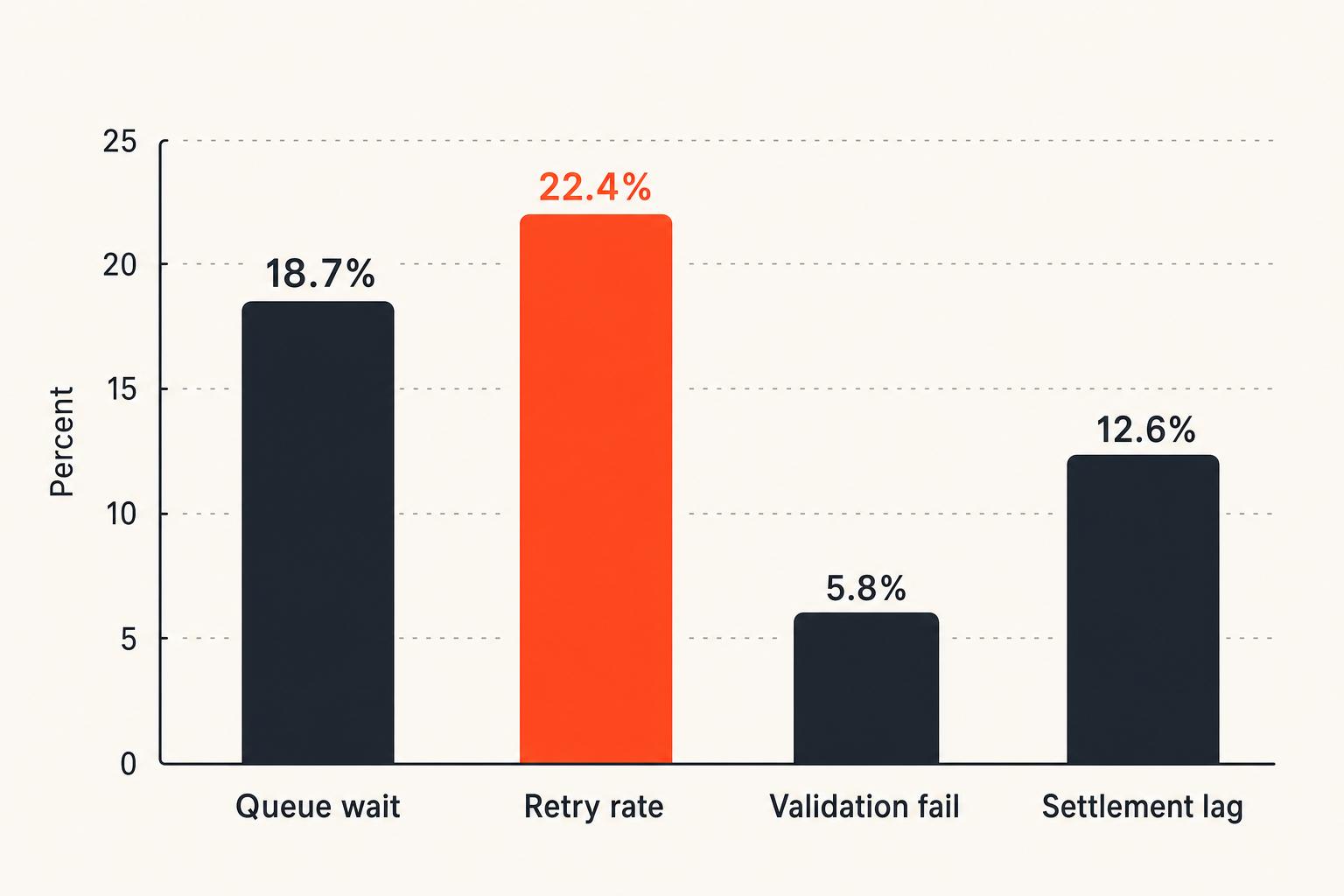
Metrics that matter
Metrics should describe user outcomes and marketplace health, not just server internals.
Track queue wait time by capability class, assignment failure rate, worker acceptance rate, execution duration, validation failure rate, retry rate, dispute rate, settlement latency, artifact upload failures, and user cancellation rate.
For AI inference, add time to first token, tokens per second, model cold-start rate, and output schema failure. For transcoding, add input fetch time, encode speed, segment validation failures, and storage write errors.
The goal is not a wall of charts. The goal is to know where work gets stuck.
Runbooks beat dashboards
Dashboards tell you something happened. Runbooks tell you what to do next.
A useful runbook says: if gpu-infer-llm-8b queue wait exceeds threshold, check worker inventory, cold-start rate, failed assignments, and price ceiling distribution. If transcoding validation failures spike, compare FFmpeg versions, input codecs, output profiles, and recent worker changes.
This is another 1970s lesson hiding in plain sight. Operators did not just watch systems. They followed procedures.
What works and what fails
What works:
- Typed job manifests with explicit resource and validation requirements.
- Queues segmented by capability class and priority.
- Worker reputation tied to job type, not generic stars.
- Payment transitions attached to job states.
- CLI commands that expose lifecycle, logs, artifacts, and receipts.
What fails:
- One global queue for every workload.
- Worker self-reporting with no verification.
- Payment systems detached from execution state.
- Validation added after disputes begin.
- Dashboards that cannot answer basic support questions.
This is the practical legacy of computing in the 1970s: the system should be understandable under pressure.
Product fit for c0mpute.com builders
Where c0mpute.com fits
c0mpute.com is built around a simple idea: decentralized compute should be usable by technical builders without hiding the workflow. The network focus is CLI-first compute across modules such as FFmpeg transcoding, DID-based payments, and AI inference.
That maps directly to the lessons above. A transcode job is a contract. An inference request is a contract. A worker identity is an operational actor, not just a wallet address. A receipt should connect execution and settlement.
The product fit is strongest when you need decentralized capacity but still care about reproducibility, logs, validation, and command-line control.
How to evaluate fit
Do not evaluate a compute marketplace only by the landing page or nominal price. Test the workflow.
Submit a small job. Inspect the manifest. Watch queue state. Check worker assignment. Force a failure. Review logs. Validate artifacts. Confirm the receipt. Retry with a larger job. Compare behavior across job classes.
If the system can explain itself during those tests, you have something usable. If it only works when everything succeeds, you have a demo.
Try c0mpute.com
If computing in the 1970s teaches one useful thing for 2026, it is that scarce compute needs explicit workflow, not vague magic.
c0mpute.com is for technical builders interested in decentralized compute, AI inference, FFmpeg transcoding, and DID-based payments. Try c0mpute.com.