If you build AI inference, video transcoding, or decentralized compute systems in 2026, the pain is not that GPUs exist somewhere else. The pain is getting useful work onto scarce machines, proving it ran correctly, paying the right party, and keeping operators out of endless manual support loops.
Computing in the 1970s had the same shape. Different hardware, different networks, different economics. But the workflow problem is familiar: many users, expensive machines, limited interactive access, queued jobs, identity boundaries, and a constant fight between utilization and usability.
Teams think the problem is buying more compute. The real problem is coordinating compute.
That changes the conversation. Computing in the 1970s is not nostalgia for mainframes. It is a useful architecture lens for anyone building decentralized compute marketplaces, CLI-first job systems, AI inference routers, FFmpeg worker pools, or DID-based payment flows.
Table of contents
- Computing in the 1970s was a shared-resource problem
- Computing in the 1970s maps cleanly to decentralized compute
- The real architecture lesson is job state
- What 1970s batch systems teach about AI inference
- What 1970s media workflows teach about FFmpeg transcoding
- Identity and accounting were not optional in the 1970s
- What breaks when teams copy the wrong part of the past
- A practical decentralized compute workflow inspired by the 1970s
- What works now and what fails now
- Where c0mpute.com fits in this architecture
Computing in the 1970s was a shared-resource problem
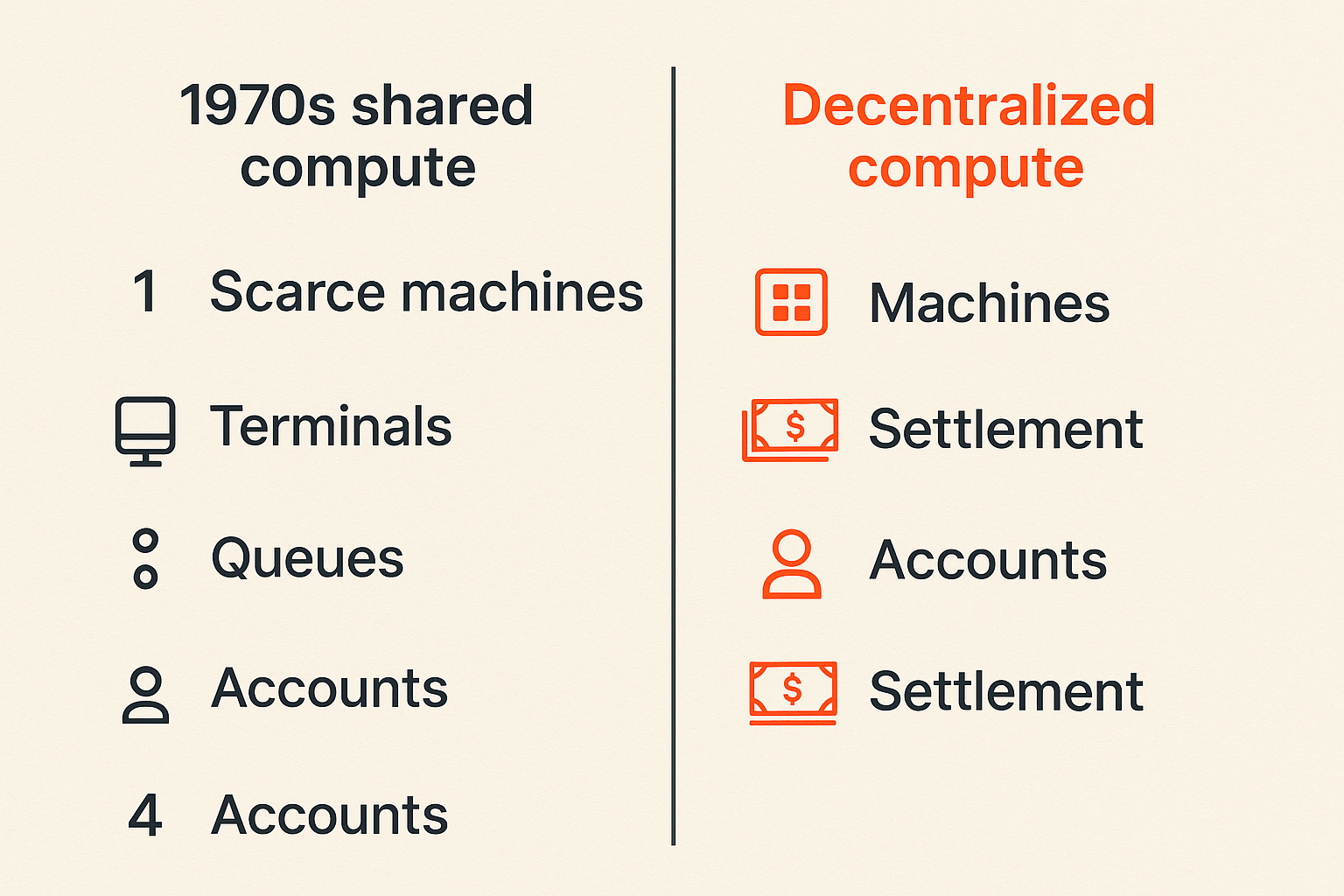
Time-sharing made utilization visible
Computing in the 1970s forced teams to see compute as a shared resource. Mainframes and minicomputers were expensive. Users did not casually spin up infinite capacity. They competed for time, memory, peripherals, storage, operator attention, and access windows.
Time-sharing was not just a technical trick. It was an operating model. Multiple users could interact with the same system through terminals, but the system still had to decide who got CPU time, how sessions were isolated, how jobs were interrupted, and what happened when demand exceeded capacity.
A useful way to think about it is this: the machine was not the product. Managed access to the machine was the product.
That is close to modern decentralized compute. A GPU sitting idle in one region and a video job waiting in another are not automatically a market. The market exists only when work can be described, routed, executed, verified, and paid for without every user negotiating manually.
Practical rule: If compute is scarce, the scheduler is part of the product, not backend plumbing.
Batch processing made queues the product
Batch processing looked slow compared with interactive terminals, but it solved a hard problem: how to accept work now and run it when capacity is available. Users submitted jobs with enough context for the system to execute later. The job had inputs, parameters, expected outputs, accounting metadata, and failure handling.
The mistake teams make is treating queues as an implementation detail. In production, the queue becomes the user experience. It defines fairness, latency, cost, visibility, cancellation, retry behavior, and support burden.
For AI inference, a queue decides whether a prompt waits, fails fast, or moves to another worker. For FFmpeg transcoding, a queue decides whether a long 4K encode blocks smaller jobs. For a compute marketplace, a queue decides whether providers get reliable work or random bursts they cannot plan around.
Terminals separated access from ownership
Terminals mattered because they separated access from the physical computer. A user could interact with a machine they did not own and might never see. That separation is basic now, but it remains the core architecture of decentralized compute.
The practical question is not whether the user owns the GPU. The practical question is whether the user can express work precisely enough that a remote machine can execute it, return evidence, and settle the transaction.
CLI-first systems make this clearer than dashboards. A command has inputs, flags, environment assumptions, identity, and output contracts. It is closer to a terminal session than a marketing UI. For adjacent reading on how teams in another domain separate user intent from operational workflow, Related reading from our network: Secure Messaging Apps in 2026: Build the Privacy Workflow, Not Just the Chat.
Computing in the 1970s maps cleanly to decentralized compute
Scarcity is still the root constraint
Computing in the 1970s was shaped by scarcity. CPU was scarce. Storage was scarce. Network access was scarce. Human operator time was scarce.
In 2026, the scarce item may be H100 availability, local inference capacity, cheap transcoding throughput, bandwidth near the data, or trusted workers with a reputation history. The surface changed, but the constraint did not disappear.
Decentralized compute builders should stop asking only where can I find more machines? The better question is how do I make scarce machines safely usable by many buyers without centralizing every decision?
That means routing, job descriptors, provider capability claims, health checks, stake or reputation, and settlement logic. These are not extras. They are the architecture.
The marketplace is the scheduler
A cloud dashboard hides scheduling behind a region selector and instance type. A decentralized compute marketplace cannot hide it as easily. It has to match demand with supply across untrusted or semi-trusted participants.
That means the marketplace is the scheduler. It must answer:
- Which workers can run this job?
- Which workers are available now?
- Which workers have proven similar work before?
- What price is acceptable?
- What happens if the worker disappears?
- What evidence is required before payment?
If those rules are undefined, the system becomes chat plus hope. Buyers negotiate, providers overpromise, and operators manually resolve disputes.
For a broader look at centralized, edge, and decentralized tradeoffs, we covered the same routing and validation problem in our architecture guide to cloud computing companies.
The CLI is the terminal again
The CLI is not retro branding. It is the cleanest interface for serious compute work because it forces the workflow to become explicit.
A CLI command can describe:
- The input artifact or model
- The job type
- Runtime constraints
- Output destination
- Identity or DID
- Payment policy
- Retry and timeout rules
- Verification requirements
That is why many infrastructure teams still prefer CLI-first workflows even when they later wrap them with APIs or UIs. The CLI is the narrow waist of the system. It exposes what the architecture actually supports.
The real architecture lesson is job state
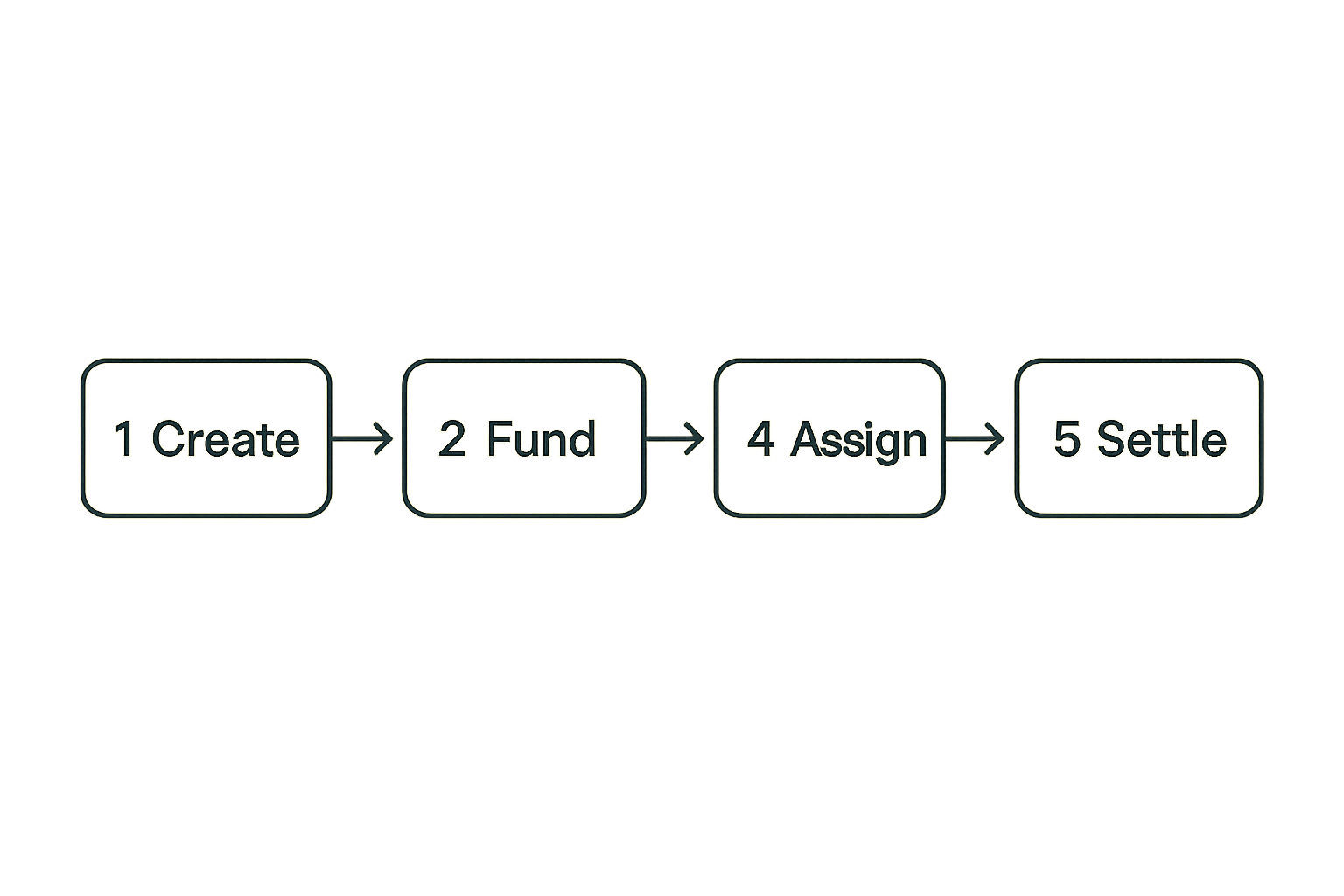
A job is not a request
A request is an event. A job is a lifecycle.
This distinction is where many compute systems fail. They accept an API request, push work to a worker, and assume success or failure will come back cleanly. In real systems, workers crash, clients disconnect, payment confirmations lag, models load slowly, outputs upload partially, and logs arrive out of order.
A job needs states. Minimal states might look like:
- Created
- Funded or authorized
- Queued
- Assigned
- Running
- Uploading output
- Verifying
- Settled
- Failed or expired
This is not bureaucracy. It is how you avoid losing money and trust.
Practical rule: Never let payment, execution, and output delivery live only inside a worker process.
State needs to survive workers
In a decentralized compute network, workers are not the source of truth. They are executors. The job record needs to survive worker restarts, provider churn, network partitions, and client retries.
The mistake teams make is letting the worker own too much state. That works in a demo because there is one worker, one user, and one happy path. It breaks when a provider updates a driver, a video file is larger than expected, or an inference job needs to move to a different node.
State should be durable enough to answer basic operational questions:
- Who requested this job?
- What did they ask for?
- Who accepted it?
- What version of the tool or model ran?
- Where are the logs?
- Where is the output?
- Was payment authorized?
- What evidence supports settlement?
Without that, support becomes archaeology.
Idempotency beats hope
Idempotency sounds like API hygiene until money enters the system. Then it becomes survival.
If a user submits the same transcode job twice because their connection timed out, should the system run it twice? If a payment callback arrives twice, should the provider be paid twice? If a worker retries output upload, should the job move backward from verifying to running?
The answer cannot depend on a human noticing. Use stable job IDs, content hashes, nonce values, and explicit state transitions. Reject invalid transitions. Make retries safe by default.
A basic job descriptor might include:
job_id: job_7h3k
kind: transcode
input_hash: sha256:abc123
profile: h264_1080p
max_price: 12.00
requester_did: did:example:buyer
settlement: after_verification
retry_policy: safe_retry
The exact schema will vary. The important part is that the system can distinguish duplicate intent from new intent.
What 1970s batch systems teach about AI inference
Interactive does not mean stateless
AI inference feels interactive because users send prompts and expect fast responses. But under the hood, many inference workloads behave like scheduled jobs. Models need loading, contexts need memory, tokens stream over time, and outputs may need policy checks, billing, or post-processing.
Computing in the 1970s teaches a useful lesson here: interactive access still needs accounting. A terminal session was interactive, but it did not mean unlimited untracked use.
For modern inference, track the session, model, provider, token budget, latency target, and settlement boundary. Otherwise every prompt becomes a one-off exception and every provider dispute becomes subjective.
Queue policy becomes product behavior
Queue policy is not neutral. If you route only by lowest price, users get slow or unreliable workers. If you route only by speed, costs drift. If you privilege large jobs, small users see unpredictable latency. If you privilege small jobs, providers may avoid larger workloads.
The practical question is what behavior you want the market to produce.
Possible policies include:
- Lowest acceptable price within a latency band
- Best reputation among compatible workers
- Regional proximity to input data
- Reserved capacity for known buyers
- Short-job priority for interactive inference
- Long-job lanes for batch processing
The right policy depends on workload. A chatbot and a batch embedding job should not compete under the same rules.
Validation has to fit the workload
Validation for AI inference is harder than validation for deterministic transcoding. Two workers may produce different outputs for legitimate reasons: sampling settings, model version, quantization, GPU kernel differences, or prompt formatting.
That does not mean validation is impossible. It means validation must fit the claim being settled.
For deterministic workloads, compare output hashes or reproducible metadata. For inference, validate model identity, runtime parameters, token counts, latency, logs, and policy compliance. If exact output equality is not expected, do not build settlement around exact equality.
Practical rule: Validate the property you are paying for, not the property that is easiest to hash.
What 1970s media workflows teach about FFmpeg transcoding
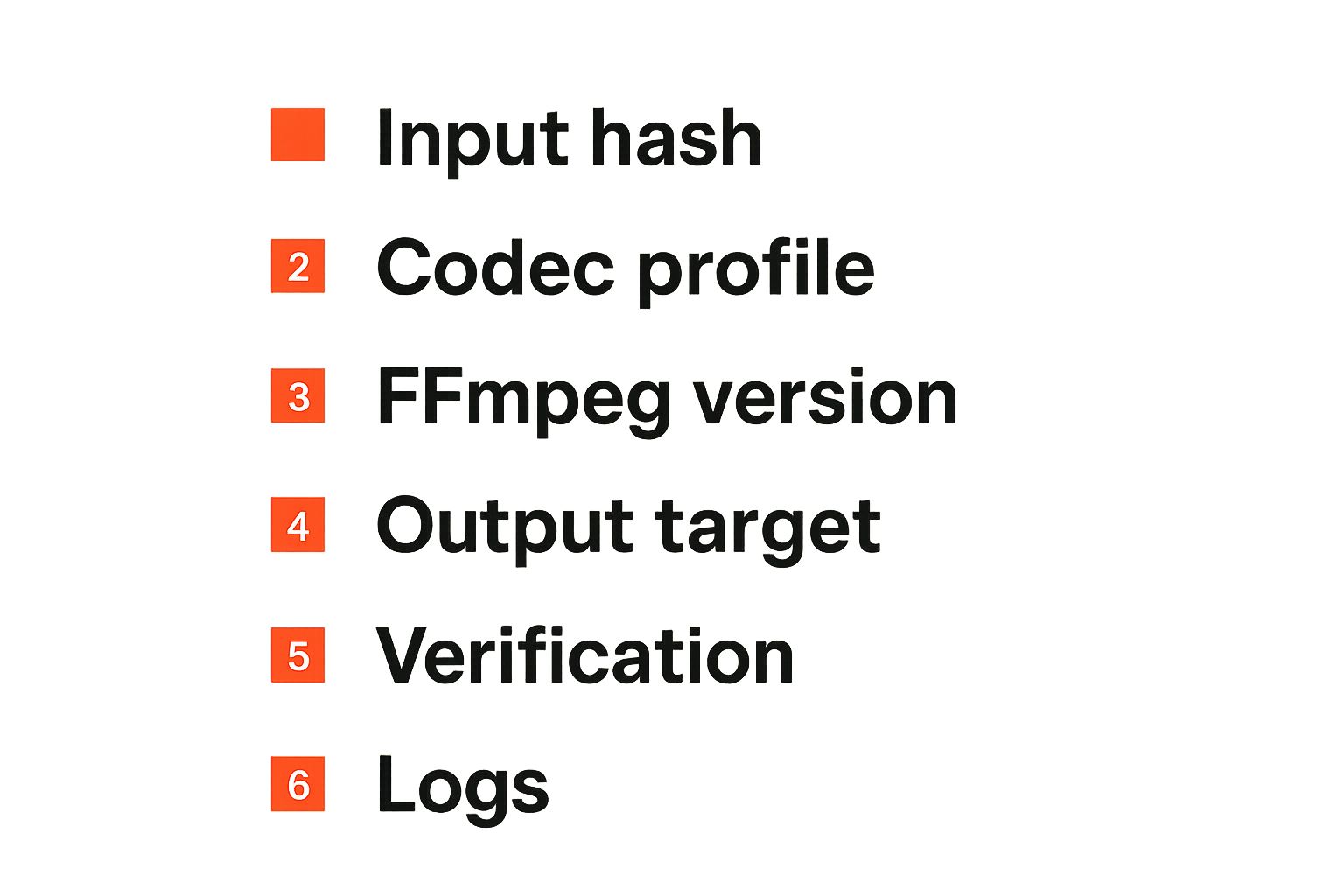
Inputs, outputs, and logs matter more than the button
Media workflows are where the 1970s batch analogy becomes very concrete. A transcode job is a batch job with a large input, tool flags, resource needs, output artifacts, logs, and a cost profile.
The UI button is the least important part. What breaks in practice is everything around it: bad inputs, unsupported codecs, missing fonts, wrong pixel formats, partial uploads, worker disk pressure, unexpected duration, and unclear output ownership.
A robust FFmpeg compute job should make these explicit:
- Input URI or content-addressed object
- Input hash and size
- Codec and container expectations
- FFmpeg version or allowed version range
- Filter graph
- Output profiles
- Output destination
- Log retention policy
- Verification method
The operator does not want to ask what happened. The job record should already know.
Determinism is a support feature
Developers often discuss determinism as a correctness feature. In transcoding, it is also a support feature.
If two workers produce materially different outputs from the same input and profile, the system needs to explain why. Was the FFmpeg version different? Was hardware acceleration used? Did one worker have a codec library the other lacked? Did the filter graph change?
The more deterministic the job contract, the easier it is to verify outputs, resolve disputes, and pay providers quickly. Full binary reproducibility may not always be practical, especially with hardware acceleration, but the system should capture enough metadata to make differences explainable.
Chunking is scheduling, not just optimization
Chunking video jobs is often presented as a performance trick. It is also a scheduling strategy. Smaller chunks can be distributed across workers, retried independently, and verified incrementally.
But chunking introduces coordination cost. You need segment boundaries, consistent encoding settings, merge logic, output ordering, and failure handling. If one chunk fails, do you retry only that chunk? If a worker is slow, do you reassign? If the final merge fails, who gets paid?
The mistake teams make is treating chunking as a pure speed feature. It changes the settlement model. Providers may complete partial work. Buyers may receive partial value. The system needs rules for that before production traffic arrives.
For adjacent reading on operational triage, ownership, and queue discipline in a different domain, Related reading from our network: CHP Traffic Incident Thinking for SOC Incident Response Architecture.
Identity and accounting were not optional in the 1970s
Accounts created operational boundaries
Computing in the 1970s relied on accounts because shared systems need boundaries. An account was not just a login. It connected identity, permissions, quotas, files, usage, and billing or internal chargeback.
Decentralized compute needs the same pattern, even if the primitives are different. A DID, wallet, API key, or signed job request must map to real operational controls.
Those controls include:
- Who can submit jobs
- How much they can spend
- Which providers they trust
- Which outputs they can access
- Which disputes they can raise
- Which logs they can view
Without identity boundaries, a marketplace becomes an anonymous job sink. That is not a business system.
DID-based payments need the same discipline
DID-based payments are useful when they bind identity, authorization, and settlement into the workflow. They are not useful if they become another detached step after the work completes.
The payment path should know the job state. The job state should know the payment path. If a job expires, the authorization should not remain open forever. If a provider fails verification, settlement should not proceed automatically. If a buyer cancels before assignment, the system should release funds cleanly.
This is where old accounting lessons still matter. Shared compute systems need usage records that both sides can understand.
Reputation is accounting with memory
Reputation is not a star rating bolted onto a marketplace. It is accounting with memory.
A provider that completes deterministic transcodes on time should gain a different reputation signal than a provider that occasionally serves low-latency inference. A buyer who repeatedly cancels assigned jobs should affect provider routing. A worker that fails under specific codecs should not be treated as globally bad, but the scheduler should remember the pattern.
The practical question is what events become reputation inputs. Good candidates include completion rate, verification success, latency bands, dispute outcomes, cancellation timing, capability accuracy, and log quality.
What breaks when teams copy the wrong part of the past
Central queues become hidden monopolies
The wrong lesson from computing in the 1970s is to rebuild a central mainframe with better branding. Some teams call a system decentralized because providers are external, but all routing, pricing, validation, and dispute control sit behind one opaque service.
That may be a reasonable transitional architecture, but do not confuse it with a resilient marketplace. If the central queue can arbitrarily prefer providers, suppress jobs, hide pricing, or rewrite settlement rules, participants eventually treat it as the counterparty.
The better pattern is progressive decentralization of the decisions that matter: job descriptors, evidence, provider claims, reputation inputs, and settlement state.
Operators become the retry system
What breaks in practice is retry logic. Failed jobs do not disappear. They become tickets, Discord messages, refund requests, angry providers, and manual database edits.
A bad system asks operators to decide whether a job should be retried, refunded, reassigned, or ignored. A better system encodes those paths:
- Detect failure type.
- Decide whether retry is safe.
- Reassign if provider-specific.
- Cancel if requester-specific.
- Preserve logs and evidence.
- Update reputation after final state.
For teams thinking about extractability and making systems easier for automated agents to understand, a similar constrained-design mindset shows up in search and AEO work. Related reading from our network: Constrained Optimization for AEO.
Logs arrive too late to matter
Logs are often treated as something you fetch after a user complains. That is backwards.
A compute marketplace should treat logs as part of the job output. Not necessarily public logs, and not necessarily permanent logs, but structured enough that the system can make decisions.
For FFmpeg, logs reveal codec errors, filter failures, missing streams, and duration mismatches. For AI inference, logs reveal model load failures, token limits, timeout boundaries, and provider-side errors. For payments, logs reveal whether authorization, capture, release, or settlement failed.
If logs are not attached to state transitions, they arrive too late to reduce support load.
A practical decentralized compute workflow inspired by the 1970s
Step 1: declare the job boundary
Start by defining the job as a contract, not a function call. The job boundary should include input, expected output, constraints, price policy, identity, verification, and timeout behavior.
For example, a transcode command could map to a structured job:
c0 job create transcode \
  --input ipfs://bafy... \
  --profile h264-1080p \
  --max-price 12 \
  --verify mediainfo \
  --settle after-verification
The command is simple, but the backend receives a full lifecycle object. That changes the conversation from run this command somewhere to manage this unit of work until it reaches a final state.
If you want to see how c0mpute exposes CLI references, worker setup, identity, health checks, transcode jobs, and inference flows, the c0mpute docs are the practical place to start.
Step 2: route by capability and trust
Routing should consider more than availability. Capability claims need to be specific enough to matter.
For FFmpeg workers, capability might include codecs, hardware acceleration, disk space, bandwidth, FFmpeg version, and known profiles. For inference workers, capability might include model families, VRAM, quantization, context length, throughput, and cold-start behavior.
Trust should be workload-specific. A provider that is excellent at short inference jobs may be poor at long media jobs. A provider that handles public data safely may not be eligible for private workloads. A provider with cheap capacity may still be a bad fit for urgent jobs.
Step 3: settle after evidence
Settlement should follow evidence, not vibes.
For a deterministic media job, evidence can include output metadata, hashes, duration checks, stream checks, and logs. For inference, evidence can include model identity, request parameters, token counts, timing, and signed provider attestations.
The workflow should be explicit:
- Buyer creates a signed job.
- Funds are authorized or escrowed.
- Scheduler assigns a compatible provider.
- Provider executes and uploads output.
- Verifier checks the evidence.
- Settlement releases payment or moves the job to dispute.
This looks old-fashioned because it is disciplined. It also looks modern because it is exactly what distributed compute markets need.
What works now and what fails now
What works
What works is boring architecture with clear boundaries.
- Treat jobs as durable state machines.
- Keep workers replaceable.
- Make routing policy explicit.
- Validate per workload type.
- Bind payment to job state.
- Track reputation from operational events.
- Make logs available before support escalates.
- Keep the CLI honest and composable.
None of this requires pretending the past was better. It requires noticing which patterns survived because they solved real coordination problems.
What fails
What fails is pretending decentralized compute is only a supply problem.
More providers do not fix unclear job contracts. More GPUs do not fix missing verification. More dashboards do not fix bad state transitions. More token incentives do not fix workers that cannot prove what they ran.
The common failure modes are predictable:
- Jobs are accepted without enough metadata.
- Payments settle before verification.
- Retries create duplicate charges.
- Worker claims are not tested.
- Reputation is global instead of workload-specific.
- Logs are unstructured or missing.
- Long jobs block short jobs.
- Operators manually resolve states that should be encoded.
A comparison table for builders
| Architecture choice | Looks easy | Breaks when | Better pattern |
|---|---|---|---|
| Single opaque queue | Yes | Providers distrust routing | Publish job and routing events |
| Worker-owned state | Yes | Worker restarts or disappears | Durable job state machine |
| Pay on assignment | Yes | Output fails verification | Settle after evidence |
| Global reputation | Yes | Workloads differ | Reputation by capability and job type |
| UI-first workflow | Yes | Automation needs precision | CLI and API as source of truth |
| Hash-only validation | Sometimes | Outputs are nondeterministic | Validate workload-specific claims |
Practical rule: The marketplace does not become reliable by adding providers. It becomes reliable by making each job auditable.
Where c0mpute.com fits in this architecture
Transcode, infer, and pay are one workflow
c0mpute.com is built around the same practical constraint: compute work is not only execution. It is job declaration, worker capability, identity, payment, verification, and operational feedback.
That matters because AI inference, FFmpeg transcoding, and DID-based payments should not live as disconnected tools. If they are disconnected, every production workflow creates glue code: one script for the model, another for the video job, another for payment, another for logs, another for retries.
A decentralized compute marketplace needs those pieces to share the same job model. The transcode module, infernet-style AI inference, and coinpay-style DID payments are different surfaces of the same architecture.
Design for operators, not demos
The demo path is always clean. Submit a small job. Run on a friendly worker. Return a result. Celebrate.
Production is not clean. Inputs are large. Workers are inconsistent. Users retry. Payments lag. Logs are noisy. Providers want predictable settlement. Buyers want proof. Operators want fewer manual interventions.
That is why the useful design target is not a prettier button. It is a workflow that can survive the boring failures. If you are building in this space, design the job lifecycle first and the UI second.
A practical way to evaluate any platform is to ask whether it helps you express the whole lifecycle from command to settlement. The main c0mpute.com decentralized compute network is aimed at exactly that CLI-first operator workflow.
Try c0mpute.com
c0mpute.com is for technical builders interested in decentralized compute, AI inference, FFmpeg transcoding, and DID-based payments.
If computing in the 1970s teaches one durable lesson, it is that shared compute only works when access, scheduling, identity, accounting, and evidence are designed together.