You do not feel the limits of cloud computing companies when the demo works. You feel them when inference latency spikes, GPU capacity disappears in one region, FFmpeg jobs queue behind a noisy tenant, or a billing surprise turns a prototype into an operational problem.
Teams think the problem is picking the cheapest or biggest cloud provider. The real problem is designing a compute workflow that can route work, verify outputs, pay providers, recover from failure, and explain state to users.
That changes the conversation. In 2026, cloud is not one place. It is hyperscale regions, edge nodes, colocated GPUs, serverless runtimes, specialized inference APIs, and decentralized compute markets. The practical question is not which logo is best. The practical question is which architecture lets your workload survive production.
For web3 developers, AI infrastructure builders, video engineers, and CLI-first operators, cloud computing companies are part of a larger execution system. The UI is not the system. The scheduler, identity layer, validation loop, retry policy, payment rail, and support workflow are the system.
Table of contents
- Cloud computing companies are an architecture choice
- Map the workload before comparing providers
- Compare centralized, edge, and decentralized compute
- Design the routing layer instead of hardcoding a provider
- Build for state, retries, and idempotency
- Validate outputs, not provider promises
- Model cost as a system, not a price sheet
- Operate with observability and support in mind
- Common failure modes when teams choose badly
- A practical implementation sequence
- Where c0mpute.com fits
Cloud computing companies are an architecture choice
The vendor is only one layer
The mistake teams make is treating cloud computing companies as interchangeable hosting accounts. They compare instance types, storage prices, GPU names, and region maps. Those details matter, but they are not the core design.
A useful way to think about it is this: the provider is an execution venue. Your product still needs a control plane. That control plane decides where a job runs, how work is described, how outputs are checked, what happens when a worker disappears, and how a user or downstream system learns the result.
If you are building an AI inference API, the control plane decides which model endpoint gets a request and what to do when the first choice times out. If you are building a video pipeline, it decides how to split, queue, transcode, inspect, and publish outputs. If you are building a web3 compute flow, it also decides who is allowed to execute, how identity is represented, and when payment settles.
Practical rule: Do not pick a cloud provider before you can describe the job lifecycle from submitted to paid, failed, or verified.
The workload should drive the cloud shape
Different workloads want different infrastructure shapes. A CRUD web app wants stable networking, databases, managed identity, and predictable deployments. Batch transcoding wants cheap parallel CPU, fast object storage, and resumable queues. AI inference wants GPU availability, warm models, batching, and latency controls.
Cloud computing companies optimize for different slices of that map. Hyperscalers are strong at broad managed services. Specialized inference providers are strong at model serving. Edge networks are strong when proximity matters. Decentralized compute markets are useful when you need flexible supply, CLI-driven execution, or a marketplace model for independent workers.
The practical question is whether your workload is bound by latency, throughput, specialized hardware, trust, geography, or cost recovery. That answer narrows the field faster than any generic cloud ranking.
Why 2026 makes this harder
In 2026, AI demand has made compute planning less boring. GPU capacity is uneven. Model sizes vary widely. Inference is often bursty. Video teams are pushing more derivatives, captions, clips, previews, and moderation passes. Web3 applications increasingly need off-chain compute that still preserves identity and settlement guarantees.
At the same time, teams are more skeptical of lock-in. They want provider choice without turning their stack into a distributed incident generator. Related reading from our network: Asana project management software workflow architecture is a different category, but the same operator lesson applies: build the workflow before you worship the tool.
Map the workload before comparing providers
AI inference has different failure modes than web APIs
AI inference breaks in ways normal web services often do not. A web API usually fails with a timeout, error, or bad deployment. Inference can fail more quietly: degraded output quality, context truncation, model mismatch, unexpected token cost, cold-start latency, or queue delay that makes the response useless.
When comparing cloud computing companies for inference, write down the real contract:
- Model or model family required
- Latency target by percentile, not average
- Maximum queue time before fallback
- Batch size and streaming requirements
- Input and output size limits
- Privacy and data retention constraints
- Validation method for unacceptable outputs
If a provider cannot expose enough state for those decisions, it may still be useful as a backend, but it should not own your product logic.
Video transcoding is a queueing problem
FFmpeg work looks simple until volume arrives. A single command can turn into a fleet problem quickly:
ffmpeg -i input.mov -vf scale=1280:-2 -c:v libx264 -preset medium -c:a aac output.mp4
The hard part is not running FFmpeg once. The hard part is running it thousands of times with isolation, retries, output inspection, and predictable cost. You need to know which jobs are pending, which are executing, which failed because of bad input, and which failed because infrastructure disappeared.
For video infrastructure engineers, compute selection should start with queue behavior. Can you split long jobs? Can you resume? Can you move outputs without egress pain? Can you inspect media metadata before and after execution? Can you reproduce the command that produced an asset?
Practical rule: Treat every transcoding job as a state machine, not a shell command.
Web3 workloads add identity and settlement
Web3 compute has another axis: who did the work and how did they get paid? A decentralized application may need off-chain execution, but still require auditable identity, reputation, and payment boundaries.
That does not mean every workload belongs on a decentralized network. It means the architecture should be honest about trust. If independent workers can execute jobs, you need a way to describe the job, validate the result, and release payment based on state. DID-based payments and reputation are not decorative features. They are part of the compute contract.
For adjacent reading on old architecture lessons applied to modern systems, Related reading from our network: Charles Babbage Analytical Engine and answer architecture is useful because it frames compute as coordinated components rather than one magic machine.
Compare centralized, edge, and decentralized compute
Centralized cloud is predictable until it is not
Centralized cloud computing companies are still the default for many teams because they provide mature primitives: IAM, object storage, databases, networks, logs, queues, and deployment tooling. That is valuable. If your workload fits those primitives, use them.
What breaks in practice is assuming centralized means simple. You can still build a fragile system on a mature cloud. A region dependency, quota limit, GPU shortage, account-level billing issue, or managed service outage can become a product outage if your architecture has no escape path.
Centralized cloud is strongest when you need integrated managed services and clear enterprise controls. It is weaker when your workload needs flexible commodity execution across many independent suppliers, or when cost and capacity change faster than your procurement process.
Edge compute moves work closer to users
Edge compute is useful when distance matters. That can mean low-latency API responses, local preprocessing, CDN-adjacent media operations, or inference that benefits from geographic proximity.
But edge is not a cure-all. Many edge environments have smaller resource envelopes, stricter runtime limits, and different observability patterns. If your FFmpeg job needs sustained CPU and large temporary files, an edge function may be the wrong place. If your inference workload requires large GPUs, edge availability may be limited.
The mistake teams make is pushing work to the edge because it sounds modern. Push work to the edge when the job benefits from proximity and the runtime can actually support the execution profile.
Decentralized compute changes supply and trust
Decentralized compute turns cloud selection from one vendor decision into a market design problem. Instead of one company owning the full execution stack, independent workers can supply CPU, GPU, storage-adjacent processing, or specialized tools.
That changes the conversation. You gain flexible supply and marketplace dynamics, but you must design for verification, reputation, identity, and settlement. You cannot assume every worker is equivalent. You cannot assume every output is correct. You cannot assume every failure is accidental.
| Approach | Best fit | What works | What fails |
|---|---|---|---|
| Centralized cloud | Managed apps, databases, enterprise controls | Integrated services, mature tooling, predictable governance | Lock-in, quota constraints, regional dependencies |
| Edge compute | Proximity-sensitive work | Low-latency routing, local preprocessing, CDN adjacency | Heavy batch jobs, large models, limited runtime control |
| Decentralized compute | Parallel jobs, marketplace execution, web3 workflows | Flexible supply, CLI-native jobs, identity and payment integration | Weak validation, poor reputation design, unclear job state |
For a deeper adjacent comparison already written for this site, see the prior guide on cloud computing companies for centralized, edge, and decentralized compute when you want the broader provider landscape.
Design the routing layer instead of hardcoding a provider
Routing inputs that actually matter
A routing layer is the part of your system that decides where work should run. Many teams do not build one. They embed provider assumptions in application code, deployment scripts, and cron jobs. Six months later, every fallback is a rewrite.
Useful routing inputs include:
- Job type: inference, transcode, analysis, render, indexing
- Hardware need: CPU, GPU, memory, disk, acceleration
- Data location: object storage region, user geography, privacy boundary
- Deadline: interactive, near-real-time, batch, best effort
- Trust level: verified worker, internal cluster, open marketplace
- Price ceiling: maximum acceptable cost per job or token
- Validation mode: deterministic hash, media probe, human review, model judge, consensus
A routing layer does not need to be complicated at first. It just needs to be explicit.
A minimal routing policy
Start with a policy that a developer can read in one screen:
job_type: transcode_1080p
inputs:
  max_duration_minutes: 20
  source_region: any
requirements:
  cpu_cores: 4
  memory_gb: 8
  ffmpeg: required
routing:
  primary: decentralized_workers
  fallback: centralized_batch
  timeout_seconds: 900
validation:
  probe_output: true
  expected_container: mp4
  min_video_streams: 1
payment:
  release_on: verified_output
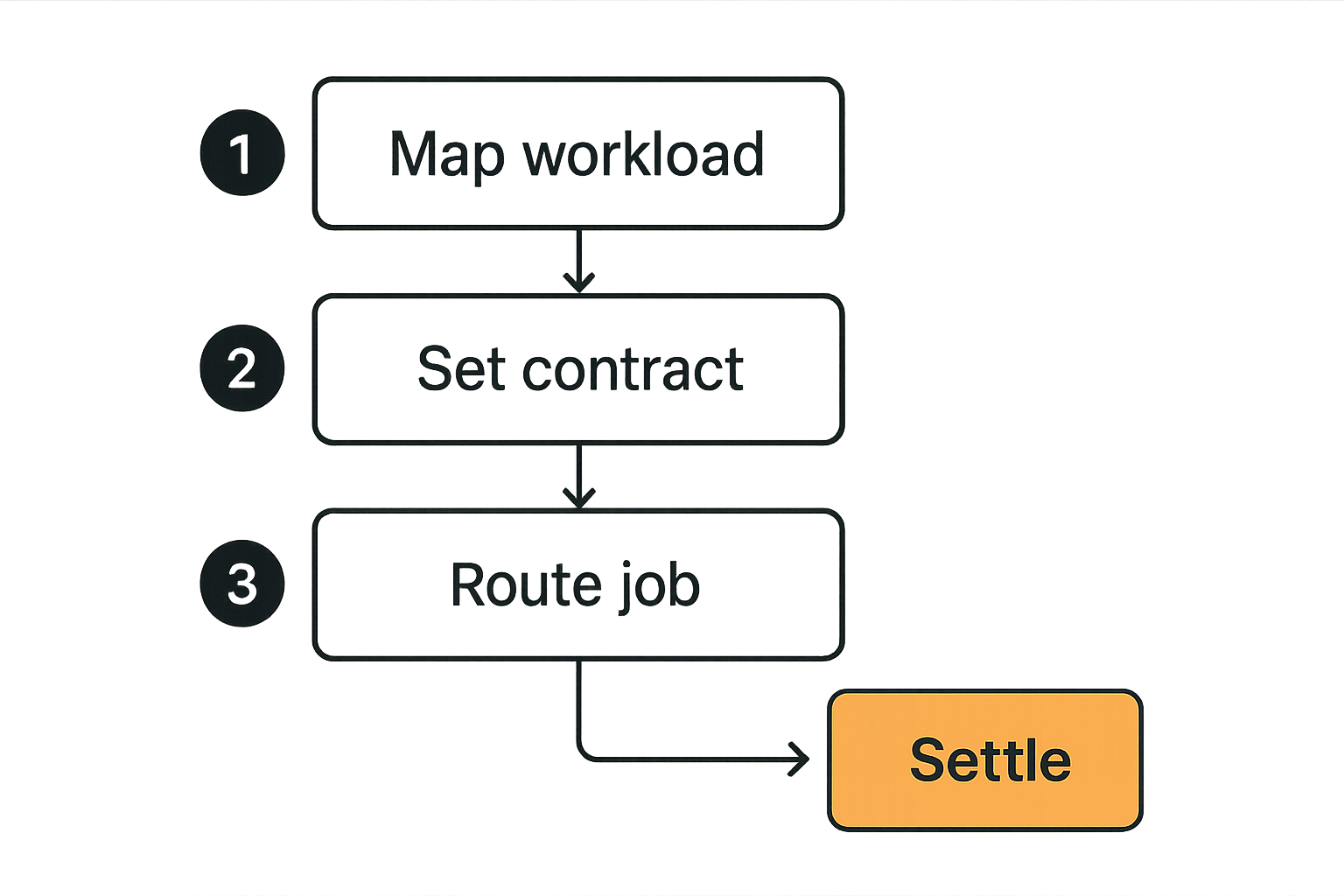
This policy creates a boundary. Application code submits a job. The control plane routes it. Workers execute it. Validators inspect it. Payment or settlement follows the result.
Practical rule: If routing logic cannot be represented outside application code, you do not have routing. You have hidden coupling.
When fallback becomes the product
Fallback is not only an incident feature. For many compute products, fallback is the product experience. A user does not care that your preferred GPU provider is saturated. They care whether their request completed within the promised window.
Fallback can mean using a smaller model, moving to a different provider, lowering output resolution, delaying a batch job, or asking the user to approve a higher price. The important part is exposing state and policy rather than pretending every job is identical.
This is where cloud computing companies become interchangeable only if your architecture has made them interchangeable. Without adapters, normalized state, and validation, multi-provider strategy is a slide deck.
Build for state, retries, and idempotency
Jobs need durable state
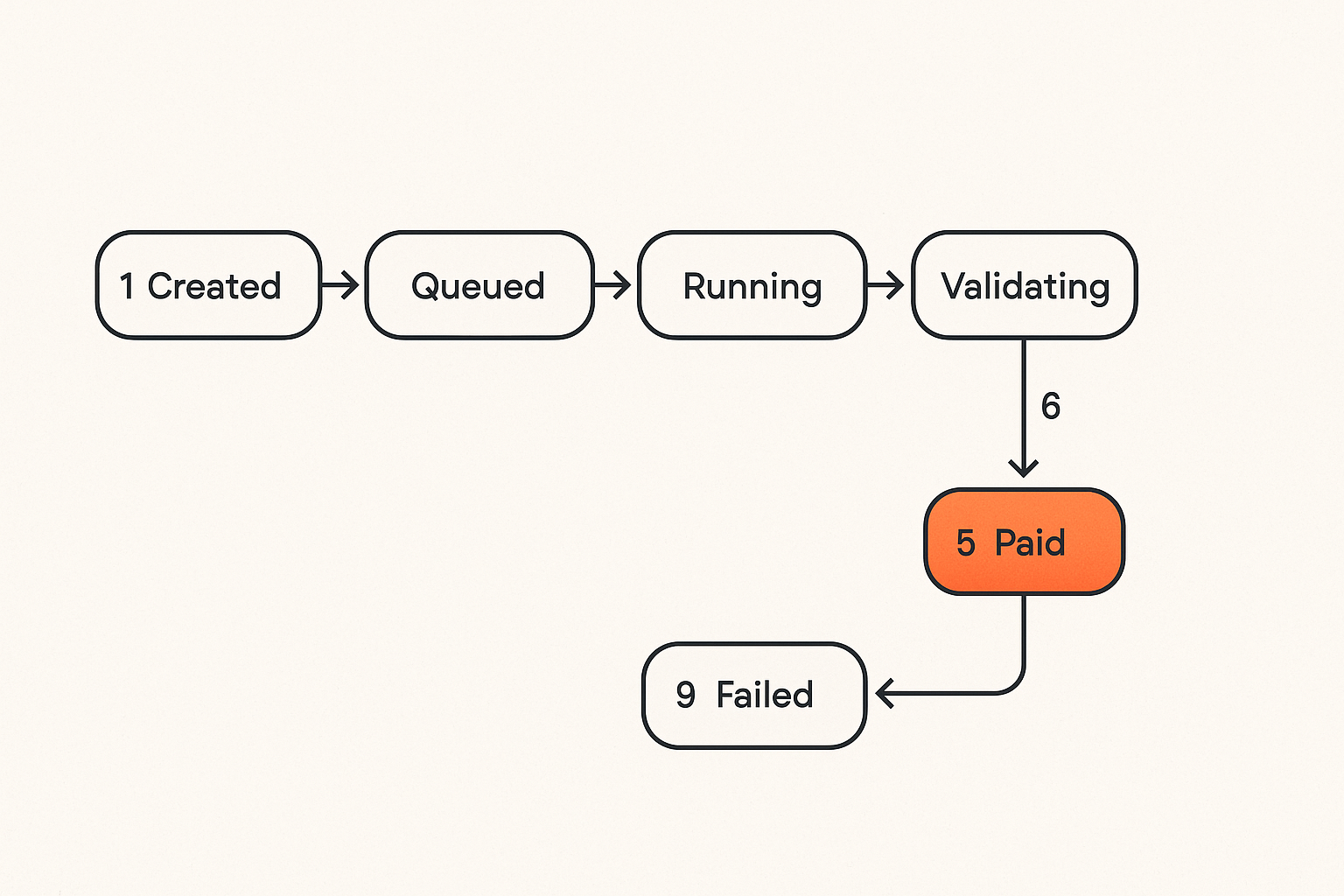
Compute workflows need durable state because execution is unreliable. Workers restart. Networks drop. Inputs are malformed. Users refresh pages. Payment callbacks arrive late. A good system can answer one question at any time: what is the job state right now?
A minimal state model might look like this:
- Created
- Queued
- Assigned
- Running
- Output uploaded
- Validating
- Verified
- Paid
- Failed
- Expired
You can add nuance later, but skipping this model creates support pain. If a user asks where the job is and your answer requires searching logs across providers, the workflow is not production-ready.
Retries must not duplicate work blindly
Retries are necessary, but naive retries are expensive. If you retry a long transcode because one callback failed, you may pay twice. If you retry an inference job with nondeterministic output, downstream consumers may see inconsistent results. If you retry payment release without idempotency, you can overpay.
Use idempotency keys at the job boundary:
idempotency_key = hash(user_id + input_asset_id + job_profile + requested_output)
Then make every adapter accept that key. The provider may not support it natively, but your control plane should. A retry should ask whether the requested work already exists, is running, or has produced a valid output.
Webhooks are not enough
Webhooks are useful, but they are not a state system. They can arrive out of order, fail delivery, be duplicated, or represent only the provider's perspective. Your system needs polling, reconciliation, and timeout logic.
A practical pattern:
- Submit the job and store local state.
- Receive webhooks as hints, not truth.
- Periodically reconcile provider state against local state.
- Validate outputs independently.
- Mark final state only after validation and settlement rules pass.
Related reading from our network: Walgreens coupon code workflow is obviously a consumer checkout example, but the operational point transfers: the visible checkout is not the system; exclusions, state, totals, and final confirmation are where correctness lives.
Validate outputs, not provider promises
Validation for AI inference
AI inference validation is not always deterministic, but it should still be designed. For structured outputs, validate schema. For embeddings, validate dimensions and model identity. For safety-sensitive flows, validate policy flags. For retrieval-augmented generation, validate citations or source references where possible.
You may not be able to prove every answer is correct. You can still reject malformed, incomplete, late, unsafe, or policy-violating outputs. That is better than treating provider success as product success.
Common inference validation checks:
- Output is parseable when JSON is required
- Token count is within expected range
- Model identifier matches requested profile
- Latency stayed within the useful window
- Safety or moderation fields are present when required
- Required citations or tool outputs exist
Validation for FFmpeg transcoding
Video validation can be more concrete. Use ffprobe. Inspect streams. Check duration tolerance. Confirm codec, container, resolution, bitrate range, audio presence, and file size sanity.
Example checks:
ffprobe -v error -show_streams -show_format output.mp4
A transcoding job should not be marked complete because a worker uploaded a file. It should be marked complete because the file matches the requested output contract.
Good validation catches bad inputs too. If a source file is corrupt, the job should fail as invalid input, not worker failure. That distinction matters for retries, reputation, and payment.
Reputation should be earned continuously
In decentralized compute, reputation is not a badge you set once. It should be updated based on observed behavior: completion rate, validation pass rate, deadline performance, dispute history, supported profiles, and consistency across job types.
The mistake teams make is reducing reputation to a single score. A worker may be excellent for CPU video jobs and poor for GPU inference. Another may be reliable for small jobs but fail under long-running workloads. Reputation should be contextual.
Practical rule: Reputation should attach to capability and observed job history, not to marketing claims or static identity alone.
Model cost as a system, not a price sheet
Unit economics start at the job
Cloud computing companies publish prices, but your cost exists at the job level. For inference, that may be cost per request, token, generated image, or completed workflow. For transcoding, it may be cost per input minute, output rendition, gigabyte processed, or verified asset.
Model the unit before optimizing providers:
| Workload | Better cost unit | Bad cost unit |
|---|---|---|
| LLM inference | Cost per successful response | Cost per GPU hour only |
| Embeddings | Cost per stored vector batch | Cost per API call only |
| FFmpeg transcode | Cost per verified output minute | Cost per CPU hour only |
| Media analysis | Cost per accepted asset decision | Cost per container run only |
| Decentralized job | Cost per verified and settled job | Bid price only |
The bid price or instance price is only one input. Failed jobs, retries, validation, egress, idle capacity, support time, and settlement overhead all affect the real cost.
Hidden cost lives in failed work
Failed work is where cheap providers become expensive. A low-cost worker with a high invalid-output rate may cost more than a higher-priced worker that passes validation consistently. A cheap GPU endpoint with frequent cold starts may be bad for interactive inference but fine for batch jobs.
Track cost by final state:
- Cost of verified jobs
- Cost of failed infrastructure jobs
- Cost of invalid input jobs
- Cost of validation failures
- Cost of retries
- Cost of expired jobs
- Cost of manual support
This gives you a pricing model you can operate. Without it, you are guessing from invoices.
Payments and settlement affect architecture
Payments are not an accounting afterthought in compute marketplaces. They influence when work starts, who accepts risk, how disputes resolve, and how reputation evolves.
For decentralized compute, you need clear custody and settlement boundaries. Does the user pre-fund? Does the platform escrow? Does the worker get paid on upload or after validation? What happens when validation fails? Can the same job be disputed? Can a worker prove partial completion?
These questions belong in the architecture phase. If you add payment logic after execution is already built, you often discover your state model is too weak.
Operate with observability and support in mind
The user asks about job state
Users rarely ask about your provider abstraction. They ask why the job is slow, whether it failed, whether they were charged, and whether they should retry.
Your internal system should make those answers cheap:
- Job ID
- User or wallet identity
- Input reference
- Provider or worker assigned
- Current state
- Last state transition
- Validation result
- Payment status
- Retry count
- Error class
For CLI-first developers, this should be inspectable without opening a dashboard. A good command surface matters:
compute jobs inspect job_8f21
compute jobs logs job_8f21
compute jobs retry job_8f21 --same-input
compute workers health --profile ffmpeg
Metrics should map to decisions
Do not collect metrics because dashboards look professional. Collect metrics that change routing, pricing, support, or capacity decisions.
Useful metrics include:
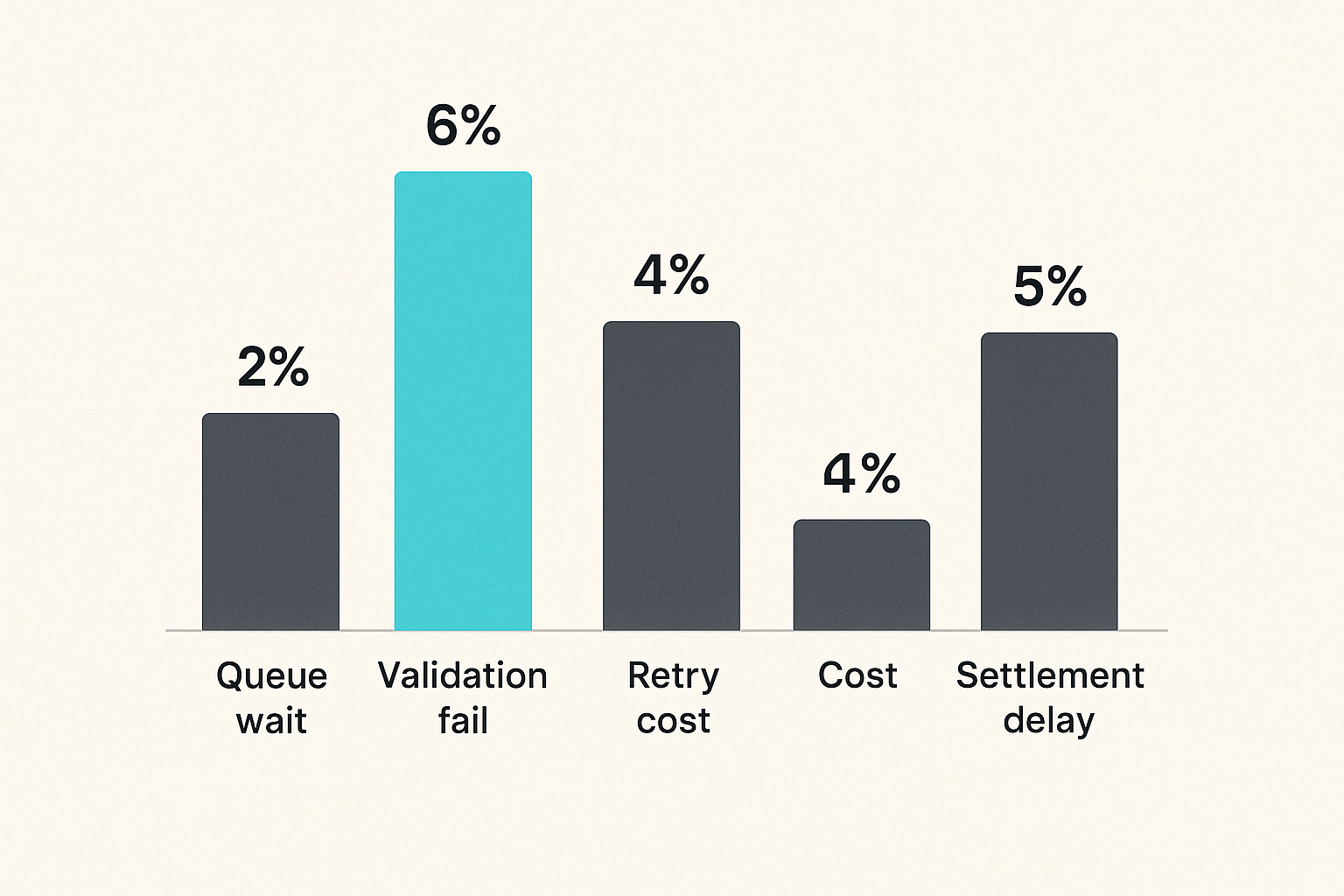
| Metric | Decision it supports |
|---|---|
| Queue wait time by profile | Add supply or change routing |
| Validation failure rate by worker | Reduce reputation or block capability |
| Cost per verified job | Adjust pricing or provider mix |
| Timeout rate by workload | Change deadlines or split jobs |
| Retry count by error class | Fix adapters or reject bad inputs earlier |
| Settlement delay | Improve payment flow or user messaging |
A chart of average CPU usage is less useful than knowing that 12 percent of 4K transcodes fail validation after consuming full runtime. Use metrics that point to action.
Status pages are part of compute UX
A compute platform needs public or customer-visible status when failures affect job execution. If workers are delayed, inference profiles are degraded, or settlement is backlogged, users need a source of truth. For c0mpute operators, the network view on c0mpute status is the kind of surface that turns infrastructure state into user-facing clarity.
Status should be tied to actual workflow states, not manually written optimism. If queue time crosses a threshold, say so. If a provider adapter is degraded, mark it. If payment settlement is delayed while execution is healthy, separate those states.
Common failure modes when teams choose badly
What fails in single-provider designs
Single-provider designs are not automatically wrong. They fail when the team pretends the provider is the architecture. Common breakpoints include quota limits, unavailable instance families, regional outages, pricing shocks, account-level policy changes, and services that work well for one workload but poorly for the next.
What works is using a single provider intentionally while keeping job contracts portable. What fails is embedding provider-specific assumptions everywhere.
Signs you are over-coupled:
- Business logic imports provider SDKs directly
- Job state exists only in provider dashboards
- Output validation depends on provider success flags
- Retry behavior is hidden inside a managed service
- Pricing assumes one billing model forever
- Users cannot distinguish queued, running, validating, and paid states
What fails in naive multi-cloud
Naive multi-cloud is worse than honest single-cloud. Teams add two providers but no normalized state, no adapter contract, no shared observability, and no consistent validation. Now every incident requires understanding multiple failure models.
Multi-cloud works when providers sit behind a deliberate job interface. It fails when each provider leaks into product code.
A basic adapter contract should normalize:
- Submit job
- Cancel job
- Inspect job
- Fetch logs
- Fetch output references
- Report provider-side errors
- Map provider states to internal states
- Apply idempotency key
If you cannot normalize these operations, you do not yet have provider portability.
What fails in unverified marketplaces
Compute marketplaces fail when they optimize matching but ignore correctness. A marketplace that can assign work but cannot validate outputs, resolve disputes, or maintain contextual reputation will produce support debt.
For decentralized compute, what works is narrow job profiles with explicit validation. Start with workloads where correctness can be checked: FFmpeg renditions, thumbnails, media probes, embeddings with known dimensions, batch inference with structured outputs. Expand later.
What fails is launching a broad marketplace where every worker claims every capability and the platform cannot tell the difference between success and garbage.
A practical implementation sequence
Start with a job contract
Before choosing among cloud computing companies, write the job contract. This is the document or schema that says what the job is, what it needs, what output means, and how completion is proven.
A minimal contract includes:
- Job type and version
- Input references and checksums
- Resource requirements
- Execution command or model profile
- Timeout and deadline
- Output contract
- Validation method
- Retry policy
- Payment or settlement rule
- Audit fields
This contract becomes the stable boundary between your product and execution venues.
Add provider adapters
Once the contract exists, add adapters. One adapter may target a centralized batch service. Another may target an inference API. Another may target a decentralized worker network. The application should not care which one runs the job.
Adapter responsibilities:
- Translate job contract into provider-specific request
- Attach idempotency key
- Store provider job ID
- Normalize provider state
- Stream or retrieve logs
- Return output references
- Classify errors
- Support cancellation when possible
This is also where CLI workflows become powerful. A builder should be able to submit the same job contract locally, to a test worker, or to a marketplace without rewriting the application. The c0mpute docs are structured around that kind of CLI reference and cookbook surface for identities, workers, transcode jobs, inference, plugins, and health checks.
Close the loop with validation and payment
The final step is closing the loop. Do not stop at execution. Validate the output, update reputation, settle payment, and expose final state.
A practical production loop looks like this:
- Accept job request and create durable state.
- Select route based on policy, price, capability, and trust.
- Assign work to provider or worker.
- Monitor execution with webhook and reconciliation.
- Fetch output into controlled storage.
- Validate output against the job contract.
- Mark verified, failed, expired, or disputed.
- Release payment or refund according to rules.
- Update worker reputation and cost metrics.
- Expose final state to user, CLI, API, and support.
This sequence is not glamorous. It is the difference between a compute demo and a compute product.
Where c0mpute.com fits
A CLI-first marketplace is a workflow primitive
c0mpute.com is not trying to be another generic cloud console. The useful framing is narrower: a decentralized compute marketplace for builders who want CLI-first workflows across FFmpeg transcoding, AI inference, and DID-based payments.
That matters because the hard problems described above are workflow problems. You need job contracts, worker identity, health checks, validation, reputation, and settlement. A marketplace only becomes useful when it plugs into that control plane instead of hiding it.
For builders evaluating cloud computing companies, c0mpute.com fits best as an execution layer and marketplace primitive, not as a replacement for every managed service. You may still use object storage, databases, and centralized APIs. The architectural question is which jobs should be routed into a decentralized worker network because they benefit from flexible supply, CLI execution, or payment-aware coordination.
Good fit workloads
Good fit workloads tend to share a few traits:
- They can be described as jobs rather than long-lived pets
- Inputs and outputs can be referenced explicitly
- Validation is possible or at least bounded
- Parallelism matters
- Worker capability can be profiled
- Payment or reputation should follow verified work
- Developers want a CLI surface, not only a dashboard
Examples include FFmpeg transcodes, thumbnail generation, media inspection, batch AI inference, embeddings, model evaluation jobs, and web3 application tasks where DID-based payment is part of the workflow.
Poor fit workloads are also worth naming. If you need a tightly coupled managed database, a complex enterprise IAM stack, or ultra-low-latency synchronous execution with no tolerance for routing variance, a decentralized marketplace is probably not the first layer to use.
The practical approach is hybrid. Keep durable product state where it belongs. Route suitable compute jobs to the best execution venue. Validate outputs. Settle based on state. That is how cloud computing companies become components instead of constraints.
Try c0mpute.com
c0mpute.com is for technical builders interested in decentralized compute, AI inference, FFmpeg transcoding, and DID-based payments. Try c0mpute.com and start with a job workflow, not a cloud logo.