Cloud computing companies used to be evaluated like procurement vendors: instance types, regions, GPUs, storage, discounts, support tier. That was workable when most teams were shipping web apps on predictable request patterns.
Now the pressure is different. AI inference queues spike. Video pipelines need FFmpeg capacity for short windows. Web3 builders want settlement and identity tied to jobs, not buried in a monthly invoice. CLI-first teams want programmable compute without turning every workload into a platform migration.
Teams think the problem is choosing the best cloud computing companies. The real problem is designing a compute workflow that can route work across different capacity models without losing control of state, trust, validation, or cost.
That changes the conversation. The practical question is not which logo owns your infrastructure. It is which parts of your workload need centralized guarantees, which parts can burst to marketplace supply, and how you prove that a job was paid for, executed, validated, and reconciled.
Table of contents
- Why cloud computing companies are now a workflow choice
- The comparison that matters: control planes, workers, and settlement
- Workload fit: AI inference, FFmpeg, batch, and burst
- The routing layer is where architectures win or fail
- Payments and trust are part of compute architecture
- Operational workflow for adding decentralized compute
- What breaks when teams choose badly
- Metrics to track before you migrate workloads
- Where c0mpute.com fits
Why cloud computing companies are now a workflow choice
Most cloud comparison pages are still written as if the buyer is choosing a permanent home for everything: API servers, databases, object storage, queues, GPUs, logs, IAM, analytics, and billing. That is not how a lot of modern compute-heavy systems are being built.
A video infrastructure team may keep metadata, uploads, and user-facing APIs in a conventional cloud, but push transcode jobs to cheaper or more available workers. An AI infrastructure team may keep its product control plane centralized, but route inference to multiple pools depending on model, latency, geography, or price. A web3 team may care less about vendor discounts and more about whether compute is bound to identity and payment at the job level.
If you want a broader category-level comparison, this earlier builder's guide to centralized, edge, and decentralized compute covers the landscape. This post goes deeper into the operating model: how to think about cloud computing companies as parts of a workflow instead of as one monolithic destination.
The mistake teams make
The mistake teams make is comparing cloud computing companies only at the resource layer. They ask:
- Which provider has the best GPU hourly rate?
- Which region is closest to users?
- Which object storage is cheapest?
- Which discount plan lowers the bill?
Those are valid questions, but they are not enough. In production, the hard problems show up between resources:
- How does a job enter the system?
- Who owns the job state?
- How is payment authorized?
- How is output validated?
- What happens when a worker disappears?
- How does the support team explain a failed job?
A useful way to think about it is this: compute is not a place. Compute is a state machine with money, identity, routing, logs, and output attached.
Practical rule: Do not compare compute providers before you define the job lifecycle. If you cannot describe queued, assigned, running, completed, failed, retried, paid, and reconciled states, you are not ready to compare vendors.
The decision surface in 2026
In 2026, the decision surface for cloud computing companies includes more than virtual machines and managed services. Builders are comparing centralized hyperscalers, specialized GPU clouds, edge networks, bare-metal providers, decentralized compute marketplaces, and hybrid internal capacity.
The right answer is rarely all-in on one model. Centralized providers are good at managed primitives, compliance boundaries, mature observability, and predictable enterprise operations. Decentralized and marketplace models are useful when workloads are portable, bursty, parallelizable, and easy to validate.
That changes the conversation from provider selection to workload placement. You are not asking which company is best. You are asking which execution environment fits each class of work.
Related reading from our network: teams designing answer-ready systems face a similar architecture problem, where the issue is not content volume but how pieces connect; the Charles Babbage Analytical Engine article is a useful adjacent model for thinking in components and control flow.
The comparison that matters: control planes, workers, and settlement
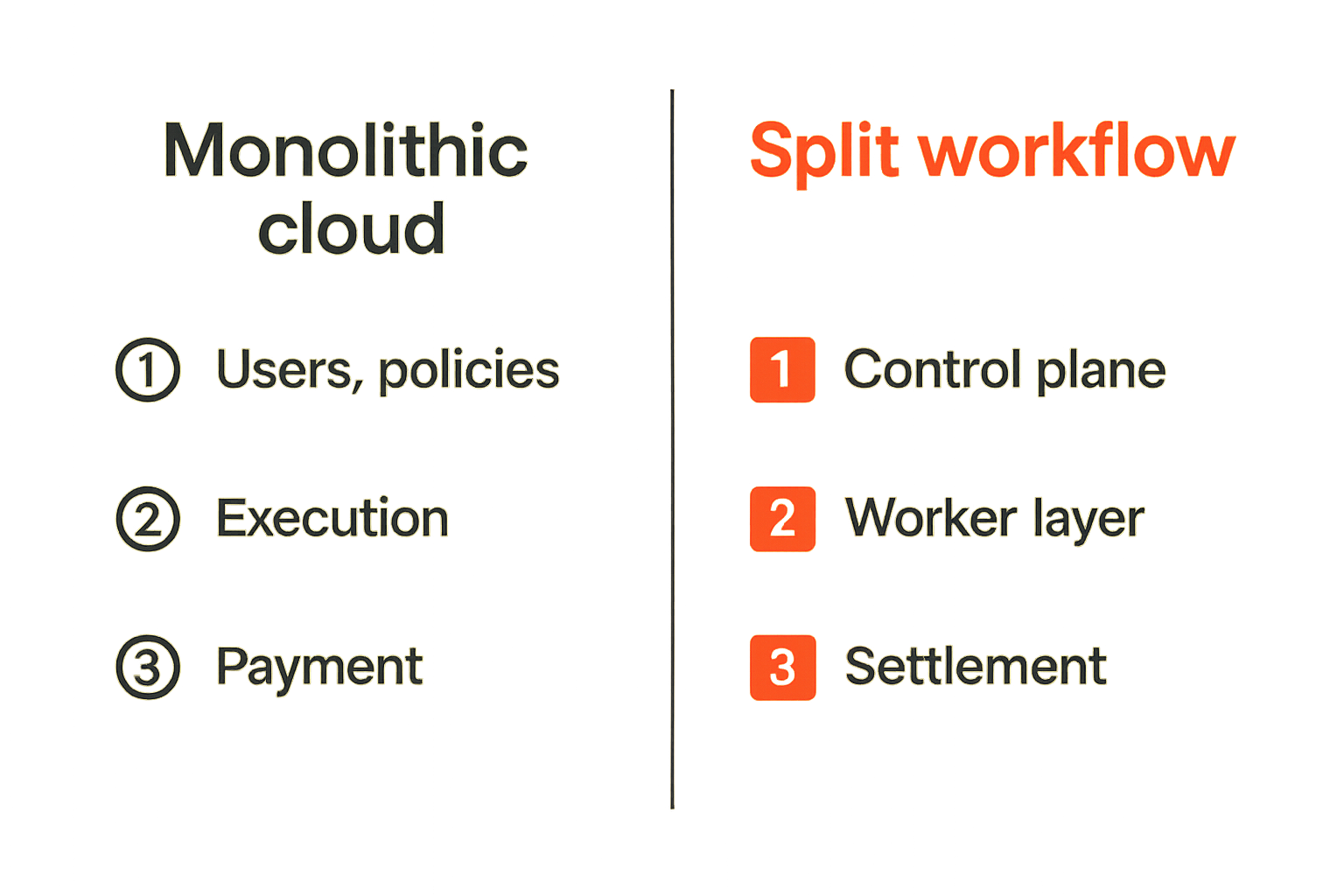
The old cloud diagram puts everything inside one provider boundary. The newer architecture separates the control plane from the execution plane.
Your control plane decides what should happen. It owns users, policies, queues, manifests, accounting, retries, and audit trails. Your worker layer performs the actual compute. Your settlement layer handles payment, proof, reconciliation, or reputation.
Once you split the system this way, cloud computing companies become interchangeable in some places and non-interchangeable in others.
Centralized cloud providers
Centralized cloud providers are still the default for many core services because they reduce coordination overhead. Databases, authentication, API gateways, object storage, secrets management, and observability stacks benefit from stable provider primitives.
They also provide a clear operational contract. If a managed database fails, there is a support channel, an incident history, and an expected remediation path. That matters for systems that hold canonical state.
But centralized cloud is not automatically the best execution layer for every workload. High-throughput batch work, AI inference bursts, and FFmpeg transcoding can turn into cost and quota problems. Specialized capacity may be available elsewhere, but only if your architecture can route work without losing state.
Edge and decentralized capacity
Edge and decentralized compute capacity works differently. It is not a replacement for every managed service. It is a way to access distributed execution for workloads that can be packaged, assigned, monitored, and validated.
The practical fit is strongest when the job has clear inputs and outputs:
- Transcode this file into these renditions.
- Run inference against this model and prompt.
- Process this batch of frames.
- Render this segment.
- Execute this deterministic task and return artifacts.
The weakness is coordination. If your system assumes workers are always trusted, always online, and always homogeneous, marketplace compute will punish that assumption. You need explicit job specs, retries, validation, and settlement.
| Architecture choice | Best for | Weak spot | Operator question |
|---|---|---|---|
| Centralized hyperscaler | Managed services, databases, steady workloads | Cost, quota, lock-in, regional concentration | What must remain canonical? |
| Specialized GPU cloud | Model serving, training bursts, GPU-heavy jobs | Availability variance, integration overhead | Which models need dedicated capacity? |
| Edge compute | Low-latency regional execution | State management, smaller resource envelopes | What can run close to users? |
| Decentralized marketplace | Portable jobs, burst compute, verifiable tasks | Worker trust, validation, routing | What can be packaged and proven? |
| Hybrid architecture | Control plane plus flexible execution | Operational complexity | Who owns state transitions? |
Workload fit: AI inference, FFmpeg, batch, and burst
Not every workload belongs on decentralized compute. Not every workload belongs on a hyperscaler either. The practical question is whether the work can be described as a job with bounded inputs, resource requirements, expected outputs, and validation rules.
If yes, you can route it. If no, keep it closer to your canonical system until you can isolate the work.
AI inference workloads
AI inference is a good example because teams often confuse model serving with product architecture. The model endpoint is only one part of the system. Around it you need rate limiting, prompt storage, safety policy, user identity, billing, logging, output handling, and fallback behavior.
For inference, decentralized or marketplace compute tends to fit when:
- The model artifact can be pinned or identified.
- Input and output sizes are controlled.
- Latency requirements are realistic.
- The result can be validated enough for the product use case.
- Fallback to another worker or provider is acceptable.
It fits poorly when the workload requires tight coupling to private data, very low latency, proprietary model weights that cannot move, or strict compliance controls that the marketplace cannot satisfy.
Practical rule: Treat AI inference as a routed job, not just an HTTP call. The routing decision should include model, price, latency, worker reputation, privacy boundary, and fallback path.
Video transcoding workloads
FFmpeg transcoding is one of the cleaner matches for distributed execution because the job boundary is natural. You have an input file, a command profile, target renditions, expected artifacts, logs, and measurable output.
A typical transcode job can be described with:
- Source URI or content-addressed input.
- Codec, bitrate, resolution, and container settings.
- Segmenting rules for HLS or DASH.
- Output destination.
- Timeout and retry policy.
- Validation checks such as duration, file size, codec metadata, and playable sample probes.
What breaks in practice is not FFmpeg. FFmpeg is predictable enough. What breaks is orchestration around FFmpeg: stale input URLs, missing codecs, non-idempotent retries, partial outputs, silent quality degradation, and support teams that cannot see worker logs.
For adjacent reading on coordination and handoff, Related reading from our network: the Vizio remote control workflow piece is a surprisingly relevant analogy for permissions, control transfer, and support visibility in distributed operations.
The routing layer is where architectures win or fail
The routing layer is the difference between a useful hybrid compute system and a pile of disconnected scripts. It decides where a job should run, when to retry, when to fail over, and when to stop spending money.
This is where many teams underbuild. They integrate a provider API directly from application code and call it architecture. Then they add a second provider. Then a queue. Then a cron retry. Then a support script. Six months later nobody can explain why a job ran three times and charged the user twice.
Placement signals
Placement should be policy-driven, not scattered across product code. At minimum, your router should evaluate:
- Workload type: inference, transcode, render, batch, validation.
- Resource requirements: CPU, GPU, memory, disk, network.
- Data location: where inputs and outputs live.
- Latency target: interactive, near-real-time, background.
- Trust requirement: trusted worker, reputation threshold, proof level.
- Cost ceiling: maximum spend per job or per customer.
- Retry tolerance: safe to rerun or requires manual review.
The first version does not need to be complex. A simple rule table is usually better than clever scheduling logic nobody can debug.
Example policy shape:
job_type: transcode
profile: hls_1080p
max_price: 0.80
max_attempts: 3
worker_requirements:
  ffmpeg: true
  min_reputation: 0.92
validation:
  ffprobe: true
  duration_delta_seconds: 2
fallback:
  centralized_cloud: true
  reason: marketplace_timeout
The important part is not the syntax. It is that routing becomes explicit and reviewable.
Fallback strategy
Fallback is not failure handling after the fact. It is part of workload design.
For example, an AI inference request might route first to a low-cost marketplace worker if the user is running an asynchronous batch. The same model might route to a dedicated endpoint for an interactive session. A transcode job might try decentralized workers for standard renditions but fall back to a centralized cloud for premium customers or urgent jobs.
Practical rule: Every routed workload needs a stop condition. Infinite retries are not reliability; they are uncontrolled spend with worse observability.
Good fallback design answers:
- When do we retry the same worker?
- When do we choose a different worker?
- When do we switch provider type?
- When do we mark the job failed?
- When does a human need to inspect it?
- How do we prevent duplicate settlement?
Payments and trust are part of compute architecture
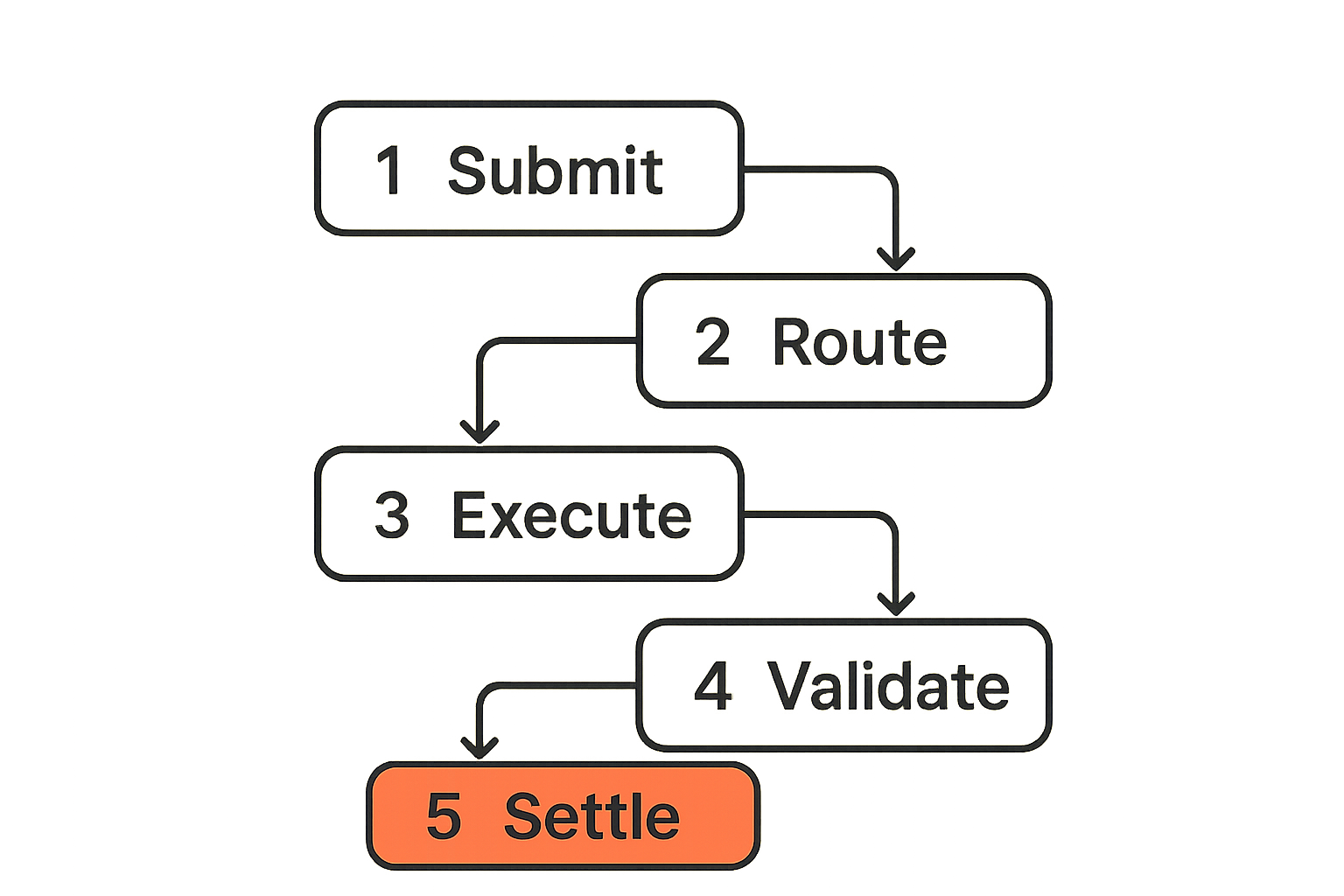
Cloud billing usually appears outside the engineering diagram. That is a mistake. Payment shape changes architecture.
With conventional cloud computing companies, teams often get a monthly invoice. That works for internal infrastructure accounting, but it does not map cleanly to job-level marketplaces, user-paid compute, escrow, or decentralized worker incentives.
When compute becomes distributed, billing becomes part of the protocol.
Why billing shape matters
If a job can run on multiple providers or independent workers, the system needs to answer basic questions:
- Who authorized this spend?
- What job was paid for?
- Was the job completed?
- Who can claim payment?
- What happens on partial failure?
- How is a retry distinguished from a duplicate charge?
This is not finance paperwork. It is production state.
A useful implementation pattern is to bind payment intent to a job ID before execution starts. The worker should not be guessing who pays. The application should not be reconstructing billing from logs after the fact. The settlement path should know the job, payer, worker, expected output, and completion rule.
Related reading from our network: local coordination systems face similar trust and routing problems; the Mighty Networks alternatives guide is about communities, but the operating lesson is the same: workflows fail when ownership and follow-up are vague.
DID-based job ownership
DID-based payment flows are useful because they let identity travel with the job instead of staying trapped inside one SaaS account or cloud billing account. For decentralized compute, that matters.
A DID-bound compute job can carry:
- Requester identity.
- Worker identity.
- Payment authorization.
- Job manifest hash.
- Output reference.
- Reputation update.
- Dispute or validation record.
This does not mean every workload needs a blockchain ceremony. The point is architectural: identity, payment, and execution should be connected in a way your system can verify.
The mistake teams make is bolting payment on after routing. That produces brittle reconciliation. If the same job is retried on three workers, support needs to know which attempt was authorized, which output was accepted, and which payment was released.
Operational workflow for adding decentralized compute
Adding decentralized compute should not start with a full migration. Start with one workload that has a clean boundary, measurable output, and low blast radius. For many teams, that is a batch inference job, a non-urgent video transcode, or an internal media processing pipeline.
The goal is not to prove ideology. The goal is to prove that your control plane can assign work to external capacity and still understand what happened.
A practical implementation sequence
Use a staged rollout:
- Define the job contract. Specify inputs, outputs, resource requirements, timeout, validation, and payment policy.
- Create a canonical job ID. Every queue message, worker log, payment intent, artifact, and support event should reference it.
- Keep source-of-truth state in your control plane. External workers execute jobs; they do not own your product state.
- Add a provider adapter. Treat each cloud, GPU pool, or marketplace as an execution backend behind a common interface.
- Route a small workload class. Start with a non-critical profile, such as 720p transcodes or offline inference batches.
- Validate outputs automatically. Do not rely on worker success messages alone.
- Add retry and fallback policies. Make duplicate execution safe with idempotency keys.
- Expose job state to operators. Support needs visibility into attempts, logs, costs, and settlement.
- Expand only after failure modes are boring. If the team still cannot explain a failed job, do not scale the pattern.
The most important habit is to keep the control plane boring. Fancy routing is less valuable than a clean job ledger.
Minimal CLI-first contract
CLI-first developers usually want something they can inspect and automate. A useful compute workflow should be scriptable before it becomes a dashboard.
A minimal contract might look like:
compute job submit transcode \
  --input ipfs://bafy-source-video \
  --profile hls-1080p \
  --max-price 0.80 \
  --timeout 1800 \
  --validate ffprobe \
  --idempotency-key vid_9x7_hls_1080p

compute job status job_abc123
compute job logs job_abc123 --attempt 2
compute job artifacts job_abc123
compute job settle job_abc123 --release-on validated
This shape forces the right questions. What is the input? What is the profile? What is the price ceiling? What is the timeout? What counts as valid? How do we prevent duplicate execution?
For implementation details, the c0mpute docs are organized around install, identity, workers, transcode jobs, AI inference, reputation, plugins, and health checks.
What breaks when teams choose badly
Choosing badly does not always mean picking the wrong vendor. More often, it means picking a provider before understanding the workflow.
The failure pattern is familiar: a team starts with one cloud API, hardcodes assumptions into application code, adds a second backend for cost or GPU availability, then discovers that state, billing, validation, and support were never abstracted. The architecture becomes a chain of exceptions.
Failure mode table
| Failure mode | What causes it | What breaks in practice | Better design |
|---|---|---|---|
| Duplicate charges | Retries without idempotency | Users pay for failed or repeated attempts | Bind payment to job ID and attempt state |
| Orphaned jobs | Worker accepts work but control plane loses state | Jobs run with no visible owner | Control plane owns lifecycle transitions |
| Silent bad output | Success based only on exit code | Corrupt video or unusable inference result ships | Validate artifacts before acceptance |
| Provider lock-in | Product code calls one provider directly | Migration requires application rewrite | Use backend adapters and job contracts |
| Runaway cost | No stop condition or price ceiling | Retry storms and surprise bills | Enforce max attempts and max spend |
| Support blindness | Logs live only on workers | Operators cannot explain failures | Centralize job events and attempts |
| Trust mismatch | Any worker can run sensitive jobs | Data exposure or policy violation | Route by trust class and workload type |
The common thread is ownership. If nobody owns the full job lifecycle, the system will eventually make a bad decision automatically.
What works and what fails
What works:
- Keep canonical state in one control plane.
- Treat providers as execution backends.
- Use explicit job manifests.
- Require idempotency for retries.
- Validate outputs, not just process exits.
- Tie payment to job state.
- Log every attempt with a reason.
What fails:
- Calling provider APIs directly from product code.
- Assuming all workers are equivalent.
- Retrying without price limits.
- Treating billing as a monthly afterthought.
- Using decentralized compute for workloads with unclear privacy boundaries.
- Expanding to multiple backends before operators can debug one.
Practical rule: If support cannot answer where a job ran, why it was routed there, what it cost, and whether the output passed validation, the architecture is not production-ready.
Metrics to track before you migrate workloads
Metrics are where hype gets filtered out. A provider can look attractive in a demo and still be a poor fit for your workload. Before shifting serious volume, track job-level metrics across your current baseline and any new execution backend.
Do not only track infrastructure utilization. Track the workflow.
Job-level SLOs
For each workload class, define practical SLOs:
- Queue wait time.
- Time to first worker acceptance.
- Execution duration.
- End-to-end completion time.
- Validation pass rate.
- Retry rate.
- Fallback rate.
- Cost per completed job.
- Cost per validated output.
- Operator intervention rate.
Cost per completed job is better than raw hourly price. Cost per validated output is better still. A cheap worker that fails often is expensive. A fast provider that produces artifacts your pipeline rejects is not fast.
The practical question is: how much reliable output did you buy?
Marketplace health signals
If you are using decentralized or marketplace compute, add health signals that do not matter as much in conventional cloud:
- Worker availability by capability.
- Reputation distribution.
- Median acceptance time.
- Failed validation by worker class.
- Dispute or withheld settlement rate.
- Geographic capacity spread.
- Version drift across tools such as FFmpeg or model runtimes.
You do not need perfect data on day one. You do need enough visibility to avoid routing blind.
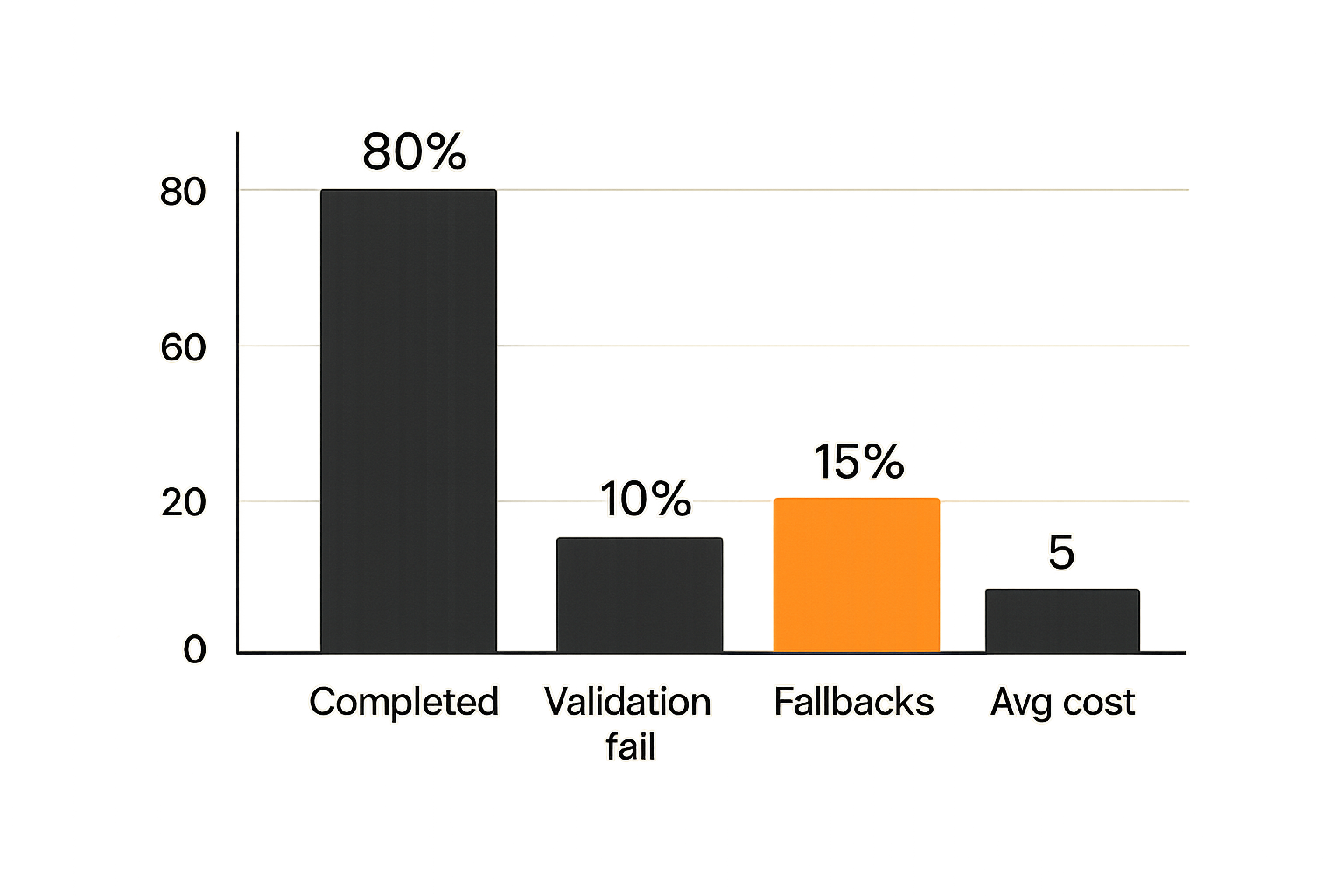
A small chart in an operator dashboard might compare four numbers by backend: completed jobs, validation failures, fallback events, and average cost. That is usually more useful than a generic uptime badge.
Where c0mpute.com fits
c0mpute.com is built around a simple premise: many compute jobs should be packaged, routed, executed, validated, and paid for as jobs, not hidden inside a monolithic cloud account.
That does not mean centralized cloud computing companies disappear. It means builders get another execution layer for workloads that are portable and operationally explicit.
Product fit for builders
The c0mpute.com model is CLI-first and organized around three practical modules: FFmpeg transcoding, AI inference, and DID-based payments. That maps to the architecture described above:
- Transcode jobs need manifests, worker execution, logs, artifacts, and validation.
- Inference jobs need model-aware routing, price ceilings, identity, and fallback.
- Payments need to connect requester, worker, job, output, and settlement.
The product fit is strongest if you are building systems where compute is already job-shaped:
- Video platforms generating renditions, previews, clips, or segments.
- AI products running asynchronous inference or batch processing.
- Web3 applications that need payment and identity at the compute layer.
- Developer tools that want scriptable execution instead of another opaque dashboard.
It is not the right abstraction for every database, every low-latency API call, or every compliance-sensitive workload. That is fine. The useful architecture is hybrid: keep canonical state where it belongs, route portable execution where it makes sense.
Closing architecture rule
Cloud computing companies should be evaluated by how they fit your workflow, not by how complete their service catalog looks. For builders in 2026, the winning pattern is usually a stable control plane, explicit job contracts, provider adapters, validation, and settlement that follows the work.
If you are comparing cloud computing companies for AI inference, FFmpeg transcoding, or decentralized compute, start with the job lifecycle. Once that is clear, provider choice becomes much easier.
Try c0mpute.com
c0mpute.com is for technical builders interested in decentralized compute, AI inference, FFmpeg transcoding, and DID-based payments. Try c0mpute.com.