You can ship a prototype on any of the major cloud computing companies. The trouble starts after the prototype works.
The AI endpoint gets popular in one geography. The video pipeline burns through egress. Your GPU quota is approved in one region but not the region where users are waiting. A worker dies halfway through a long FFmpeg job. Finance wants predictable settlement, engineering wants retries, and users only care that the job finishes.
Teams think the problem is choosing the cheapest provider. The real problem is designing a compute workflow that can route work, verify output, handle payment, and recover from failure across more than one execution environment.
That changes the conversation. In 2026, cloud computing companies are not just vendors on a pricing page. They are control planes, trust boundaries, billing systems, observability surfaces, identity models, and operational habits. For web3 developers, AI infrastructure builders, video engineers, and CLI-first teams, the practical question is not which logo is best. It is which architecture lets your workload survive production.
Table of contents
- What cloud computing companies actually sell in 2026
- The architecture comparison: centralized cloud, edge, and decentralized compute
- The practical evaluation model for cloud computing companies
- AI inference workloads need routing, not just GPUs
- Video transcoding workloads expose hidden cloud costs
- Web3 payments and identity change procurement
- What breaks when teams choose badly
- Implementation workflow for a multi-provider compute layer
- What works and what fails in production
- Where c0mpute.com fits among cloud computing companies
What cloud computing companies actually sell in 2026
Capacity is only the visible layer
Most comparison pages reduce cloud computing companies to compute instances, managed databases, storage, and pricing calculators. That is useful for procurement, but incomplete for builders.
Capacity is the part you can see. The harder parts are scheduling, identity, payment, job lifecycle, recovery, audit logs, quotas, region availability, and support workflows. If your system is a simple web app with predictable traffic, a single cloud may be enough. If your system runs bursty AI inference, video encoding, or marketplace jobs, capacity alone is not the product.
The mistake teams make is treating compute as a static resource. In production, compute is a routing decision made repeatedly under constraints.
Practical rule: Evaluate compute providers by the workflow they force on your team, not only by the machines they expose.
Control planes decide your operating model
A control plane answers basic questions: who can request work, where it can run, what it costs, how it is monitored, what happens on failure, and who gets paid. Traditional cloud platforms provide mature control planes inside their own perimeter. That is valuable, but it can also become a lock-in layer.
For CLI-first builders, the control plane should be scriptable. You want job submission, status polling, logs, identity, and settlement to fit into pipelines. If every provider requires a different dashboard, role system, billing export, and retry model, the integration cost becomes the real tax.
A useful way to think about it is this: the cloud instance is an implementation detail. The job contract is the abstraction you actually depend on.
Why decentralized compute changes the buy decision
Decentralized compute does not magically replace hyperscalers. The hype version says unused machines become an infinite cloud. The production version is more practical: independent workers can accept well-defined jobs, return verifiable output, build reputation, and settle through programmable payment flows.
That makes the buy decision less about choosing one of the big cloud computing companies and more about deciding which workloads can be detached from a single control plane. Prior work on IaaS in cloud computing architecture makes the same point from the infrastructure layer: routing, payment, validation, and ownership matter as much as raw instances.
Related reading from our network: teams thinking about architecture as a sequence of execution stages may enjoy the way the Analytical Engine maps to answer-ready systems. The domain is different, but the lesson is similar: architecture beats category labels.
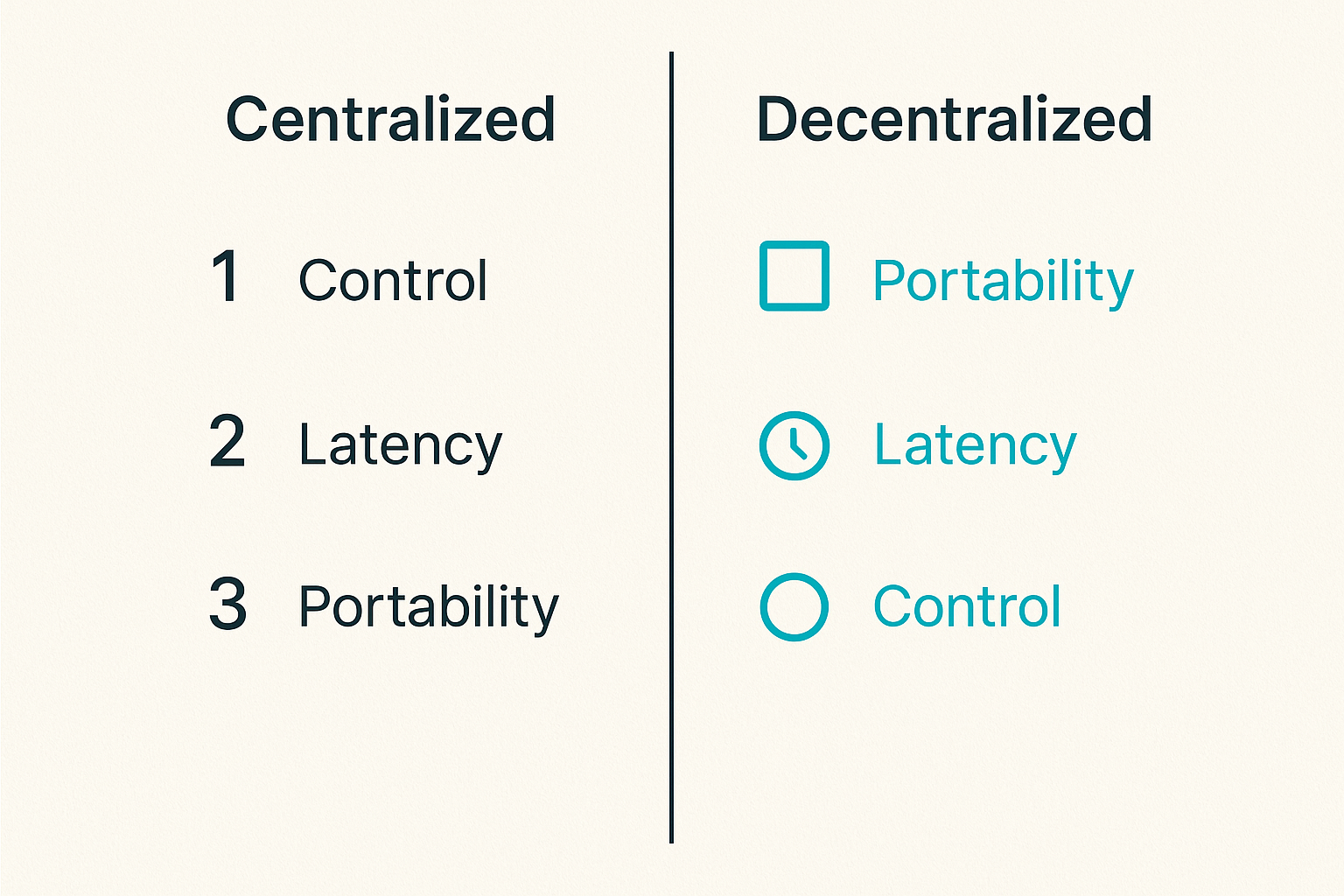
The architecture comparison: centralized cloud, edge, and decentralized compute
Where hyperscalers still win
The major cloud computing companies are strong when you need integrated services, predictable compliance processes, mature networking, managed databases, private connectivity, and enterprise support. If your workload depends on a managed warehouse, proprietary AI platform, or deeply integrated IAM policy, moving everything elsewhere is usually a bad trade.
Hyperscalers also win when the cost of operational variance is higher than the cost of the platform. A bank back office, a regulated enterprise app, or a latency-critical internal system may prefer one provider with tight controls.
The practical question is whether your workload needs those guarantees for every job, or only for the control plane and sensitive data layer.
Where marketplaces create leverage
Compute marketplaces create leverage when work is portable, bounded, and verifiable. Examples include rendering, FFmpeg transcoding, embeddings, batch inference, media normalization, test workloads, and non-sensitive parallel jobs.
The best fit is not every workload. The best fit is work that can be packaged, sent to a worker, checked, and paid for without trusting a permanent account relationship. That changes procurement. Instead of negotiating capacity months ahead, you route eligible jobs into available supply.
| Approach | Best for | Weak point | Operator concern |
|---|---|---|---|
| Centralized cloud | Integrated platforms, databases, enterprise controls | Vendor lock-in and regional quota limits | Cost governance and IAM sprawl |
| Edge platforms | Low-latency user proximity and lightweight functions | Limited heavy compute and state complexity | Debugging distributed failures |
| Decentralized compute | Portable jobs, AI inference, transcoding, burst capacity | Requires validation, reputation, and settlement | Job contracts and result trust |
| Hybrid layer | Teams that need control plus optional capacity | More architecture work up front | Routing policy and observability |
The workload decides the architecture
Do not start with ideology. Start with workload mechanics.
A database primary is not the same as a transcoding job. A chat completion request is not the same as a long-running batch embedding task. A private customer file is not the same as a public video segment. A deterministic command is not the same as a probabilistic model output.
Practical rule: If a job can be described, bounded, retried, and verified, it is a candidate for a distributed compute marketplace. If it needs shared mutable state, keep it close to the system of record.
The practical evaluation model for cloud computing companies
Start with job shape, not vendor category
Before comparing cloud computing companies, write down the shape of the jobs you run. This sounds basic, but it prevents bad architecture.
Useful job fields include:
- Input size and sensitivity
- Expected runtime
- CPU, GPU, memory, and disk requirements
- Determinism of output
- Maximum acceptable latency
- Retry safety
- Verification method
- Payment or cost attribution unit
- Data retention requirement
For example, a 30-second video clip can often be transcoded by a remote worker if the input is accessible and the output can be inspected. A regulated user profile database cannot be treated the same way. An AI inference request for public content has a different trust boundary than an inference request over confidential source code.
Price is not the first filter
Price matters, but it should not be the first filter. Cheap compute that fails often, returns unverifiable results, or requires manual reconciliation is expensive. Expensive compute that removes a week of debugging may be cheap.
The mistake teams make is comparing unit prices without comparing failure handling. In production, the bill is not just compute seconds. It includes engineer time, support tickets, failed jobs, re-runs, monitoring gaps, and delayed user workflows.
A better filter order is:
- Can the provider run the job correctly?
- Can the result be verified?
- Can the job be retried safely?
- Can cost be attributed to a user, tenant, or workflow?
- Can the system degrade gracefully when capacity disappears?
- Is the unit price acceptable after those controls exist?
Define the failure contract
Every provider fails. The question is whether failure is explicit. A useful failure contract states what happens when the worker disappears, output is corrupt, capacity is unavailable, payment cannot settle, or a job exceeds its runtime limit.
A minimal job contract might look like this:
job:
  type: transcode
  input: ipfs-or-https-uri
  runtime_limit: 20m
  retry_limit: 2
  verify: probe-output-and-checksum
  settlement: pay-on-verified-result
  retention: delete-after-delivery
This is not vendor paperwork. It is the interface between product reliability and infrastructure reality.
AI inference workloads need routing, not just GPUs
Latency classes matter
AI infrastructure builders often ask where to find GPUs. That is the wrong first question. The better question is which requests require immediate response and which can be routed through slower, cheaper, or more available workers.
Split inference into classes:
- Interactive: user waits on the response
- Nearline: response is needed soon, but not instantly
- Batch: throughput matters more than latency
- Background: opportunistic work that can run when capacity is cheap
Interactive requests may belong on reserved infrastructure or carefully selected low-latency providers. Batch embedding jobs can use a wider pool. Evaluation runs, media tagging, and summarization pipelines may tolerate delayed completion if the price and capacity are better.
Model placement and warm pools
GPUs are only useful if the model is available, loaded, and compatible with the worker. Cold starts can dominate latency. Model weights can be large. Version drift can make results inconsistent.
For marketplace-style inference, the control plane needs to know more than GPU type. It should track model availability, runtime image, memory headroom, recent success rate, and warm status. A request router that sees only price will make bad choices.
A practical routing record might include:
worker:
  gpu: cuda-compatible
  model: llama-family-quantized
  warm: true
  max_context: 8192
  avg_queue: low
  reputation: high
This is where decentralized compute becomes an orchestration problem, not a slogan.
Validation and result trust
AI outputs are not always deterministic, so validation is harder than checking a checksum. Still, you can validate structure, policy, latency, model version, token limits, and task-specific constraints. For some workloads, you can compare outputs from multiple workers or reserve trusted worker pools.
Practical rule: Do not route AI inference to external workers until you know what you can validate and what you are choosing to trust.
What breaks in practice is silent trust expansion. A team starts with public text summarization, then routes sensitive prompts through the same path because it is convenient. That is not a compute problem. That is a boundary problem.
Video transcoding workloads expose hidden cloud costs
FFmpeg is simple until it runs at scale
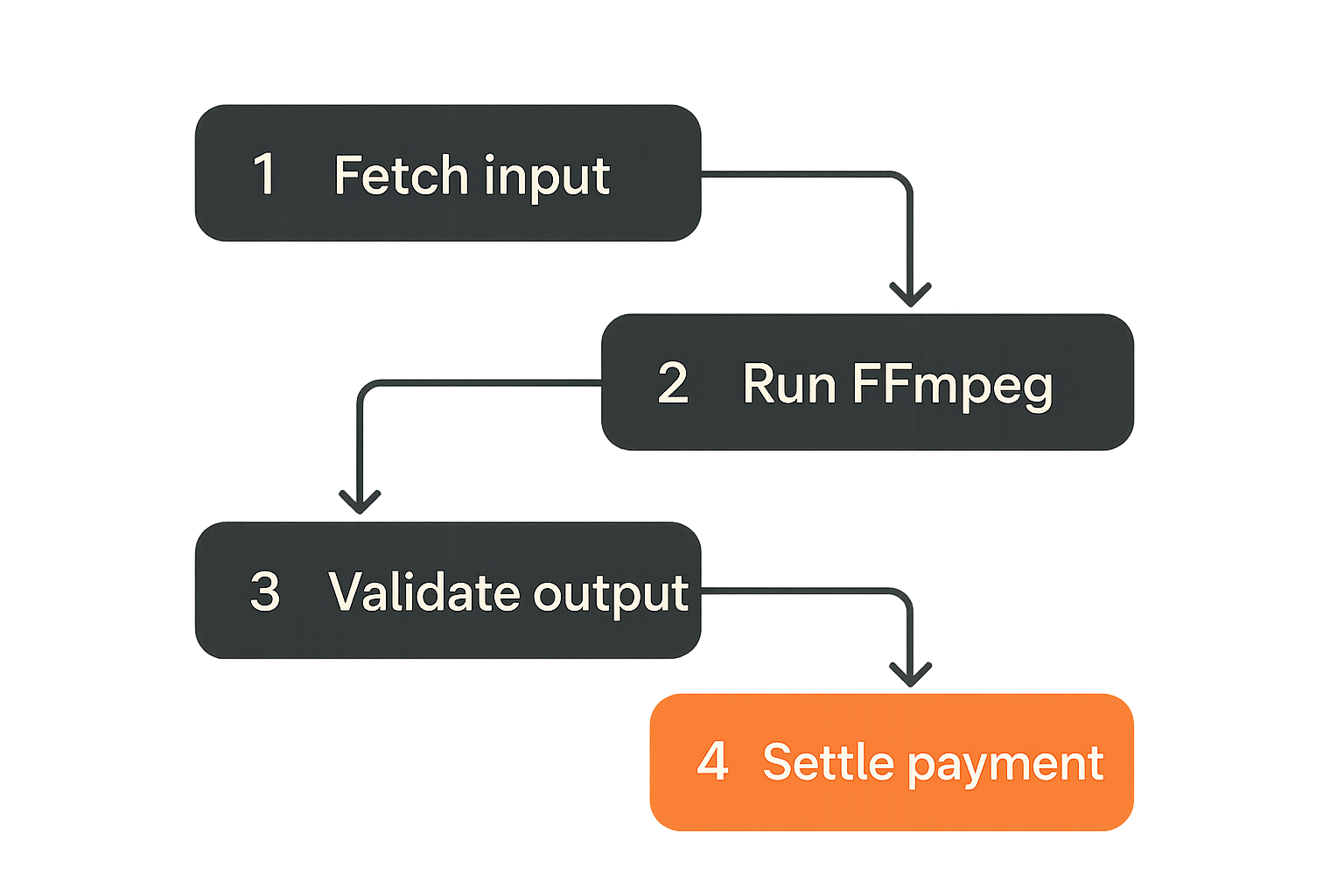
FFmpeg is one of the best examples of why cloud computing companies should be evaluated through workflow. The command may be simple. The production system is not.
You need input fetch, codec detection, output profiles, progress tracking, retries, partial failure handling, output validation, storage, and user-facing status. One broken segment can generate a support ticket. One bad retry loop can double your cost.
A typical command is easy to understand:
ffmpeg -i input.mp4 -vf scale=1280:-2 -c:v libx264 -c:a aac output-720p.mp4
The hard part is deciding where that command runs, how output is checked, and how the worker gets paid.
Batch pipelines fit distributed workers
Transcoding often fits decentralized compute because jobs are bounded and outputs can be inspected. You can split work by file, rendition, segment, or queue priority. Workers do not need access to your whole application database. They need a job spec, an input, and a destination for output.
Related reading from our network: media teams face similar operational tradeoffs around throughput, privacy, and troubleshooting in information technology for streaming and home media workflows. The scale is different, but the failure modes rhyme.
For production, avoid sending arbitrary shell strings to workers. Use a constrained job schema. For example:
transcode:
  input_uri: https-uri
  output_profile: h264-720p
  max_duration: 1800s
  output_format: mp4
  verify:
    - ffprobe-readable
    - duration-within-tolerance
    - audio-stream-present
Egress and retries become architecture
Video workloads make egress visible. Moving large files across regions or providers can erase savings. Retrying a failed transcode can be expensive if the input must be fetched again. Writing output to the wrong storage layer creates downstream pain.
The practical pattern is to keep storage policy separate from execution policy. Your router should ask: where is the input, where should output land, which workers are close enough, and what is the retry budget?
If you cannot answer those questions automatically, the system will eventually make a human answer them during an incident.
Web3 payments and identity change procurement
DID based settlement replaces account sprawl
Traditional cloud procurement assumes accounts, invoices, credit cards, purchase orders, and IAM roles. That model works inside companies. It is clumsy for open compute networks where many workers may provide capacity.
DID based identity and programmable payments change the shape of the relationship. A worker can have an identity, reputation, accepted job types, and settlement address. A job can define payment conditions. The buyer does not need a standing vendor relationship with every machine.
This is not just a payments feature. It affects routing. If payment is tied to verified completion, the system can prefer workers that complete jobs correctly instead of workers that merely advertise capacity.
Custody boundaries must be explicit
Web3 builders sometimes under-specify custody. Who holds funds before the job completes? When is payment released? Can a failed worker claim partial payment? What happens if validation is disputed? Are funds locked per job or per account balance?
These questions belong in the compute architecture, not in a later billing integration. If settlement is unclear, support becomes the arbitration layer.
A useful model is escrow-like job settlement:
- Buyer funds or authorizes a job.
- Worker accepts the job contract.
- Worker returns output and proof metadata.
- Validator checks the result.
- Payment releases on verified completion.
- Failed jobs return to the queue or release funds back to the buyer.
Reputation is part of routing
Reputation should not be a vanity score. It should be an input to scheduling. A worker with a long history of valid FFmpeg jobs should win those jobs more often. A worker with low latency for a specific model should be preferred for that model. A worker with recent failures should be throttled or quarantined.
The mistake teams make is bolting reputation onto the UI while the scheduler still routes by lowest price. That creates a market for cheap failure.
Practical rule: If reputation does not affect routing, pricing, or limits, it is decoration.
What breaks when teams choose badly
The single region trap
Many teams discover too late that their architecture is really a single-region architecture with a multi-region slide deck. They use one provider, one region, one storage bucket, one queue, and one GPU quota. Then a quota issue, pricing change, or regional incident turns into a product incident.
This does not mean every team needs active-active everything. It means teams should identify which jobs can move before they need to move them.
The fix is not immediate multi-cloud complexity. The fix is job portability. Package work so at least some classes can run elsewhere without rewriting the product.
The orphaned job problem
An orphaned job is work that is no longer owned by a healthy process. The API request timed out, the worker kept running, the queue lost visibility, the payment state is unclear, or the user refreshed the page and now nobody knows whether to retry.
Orphaned jobs are common in transcoding and inference pipelines. They are also expensive because they create duplicate work and support ambiguity.
Design every job with states:
created -> funded -> assigned -> running -> submitted -> verified -> settled
created -> assigned -> failed -> retrying
running -> expired -> reassigned
submitted -> rejected -> retrying
If you cannot draw the state machine, you do not have a reliable compute workflow.
Observability without ownership
Logs are not enough. Dashboards are not enough. The system needs ownership. Who acts when a worker fails validation? Who tunes retry budgets? Who decides when a provider is removed from rotation? Who handles user credits after failed settlement?
Observability without ownership creates a museum of red graphs. Operators look at the problem but cannot change the system.
Related reading from our network: CI/CD teams face a parallel issue when controls exist but ownership is unclear; security license architecture for CI/CD is a useful adjacent example of gating, policy, and accountability.
Implementation workflow for a multi-provider compute layer
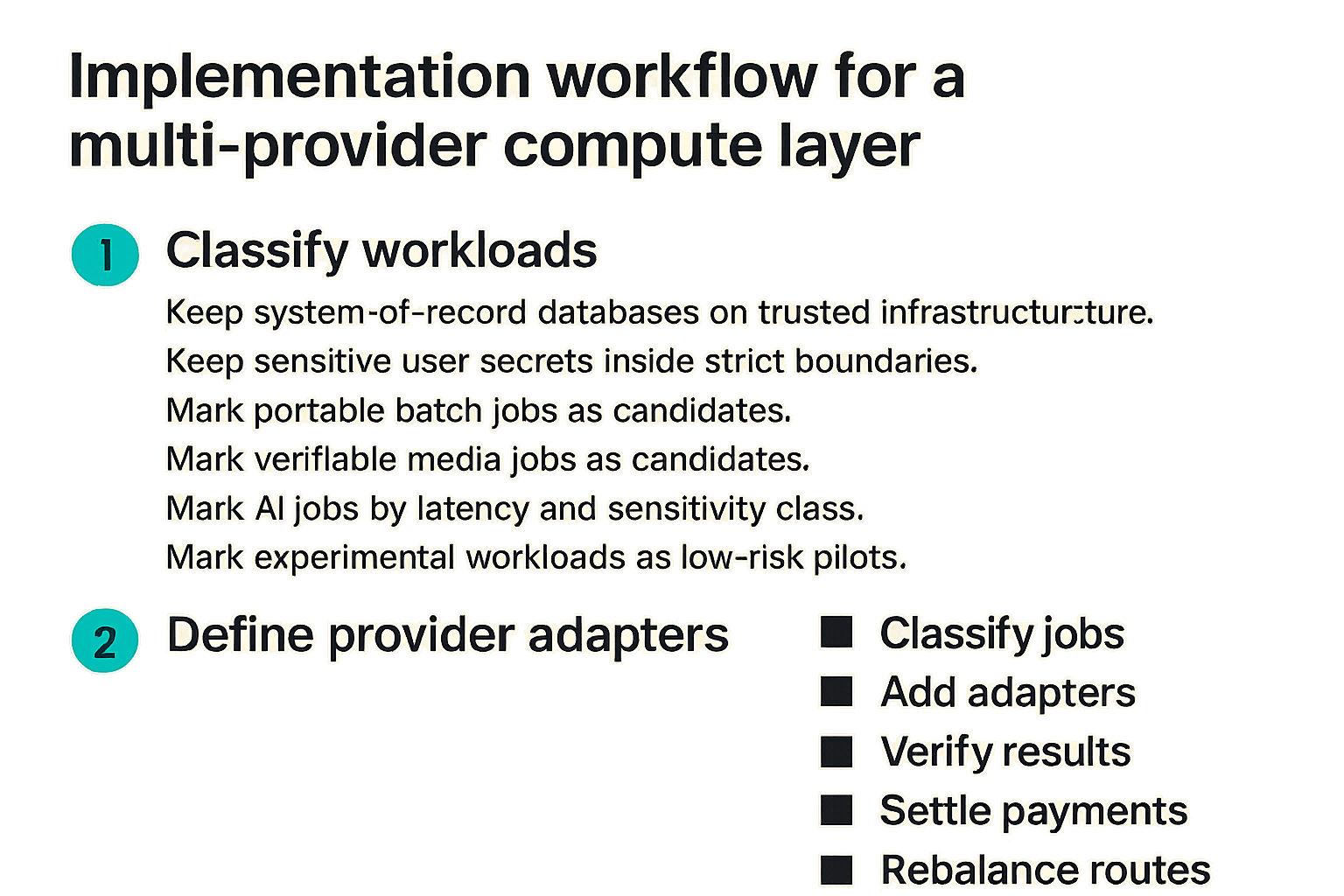
Step 1 classify workloads
Start by separating workloads into classes. Do not try to decentralize everything.
- Keep system-of-record databases on trusted infrastructure.
- Keep sensitive user secrets inside strict boundaries.
- Mark portable batch jobs as candidates.
- Mark verifiable media jobs as candidates.
- Mark AI jobs by latency and sensitivity class.
- Mark experimental workloads as low-risk pilots.
For each class, define the job contract, validation method, timeout, retry limit, and settlement rule.
Step 2 define provider adapters
A provider adapter hides vendor-specific mechanics behind a stable job interface. One adapter may submit to a traditional cloud batch service. Another may submit to a decentralized compute network. Another may run locally for development.
Your internal interface should be boring:
submit_job:
  job_type: infer
  input_ref: object-uri
  requirements:
    gpu: required
    model: selected-model
  policy:
    max_price: set-by-router
    max_latency: set-by-class
    trust_tier: approved
The adapter should translate this into provider-specific calls, then report status back into the same state machine. Builders exploring c0mpute can use the c0mpute CLI docs to map this pattern to install, identity, worker, transcode, inference, reputation, and health-check workflows.
Step 3 add verification and settlement
Verification cannot be an afterthought. It should run before payment settlement and before output is exposed to users.
For video, use ffprobe, checksums, duration checks, codec checks, and sample playback where appropriate. For AI inference, validate schema, model metadata, token constraints, policy boundaries, and task-specific acceptance checks. For generic batch jobs, validate exit codes, output files, logs, and deterministic test cases.
Then attach settlement to state transitions. Payment should not release just because a worker claims success. It should release because the system accepted the result.
Step 4 measure and rebalance
Once multiple providers or worker pools are available, routing becomes a control loop. Measure completion rate, validation failure rate, queue time, runtime, total cost, retry cost, and support impact.
A simple weekly review can answer:
- Which job classes are stable enough to expand?
- Which workers or providers fail validation too often?
- Which routes look cheap but create retries?
- Which jobs should move back to reserved capacity?
- Which inputs create outsized egress or timeout problems?
The system should get better as it runs. If every exception requires a manual rule, the control plane is not mature enough.
What works and what fails in production
What works
What works is boring infrastructure discipline applied to new compute supply.
- Use explicit job contracts.
- Keep sensitive state out of portable jobs.
- Validate before settlement.
- Make routing policy visible.
- Treat reputation as a scheduler input.
- Track cost by job class, not only provider invoice.
- Keep a fallback path for urgent workloads.
- Test failure modes before volume arrives.
This is not anti-cloud. It is pro-control. You can still use major cloud computing companies for databases, control planes, and baseline capacity while routing eligible jobs elsewhere.
What fails
What fails is pretending a compute marketplace is just a cheaper VM list.
- Sending raw commands without constraints
- Ignoring data locality and egress
- Routing sensitive prompts through untrusted workers
- Paying before verification
- Comparing only advertised prices
- Letting jobs run without expiry
- Treating dashboards as incident response
- Building one-off integrations per provider
The worst pattern is hidden coupling. The team says it is multi-provider, but every job depends on a proprietary queue, storage path, identity role, or billing export from one platform.
A simple decision table
Use this table as a first pass, not a law.
| Workload | Better default | Why | Watch out for |
|---|---|---|---|
| Primary database | Centralized cloud | Strong consistency and managed recovery | Lock-in and backup portability |
| Public video transcode | Decentralized or hybrid compute | Bounded jobs and verifiable output | Egress, retries, codec drift |
| Interactive AI chat | Reserved cloud or trusted low-latency pool | User waits on response | Cold starts and model drift |
| Batch embeddings | Hybrid or marketplace routing | Throughput matters more than latency | Validation and cost attribution |
| CI media tests | Marketplace or spot-like capacity | Parallel and retryable | Flaky test ownership |
| Secret analysis | Trusted private infrastructure | Sensitive input boundary | Accidental routing expansion |
The decision is rarely permanent. Mature teams move classes of work as their validation, routing, and payment systems improve.
Where c0mpute.com fits among cloud computing companies
Product fit for builders
c0mpute.com is built for technical builders interested in decentralized compute, AI inference, FFmpeg transcoding, and DID-based payments. That puts it in a different mental category from traditional cloud computing companies. It is not trying to be your managed database, office suite, or enterprise dashboard.
The fit is portable compute work: jobs that can be described from a CLI, routed to workers, verified, and settled. For an AI builder, that may mean inference workflows with explicit model and trust policies. For a video engineer, it may mean FFmpeg transcodes with validation. For a web3 developer, it may mean payment-aware job execution where identity and settlement are part of the workflow.
That changes the conversation from cloud replacement to workload placement.
How to pilot without rewriting your stack
A practical pilot should be narrow. Pick one job class, not the whole platform.
Good pilots include:
- A non-sensitive FFmpeg rendition pipeline
- Batch media metadata extraction
- Public-content summarization
- Embedding generation for low-risk documents
- Developer-triggered inference tests
- CLI-based worker experiments
Avoid starting with regulated data, hard real-time user paths, or workloads with no validation plan. The goal is to prove the job contract, worker routing, result verification, and settlement loop.
A simple pilot sequence:
- Define one job schema.
- Run it locally from the CLI.
- Submit it to a remote worker path.
- Validate output automatically.
- Record job state transitions.
- Attach payment or accounting to verified completion.
- Compare cost, latency, failure rate, and support burden against your current provider path.
If the pilot works, expand by workload class. If it fails, you still learned where your job contract was vague.
Try c0mpute.com
If your current cloud computing companies are good at baseline infrastructure but awkward for portable AI inference, FFmpeg transcoding, or DID-based payment workflows, test the job-based model. c0mpute.com is for CLI-first builders working with decentralized compute, AI inference, FFmpeg transcoding, and DID-based payments.