Most teams still talk about iaas in cloud computing as if the main decision is instance size. Pick a VM, attach storage, open a port, ship the workload. That worked when the workload was a long-running web service and the cloud provider was the only realistic execution layer.
That is not the shape of a lot of infrastructure in 2026. AI inference jobs, FFmpeg transcodes, batch media pipelines, model evaluation runs, and web3 services often behave less like servers and more like routed work. The operator question is not only where do I rent a machine. It is where should this job run, under what contract, with what proof, paid by whom, and how do I recover when it fails.
Teams think the problem is infrastructure provisioning. The real problem is compute coordination.
That changes the conversation. IaaS in cloud computing is no longer just a cloud SKU category. For builders using decentralized compute marketplaces, it becomes an architecture decision about control planes, execution nodes, identity, payments, validation, retries, observability, and support.
Table of contents
- Why iaas in cloud computing is now a routing problem
- The IaaS control plane and data plane
- IaaS in cloud computing versus decentralized compute marketplaces
- Workload fit for AI inference and FFmpeg jobs
- Identity payments and settlement are part of infrastructure
- A practical IaaS implementation workflow
- Failure modes when teams implement IaaS badly
- What works for CLI-first builders
- Security privacy and operational context
- Where c0mpute.com fits
- Closing: iaas in cloud computing as a compute routing decision
Why iaas in cloud computing is now a routing problem
The old model was capacity planning
Classic IaaS was sold around primitives: virtual machines, disks, networks, firewalls, images, regions, and accounts. You mapped a service to a VM type, estimated load, added autoscaling, and accepted the provider as the trust boundary.
That model is still useful. A database wants durable storage. An API gateway wants stable network identity. A control plane often wants boring, centralized reliability.
But many high-value workloads are not shaped that way. A batch inference run may need GPUs for eight minutes. A video job may need FFmpeg workers for a burst and then nothing. A model benchmark may need heterogeneous hardware and a clean artifact trail. The mistake teams make is forcing these workloads into server-shaped architecture because the billing page is server-shaped.
The new model is workload placement
A useful way to think about it is this: infrastructure is now a routing layer.
You have a job. The job has inputs, constraints, cost sensitivity, privacy requirements, validation rules, and a deadline. The platform has available workers, locations, hardware profiles, prices, reputation signals, and failure rates. IaaS is the mechanism that matches the job to execution capacity.
In a centralized cloud, the routing logic is often hidden inside a provider account. In a decentralized compute marketplace, more of that routing logic becomes explicit. You need to decide which constraints are hard, which are soft, and what evidence proves the job was completed.
What operators actually buy
Operators do not really buy VMs. They buy a result with acceptable risk.
For a web3 developer, that might be a reproducible compute task tied to a wallet or DID. For an AI builder, it might be an inference response within a latency budget. For a video engineer, it might be a transcoded HLS ladder with logs and checksums. For a CLI-first developer, it might be a command that runs locally, dispatches remotely, and returns artifacts without requiring a dashboard session.
Practical rule: Treat IaaS as a contract for execution, not a place where machines happen to live.
Related reading from our network: teams coordinating remote infrastructure hit similar ownership and rollout issues in cloud based productivity and collaboration tools, even when the workload is people rather than compute.
The IaaS control plane and data plane
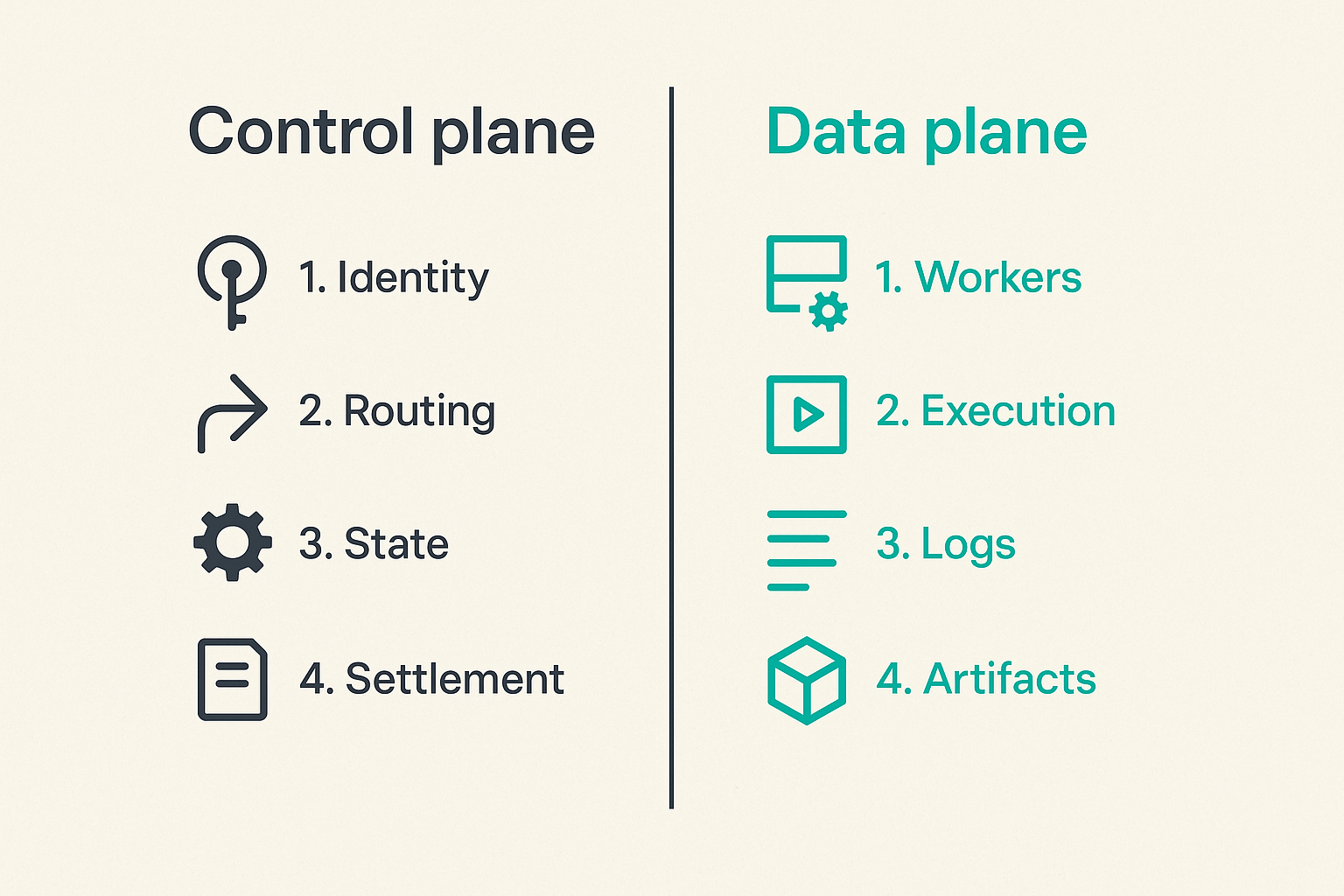
Control plane responsibilities
The control plane answers who is allowed to do what, where work should go, and what the system believes is true. In IaaS, that includes identity, scheduling, quotas, pricing, policies, reputation, job state, and audit history.
In practice, the control plane should handle:
- Authentication and identity binding
- Job submission and schema validation
- Worker discovery and capability matching
- Pricing, escrow, or billing authorization
- State transitions such as queued, running, failed, completed, paid
- Observability metadata and audit logs
- Retry policy and cancellation rules
If the control plane is vague, everything downstream becomes support work. Users will ask whether a job ran, workers will dispute payment, and operators will have no clean source of truth.
Data plane responsibilities
The data plane moves and executes the workload. It pulls inputs, runs containers or commands, streams logs, writes outputs, and reports completion. For FFmpeg, the data plane touches media files, codecs, CPU cycles, GPU acceleration, object storage, and artifact packaging. For inference, it touches prompts, embeddings, model weights, GPU memory, token streaming, and response serialization.
What breaks in practice is mixing control-plane trust with data-plane execution. A worker should not be able to rewrite the economic state of a job just because it produced an output. A scheduler should not need to inspect sensitive payloads to route work. The boundary matters.
Where decentralized compute changes the boundary
In a centralized cloud, the provider owns the account system, hosts the hardware, controls the network, and bills the customer. In decentralized compute, the infrastructure operator may be a marketplace, while execution happens across independent workers.
That changes the failure model. You need stronger job manifests, clearer validation, and more explicit payment state. A marketplace cannot rely on implicit account trust in the same way a single provider can. It has to coordinate independent actors.
For builders, that is not only a risk. It is also the opportunity. If job state, identity, validation, and settlement are explicit, infrastructure becomes more composable. You can route across supply, compare providers, isolate workloads, and design around portable artifacts.
IaaS in cloud computing versus decentralized compute marketplaces
What stays the same
IaaS in cloud computing still gives builders access to compute without buying hardware. You still care about CPU, GPU, RAM, storage, network egress, region, uptime, images, secrets, and logs. You still need to plan for capacity, latency, failure, and cost.
The core operational loop does not disappear:
- Define the workload.
- Provision or select capacity.
- Execute the work.
- Observe behavior.
- Handle failures.
- Pay for usage.
- Improve the next run.
The practical question is where each responsibility lives and how much of it is portable.
What changes
The biggest change is that decentralized compute turns infrastructure from an account-local resource into a marketplace-mediated workflow.
Instead of assuming that all machines are inside one provider trust domain, you assume workers vary. Some are faster. Some are cheaper. Some are closer to users. Some have better reputation. Some fail. Some should never receive certain data. Your architecture has to encode those assumptions.
This is where a lot of hype gets unhelpful. Decentralization does not remove operations. It moves operations into protocols, job specs, worker selection, validation, and settlement.
Comparison table for builders
| Dimension | Traditional IaaS | Decentralized compute marketplace | Operator implication |
|---|---|---|---|
| Capacity source | Provider-owned regions | Independent workers or pools | Routing and reputation matter |
| Trust model | Account and provider boundary | Job, identity, and validation boundary | More explicit contracts |
| Billing | Provider invoice | Job-level payment or settlement | State tracking becomes critical |
| Workload shape | Long-running servers and managed resources | Jobs, tasks, bursts, specialized workers | Better for batch and elastic jobs |
| Failure handling | Provider SLA plus app retries | Marketplace policy plus job retries | Idempotency is mandatory |
| Portability | Often provider-specific | Higher if artifacts and specs are portable | Avoid hidden dependencies |
Practical rule: If you cannot describe the job without naming a specific machine, you probably have not separated workload intent from infrastructure execution.
Related reading from our network: private coordination has similar boundary problems, and the workflow view in end-to-end encrypted messaging is a useful adjacent pattern for thinking about identity, devices, and metadata.
Workload fit for AI inference and FFmpeg jobs
AI inference wants latency and model locality
AI inference is not one workload. A one-off batch classification job, a streaming chatbot, an embedding pipeline, and a GPU-heavy image generation task all have different IaaS requirements.
For decentralized compute, the best fit often starts with jobs that have clear inputs and outputs:
- Batch inference over a dataset
- Evaluation runs across prompts or models
- Embedding generation
- Non-interactive image or audio generation
- Internal tools where latency can be bounded but not ultra-low
Interactive inference can work, but only if the marketplace exposes enough routing information. You need to know worker readiness, model availability, queue depth, network path, and timeout behavior. Cold starts and model loading are not small details. They are often the difference between usable and unusable.
Video transcoding wants throughput and repeatability
FFmpeg transcoding is a strong workload for marketplace-style IaaS because the contract can be concrete. Input file. Codec ladder. Output format. Time budget. Logs. Checksums. Payment on completion.
Video infrastructure engineers should care less about whether the worker is called a VM and more about whether it can produce repeatable artifacts. The output must match the requested profile. The logs must show enough detail to debug codec failures. The system must handle large input files without turning network transfer into the real bottleneck.
A simple transcode job spec might include:
job: transcode
input: ipfs_or_object_storage_uri
profile: hls_1080p_720p_480p
codec: h264
preset: fast
max_runtime_seconds: 1800
outputs:
  - manifest.m3u8
  - segments
validation:
  - ffprobe
  - checksum
  - duration_match
This is the right level of abstraction. The user asks for a result. The infrastructure layer handles placement.
Interactive services need stricter contracts
Not every workload should be pushed into a decentralized marketplace immediately. Stateful databases, latency-sensitive trading systems, private key management, and tightly coupled microservices need stricter guarantees.
That does not mean they cannot use decentralized compute. It means the boundary should be deliberate. Keep the stateful control surface in a trusted environment. Use marketplace compute for bounded jobs that can be retried, validated, and settled independently.
Practical rule: Start with workloads that are bounded, observable, and repeatable. Move interactive workloads only after routing, validation, and rollback are boring.
Identity payments and settlement are part of infrastructure
Why account identity is not enough
In classic cloud, identity usually means account, IAM role, API key, service account, or SSO user. In decentralized compute, identity has to describe more than access. It must connect requesters, workers, job state, payment rights, reputation, and dispute handling.
DID-based identity is useful because it can bind compute activity to portable actors instead of only provider accounts. A worker can build reputation. A requester can authorize jobs. A payment module can settle based on job completion. The architecture becomes less dependent on one platform account as the source of truth.
This does not remove the need for policy. It gives policy a better object to attach to.
Payments need job-level state
The mistake teams make is bolting payments on after execution. They build a queue, add workers, produce outputs, and then discover that settlement is ambiguous. Did the job start. Did it complete. Was the output valid. Who pays for partial work. What happens on timeout.
Payments need to be part of the state machine from the beginning.
A minimal job payment state should include:
- Price quoted
- Funds authorized or escrowed
- Worker assigned
- Work accepted
- Output submitted
- Validation passed or failed
- Settlement released or refunded
- Dispute window closed
Without this, support becomes the payment processor. That is not architecture. That is manual reconciliation with better branding.
Escrow and reputation reduce coordination cost
Escrow is not magic, but it gives the system a place to hold intent. Reputation is not perfect, but it gives routing a memory. Together, they reduce the number of human decisions required for routine jobs.
For example, a video pipeline can prefer workers with successful codec-specific history. An inference job can prefer workers with verified model availability. A high-value task can require stronger validation before settlement. Low-value jobs can optimize for speed and cost.
The point is not to financialize every CPU cycle for its own sake. The point is to make compute coordination explicit enough that independent parties can participate without every job becoming a negotiation.
A practical IaaS implementation workflow
Step 1 classify the workload
Before choosing infrastructure, classify the workload. This is where many architecture mistakes are created. Teams jump directly to machines and skip the contract.
Use a simple classification pass:
- Is the workload stateless or stateful.
- Is it batch, streaming, or interactive.
- Does it require CPU, GPU, memory, disk, or network intensity.
- Are inputs public, private, licensed, or regulated.
- Can outputs be validated automatically.
- Is latency hard, soft, or irrelevant.
- Can the job be retried safely.
If you cannot answer these questions, no cloud model will save you. Traditional IaaS will hide the confusion for longer. A decentralized marketplace will expose it earlier.
Step 2 define the contract
The contract is the job spec. It should be machine-readable, versioned, and small enough that operators can reason about it.
For an inference job, the spec might include:
job: inference
model: mistral_small_or_compatible
input_uri: object_storage_uri
max_tokens: 800
latency_budget_ms: 4000
privacy: no_persistent_storage
validation:
  - schema_check
  - max_token_check
settlement:
  mode: escrow
  release: on_valid_response
The contract should separate intent from implementation. Do not encode a specific worker unless there is a hard reason. Encode capabilities and constraints.
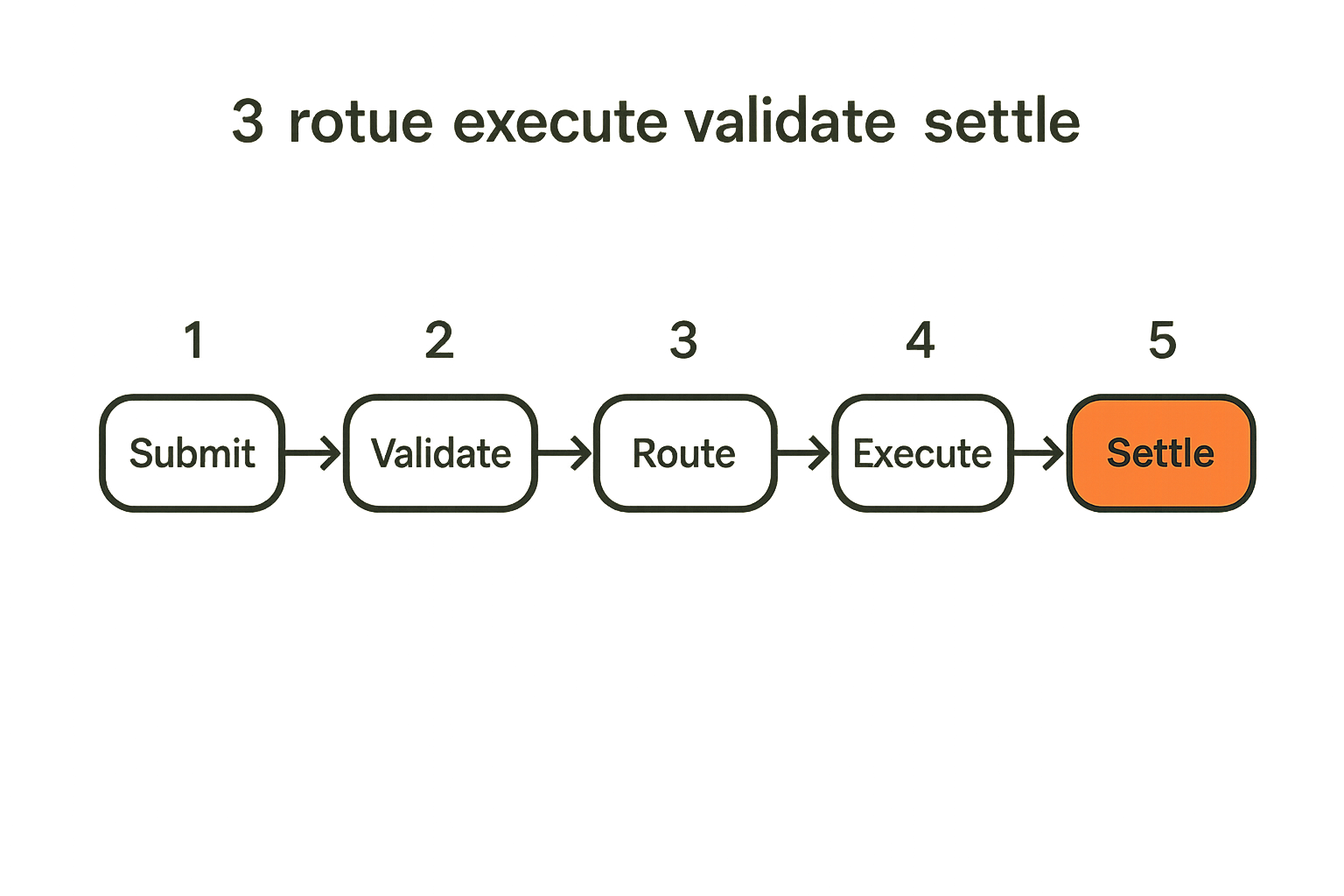
Step 3 route execute validate settle
A practical implementation sequence looks like this:
- Submit the job spec through CLI or API.
- Validate schema, permissions, funds, and input availability.
- Route to eligible workers based on capability, reputation, cost, and location.
- Execute with isolated runtime, bounded resources, and streamed logs.
- Validate output using deterministic checks where possible.
- Settle payment, update reputation, and persist audit metadata.
- Return artifacts and final state to the requester.
This is the workflow that makes IaaS usable beyond rented machines. Each step should have explicit state. Each state should be observable from the CLI. Each transition should be safe to retry.
For c0mpute builders, the CLI reference and cookbook is the natural place to map these concepts to install, identity, workers, transcode jobs, AI inference, plugins, and health checks.
Step 4 observe and tune
Observability is not only CPU graphs. For job-routed infrastructure, you need workflow metrics:
- Queue time
- Route time
- Worker acceptance rate
- Start latency
- Runtime
- Validation failure rate
- Retry count
- Settlement time
- Artifact retrieval time
- Cost per successful job
The goal is not to create a wall of dashboards. The goal is to see which part of the contract is breaking. If queue time is high, you have supply or routing pressure. If validation fails, you have worker quality or spec ambiguity. If settlement lags, you have payment-state design problems.
Failure modes when teams implement IaaS badly
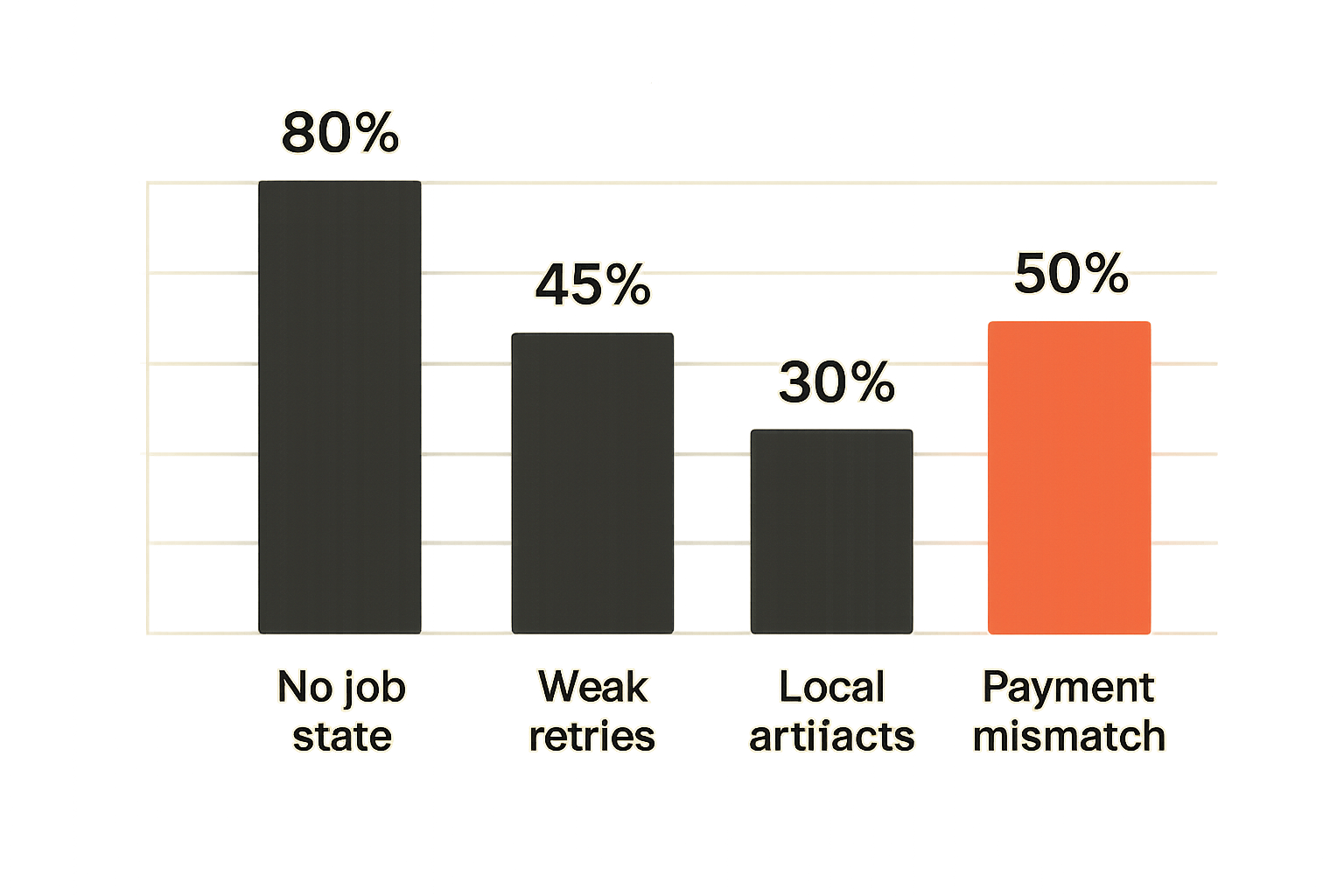
They treat instances as architecture
The most common failure is mistaking rented compute for system design. A team provisions a large VM, runs everything there, and calls it cloud-native. Then costs rise, jobs block each other, failures are hard to isolate, and no one knows which output belongs to which execution context.
In decentralized compute, this failure becomes obvious faster. If a job cannot be described, routed, retried, and validated, it is not ready for a marketplace. It is just a script that happened to work once.
What fails:
- SSH-driven operations with no job state
- Manual worker selection for routine jobs
- Outputs stored only on local disks
- Logs that disappear with the instance
- Payment records disconnected from execution records
What works:
- Declarative job specs
- Artifact-first output design
- Explicit state machines
- Worker capability matching
- Validation before settlement
They ignore retries and idempotency
Distributed systems fail in boring ways. Network calls timeout. Workers crash. Inputs move. Containers pull slowly. GPUs run out of memory. Payment callbacks arrive twice. Users resubmit jobs because the first response looked stuck.
If retry behavior is not designed, the system will either lose work or duplicate work. Both are expensive.
Idempotency should exist at the job boundary. A requester should be able to submit a job with a stable key. The platform should know whether that job is new, running, completed, failed, or safe to retry. Workers should not receive duplicate settlement for the same accepted unit of work unless the contract explicitly allows partial execution.
Practical rule: Every job submission, validation callback, artifact upload, and settlement event should be safe to replay.
They centralize trust without noticing
Some teams claim to be decentralized while quietly depending on one hidden database, one admin wallet, one scheduler, one artifact bucket, or one manual approval path. Sometimes that is acceptable during early development. The problem is pretending it is not there.
Centralized components are not automatically bad. Undocumented centralized trust is bad.
If your scheduler can censor jobs, document it. If your operator can reverse settlement, document it. If your artifact store is a single point of failure, design around it or accept the risk. Builders can work with honest constraints. They cannot build reliably on vague promises.
Related reading from our network: local networks face a similar coordination problem where trust, intake, routing, and follow-up must be explicit, as described in this operating model for community first local networks.
What works for CLI-first builders
Use job specs instead of dashboards
Dashboards are useful for inspection. They are weak as the primary operating interface. CLI-first builders want repeatability, version control, automation, and pipes.
A good IaaS workflow lets a developer run commands like:
compute jobs submit transcode.yaml
compute jobs watch job_123
compute jobs logs job_123
compute jobs artifacts pull job_123 ./out
compute jobs retry job_123 --from failed_step
The exact command names matter less than the model. The CLI should expose the state machine. It should not hide important transitions behind a browser-only flow.
Keep artifacts and logs portable
Portability is where many cloud architectures quietly fail. The job runs, but the output lives in a provider-specific bucket, logs require a proprietary viewer, and metadata cannot be exported without glue code.
For AI and video work, portable artifacts are non-negotiable. Store outputs with content addressing or stable URIs where possible. Attach checksums. Keep logs structured enough for machines and readable enough for humans. Include tool versions, model identifiers, codec parameters, and worker metadata.
A useful artifact bundle might contain:
- Output files
- Manifest
- Checksums
- Runtime logs
- Validation report
- Cost and settlement record
- Worker capability summary
This makes debugging possible after the worker is gone.
Automate health checks before scale
Health checks should not start after you have many workers. They should start before you trust one worker.
For compute marketplaces, health checks need to cover more than process liveness. They should test capability truth. Can the worker run the advertised FFmpeg build. Does it have the claimed GPU. Can it load the requested model. Can it fetch inputs. Can it return artifacts. Does it report state transitions correctly.
The public network status page is useful for high-level visibility, but serious builders should also run their own job-level checks for the specific workflows they depend on.
Security privacy and operational context
Define the trust boundary
Security in IaaS is often discussed as a checklist of controls. Firewalls, IAM, encryption, secrets, scans. Those matter, but the first question is simpler: who can see or change what.
For decentralized compute, define the trust boundary per workload:
- Who can submit the job.
- Who can inspect inputs.
- Who can execute the workload.
- Who can view logs.
- Who can validate outputs.
- Who can release payment.
- Who can resolve disputes.
If the input is public video, the boundary is different from private customer data. If the prompt contains sensitive business logic, the boundary is different from a public benchmark. Do not use one policy for every job because the word compute appears in all of them.
Protect data in motion and at rest
Data movement is often the real architecture. A cheap worker is not cheap if the input transfer dominates runtime. A fast GPU is not useful if model weights are pulled cold for every job. A private workload is not private if logs leak payloads.
Practical controls include:
- Signed input URLs with short lifetimes
- Encrypted artifact storage
- Payload redaction in logs
- Runtime isolation between jobs
- Secret injection with scoped permissions
- Output validation that avoids exposing unnecessary data
- Deletion rules for temporary files
For some workloads, the right answer is not to send the data to external workers. Use decentralized compute where the trust boundary fits, not because the architecture diagram looks modern.
Audit decisions not just machines
Traditional infrastructure audit trails often emphasize machine events: instance created, disk attached, firewall changed. In job-routed IaaS, audit trails must also capture decisions.
Why did this worker receive this job. Which constraints were evaluated. What price was quoted. Which validation rule passed. Why was payment released. Which retry policy ran. Which user or DID authorized the action.
This kind of audit trail is operationally useful. It helps debug cost spikes, worker disputes, failed outputs, and user complaints. It also makes the marketplace more legible to builders who need predictable behavior.
Where c0mpute.com fits
A marketplace shaped around jobs
c0mpute.com is built around a practical idea: many compute workloads should be expressed as jobs, routed to capable workers, validated, and paid for through clear state transitions. The focus is not another dashboard for renting generic machines. The useful abstraction is a CLI-first decentralized compute network for real workloads like FFmpeg transcoding, AI inference, and DID-based payments.
That means the product fit is architectural. If your workload can be packaged as a job with inputs, constraints, outputs, and validation, it is a candidate for marketplace execution. If your workload requires a tightly coupled stateful cluster with private data and sub-millisecond coordination, keep that in a conventional environment and use marketplace compute around it.
When to use it
Use decentralized compute when you want to:
- Burst beyond owned capacity for transcodes or inference runs
- Route jobs to specialized workers
- Experiment with worker marketplaces without rebuilding payment rails
- Keep execution workflows CLI-friendly
- Connect identity, job state, and settlement
- Validate outputs before releasing payment
Do not use it as a vague replacement for all cloud infrastructure. Use it where the job boundary is clean. That is where decentralized IaaS becomes practical instead of performative.
You can explore the network entry point at c0mpute.com, then move into docs and job workflows when you are ready to test real workloads.
Closing: iaas in cloud computing as a compute routing decision
The short version
IaaS in cloud computing used to be mostly about renting servers. That model still matters, but it is incomplete for builders working with AI inference, FFmpeg transcoding, and decentralized execution.
The practical question is not whether centralized cloud or decentralized compute wins. The practical question is which workloads need stable provider-managed infrastructure, which can be expressed as portable jobs, and how the system handles routing, validation, payment, and failure.
The teams that get this right will not start with instance types. They will start with workload contracts. They will make state explicit. They will separate control plane from data plane. They will design retries before failures happen. They will treat payments and identity as infrastructure, not afterthoughts.
That is the useful way to think about iaas in cloud computing in 2026: not as a definition, but as a workflow for turning compute demand into verified execution.
Try c0mpute.com
c0mpute.com is for technical builders interested in decentralized compute, AI inference, FFmpeg transcoding, and DID-based payments. Try c0mpute.com