The coinbase cryptocurrency exchange is often treated as the simple part of a crypto-enabled product. Add an account, buy assets, send funds, and the marketplace can start paying workers. That looks clean in a slide deck.
Then production starts. A GPU worker finishes an inference job. A video transcode fails halfway through a segment ladder. A buyer disputes output quality. A webhook arrives late. A user sends the right asset on the wrong network. Suddenly the exchange account is not the payment system. It is only one boundary in a larger workflow.
Teams think the problem is choosing a crypto exchange. The real problem is designing settlement, custody, identity, job state, retries, and support paths so the exchange can be used safely without becoming the control plane.
That changes the conversation. For decentralized compute builders, Coinbase is not just a place to acquire cryptocurrency. It is a fiat-to-crypto bridge, a custody surface, a liquidity source, and sometimes an operational dependency. The practical question is where it belongs in the architecture, and where it absolutely does not.
Table of contents
- Coinbase cryptocurrency exchange is not just an on-ramp
- Where the Coinbase cryptocurrency exchange fits in a compute marketplace
- Custody, identity, and DID payments are separate decisions
- Designing the payment state machine
- Reference architecture for decentralized compute settlement
- Pricing compute when crypto assets move
- Failure modes that break real systems
- What works, what fails, and why
- Implementation notes for CLI-first builders
- How c0mpute.com thinks about this layer
Coinbase cryptocurrency exchange is not just an on-ramp
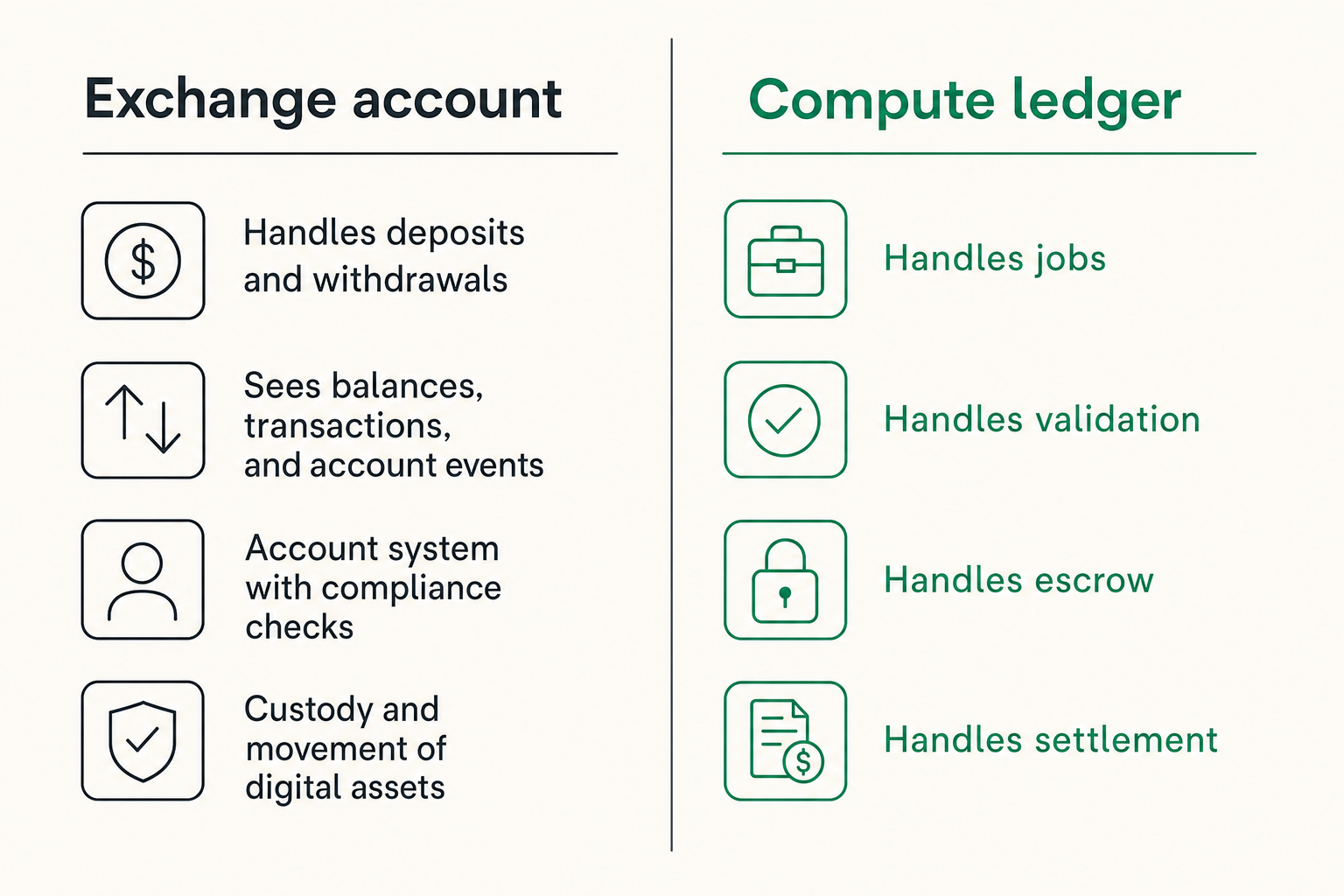
The exchange solves access, not marketplace accounting
A centralized crypto exchange is good at a narrow job: helping users buy, sell, custody, and move digital assets through an account system. That is useful. Many builders underestimate how useful it is because they want everything to be purely decentralized from day one.
But the exchange does not know your compute job model. It does not know whether an FFmpeg output was valid, whether a model response met latency requirements, whether a worker cheated, or whether an inference prompt violated your policy. It only sees balances, transactions, withdrawals, deposits, and account events.
The mistake teams make is using an exchange account as if it were the marketplace ledger. It is not. Your marketplace ledger needs to know who requested work, who accepted it, what was promised, what was delivered, what was validated, what was paid, and what can still be disputed.
Practical rule: Treat the exchange as an external financial rail, not as the source of truth for compute state.
The architecture boundary matters more than the brand
The Coinbase cryptocurrency exchange has strong name recognition, but the architectural question is not whether the brand is familiar. The question is what boundary you are crossing.
On one side, you have exchange-controlled accounts, compliance checks, supported assets, network availability, withdrawal rules, and API constraints. On the other side, you have your own protocol, worker registry, DID identity, job queues, validation logic, and settlement policy.
A useful way to think about it is this: the exchange can help users enter and exit crypto rails. It should not decide when a compute job is complete.
What changes for compute workloads
Compute marketplaces are not simple carts. A buyer is not purchasing a static SKU. They are buying execution under constraints: GPU type, model, token limit, codec, resolution, segment duration, latency target, output format, validation method, and timeout.
That means payment has to follow workflow state. For example:
- A buyer funds a job before execution.
- A worker reserves the job and commits capacity.
- The network validates the output.
- Settlement releases funds or refunds the buyer.
- Failed or partial work is handled by policy.
The exchange may have helped the buyer acquire funds. It may help the worker off-ramp later. But between those events, your compute marketplace needs its own state machine.
Where the Coinbase cryptocurrency exchange fits in a compute marketplace
Buyer funding
For buyers, the Coinbase cryptocurrency exchange can be part of the funding path. A developer may hold USDC, ETH, BTC, or another supported asset in an exchange account and move funds to a wallet or payment address used by the marketplace.
That does not remove the need for deposit detection. Your system still needs to understand asset, network, amount, confirmations, memo or tag requirements where applicable, and reconciliation against an invoice or job intent.
The practical question is not whether the user can buy crypto. It is whether your platform can map the eventual on-chain payment to the right job without manual support.
Worker payouts
Workers care about predictable settlement. If a GPU operator runs a batch of inference jobs or a transcode node processes hundreds of segments, they need a payout trail they can reconcile.
Some workers may prefer funds sent to a self-custody wallet. Others may want to move funds to an exchange account later. That off-ramp preference should not leak into job execution. Your network should settle according to worker identity and payout configuration, then let the worker decide what to do next.
This is especially important when workers run infrastructure as a business. They need payout IDs, job IDs, fee breakdowns, and timestamps. A generic exchange withdrawal history is not enough.
Treasury and rebalancing
Marketplace operators may use an exchange for treasury functions: acquiring assets, converting revenue, rebalancing operational balances, or handling fiat expenses. That can be reasonable.
What breaks in practice is when treasury operations are mixed with user liabilities. If buyer escrow, worker payouts, protocol fees, and company treasury all live in the same operational bucket, support becomes painful and risk increases.
A better pattern is to separate:
| Balance type | Purpose | Should it touch exchange accounts? | Operator risk |
|---|---|---|---|
| Buyer escrow | Funds reserved for open jobs | Only through controlled funding or rebalancing | High if commingled |
| Worker payable | Earned but unpaid rewards | Possibly for batch payout liquidity | High if delayed |
| Protocol fees | Marketplace revenue | Yes, after settlement finality | Medium |
| Treasury | Company operations | Yes, with policy controls | Medium |
| Test funds | Development and staging | No production dependency | Low |
Practical rule: Keep user liabilities, worker payables, and company treasury in separate accounting domains even if they use the same asset.
Custody, identity, and DID payments are separate decisions
Custody is not the same as authorization
Custody answers who controls funds. Authorization answers who is allowed to trigger a payment action. These are related, but they are not the same.
A centralized exchange account is custodial. A smart contract escrow is programmatic custody. A self-custody wallet puts key control with the user. A managed wallet splits responsibility across provider and application logic. Each model creates different support, security, and compliance tradeoffs.
For compute builders, the dangerous shortcut is assuming custody choice also solves identity. It does not. A wallet address can receive funds, but it does not explain which worker binary produced an output, which DID accepted the job, or which key is authorized to rotate payout addresses.
DID identity helps with compute trust
DID-based identity is useful because compute networks need more than payment addresses. They need durable identifiers for workers, buyers, validators, and possibly model providers. Those identifiers can bind to keys, attestations, reputation records, supported capabilities, and payout preferences.
The payment layer should ask: is this DID authorized to receive funds for this completed job? It should not ask: does this random address look familiar?
That changes the conversation from address-based payment to identity-based settlement. The worker can rotate payout credentials without losing reputation. The buyer can sign job intents. Validators can attach output proofs. The ledger can remain readable.
Account recovery is part of the protocol
Recovery is where many web3 systems become hostile to normal operators. A video infrastructure engineer running transcode workers may rotate hosts, rebuild images, replace GPUs, or migrate regions. An AI infrastructure builder may run ephemeral inference workers that should not hold long-lived payout keys.
Design for recovery upfront:
- Separate operator identity from hot worker keys.
- Allow payout address rotation with delay or multisig approval.
- Keep signed job receipts independent from exchange transaction IDs.
- Log identity changes as first-class events.
- Make disabled or compromised workers unable to claim new jobs.
If account recovery depends on opening a support ticket and manually editing a database row, it is not a protocol. It is an incident waiting to happen.
Designing the payment state machine
Keep exchange state outside job state
Job state and payment state need to be connected, but not collapsed.
A job can be queued, assigned, running, submitted, validating, accepted, failed, or expired. A payment can be invoice_created, awaiting_funds, funded, locked, release_pending, released, refund_pending, or refunded.
Those states move at different speeds. A blockchain confirmation may arrive after a job timeout. A worker may submit output before final settlement. An exchange withdrawal may be delayed while the marketplace has already marked worker earnings internally.
The mistake teams make is creating one giant status field called paid or complete. That field becomes impossible to reason about.
Use idempotency everywhere money moves
Payment systems fail in boring ways. Requests time out. Workers retry. Webhooks duplicate. Operators rerun scripts. Queue consumers crash after writing one record but before acknowledging the message.
Idempotency is how you avoid turning ordinary failures into double payments.
Every money-moving intent should have a stable key:
deposit_intent_idfor buyer fundingjob_lock_idfor escrow reservationsettlement_idfor worker releaserefund_idfor buyer refundpayout_batch_idfor grouped withdrawals
The key should be generated by your system, stored before external calls, and reused on retry. If the external system does not support idempotency in the exact way you want, you still need internal deduplication.
Practical rule: No retry path should be able to create a second economic event unless a human explicitly approves it.
Treat webhooks as hints, not truth
Webhooks are useful. They are not a database.
If an exchange, wallet service, indexer, or payment provider sends a callback, record it as an event. Then reconcile it against your own expected state. Do not let a callback blindly advance a compute job to paid or released.
A safer pattern is:
- Receive callback.
- Store raw payload and metadata.
- Verify signature or source where supported.
- Map it to an internal intent.
- Query the authoritative source if needed.
- Apply a state transition only if allowed.
- Emit an internal event for workers, buyers, or support tools.
Related reading from our network: teams building publishing automation face a similar problem with callbacks, approvals, and review gates in blog content automation workflow architecture.
Reference architecture for decentralized compute settlement
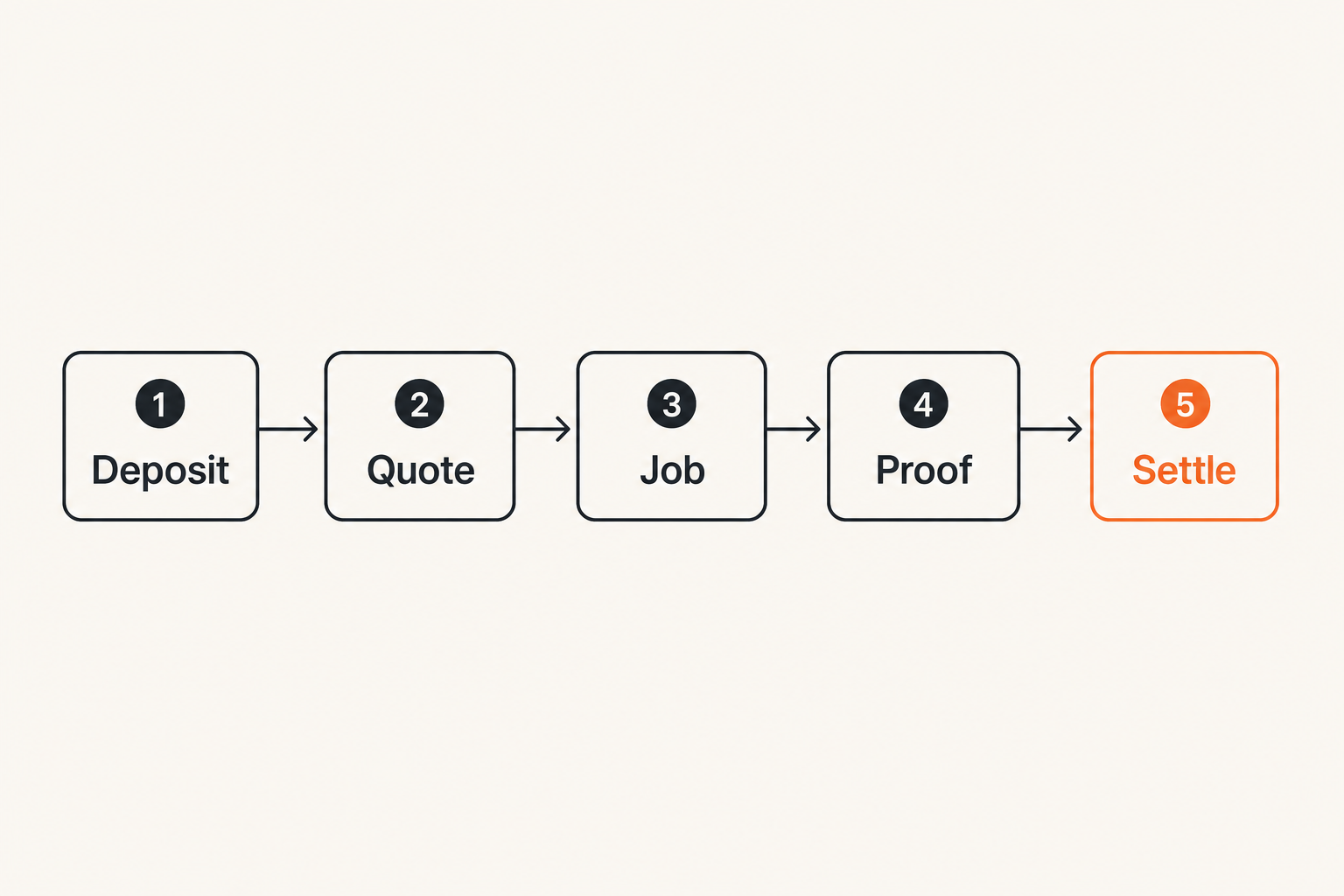
Core components
A practical decentralized compute settlement architecture usually needs these components:
- Job API: accepts compute requests, pricing inputs, and buyer identity.
- Quote service: calculates price, expiry, asset, network, and fee assumptions.
- Payment intent service: creates deposit or escrow instructions.
- Ledger: records internal balances, liabilities, locks, releases, refunds, and fees.
- Worker registry: maps DID identities to capabilities and payout settings.
- Validation service: verifies output before settlement.
- Settlement engine: decides when funds move from reserved to earned or refunded.
- Reconciliation worker: compares external transactions to internal ledger expectations.
- Operator console or CLI: gives humans enough context to debug without guessing.
This is not overengineering. It is the minimum surface area required when compute and money move asynchronously.
The older architecture lessons are surprisingly relevant here: queues, terminals, batch jobs, and explicit accounting were normal constraints long before web3. The c0mpute post on computing in the 1970s and decentralized compute lessons is useful context if you are designing worker queues and settlement as one operational system instead of separate products.
A practical settlement workflow
Here is a workable sequence for a CLI-first compute network:
- Buyer requests quote. The CLI sends workload metadata such as model, token cap, codec, resolution, duration, timeout, and validation mode.
- Marketplace creates payment intent. The response includes asset, network, amount, expiry, and a job funding reference.
- Buyer funds intent. Funds arrive from a wallet, exchange withdrawal, or existing internal balance.
- Reconciliation marks funded. The ledger records funds as buyer liability and locks them to the job.
- Worker accepts job. A DID-bound worker claims the job and signs acceptance.
- Worker submits output. Output includes artifact URI, checksum, logs, and runtime metadata.
- Validation runs. The network checks expected output, thresholds, or sample-based verification.
- Settlement engine releases or refunds. The ledger moves locked funds to worker payable, refund payable, and protocol fee accounts.
- Payout executes. Worker payable is sent according to payout policy or kept as withdrawable balance.
- Support trail closes. The system links job, quote, funding, validation, settlement, and payout events.
Notice that the exchange can appear at step 3 or later during off-ramp. It does not own the workflow.
What to log for support
Support logs are not just for customer support. They are for operators debugging economic correctness.
Log these fields as first-class data:
- Job ID, quote ID, payment intent ID, settlement ID
- Buyer DID, worker DID, validator identity
- Asset, network, amount, fee assumption, quote expiry
- Deposit transaction reference and confirmation state
- Output checksum, artifact URI, validation result
- Ledger entries before and after settlement
- Payout destination, batch ID, transaction reference
- Retry count and idempotency key
What fails is logging only external transaction hashes. A transaction hash can prove movement occurred. It cannot explain why the movement was allowed.
Pricing compute when crypto assets move
Quote in a stable unit
Compute costs are usually tied to infrastructure inputs: GPU time, CPU time, bandwidth, storage, model size, token count, or video duration. Crypto assets introduce volatility unless you manage the quote layer carefully.
For most marketplaces, quoting in a stable unit is simpler. That may mean denominating internally in USD cents, credits, or a stablecoin amount, then allowing settlement through supported crypto rails. The quote service should record the conversion assumptions used at quote time.
The practical question is not whether crypto prices move. They do. The question is who carries that risk and for how long.
Separate quote expiry from job expiry
A quote expiry protects price assumptions. A job expiry protects capacity and execution commitments. They should not be the same field.
A buyer might receive a quote valid for ten minutes, fund it in five, then submit a job that must be accepted by a worker within thirty seconds. Or a funded batch may contain multiple segment jobs executed over several minutes.
If quote expiry and job expiry are collapsed, you will create confusing edge cases:
- Funds arrive after quote expiry but before job assignment.
- A worker starts a job after payment expires.
- A buyer funds a batch where some jobs remain queued.
- A refund is triggered while validation is still running.
Use separate clocks. Make transitions explicit.
Handle dust, fees, and partial fills
Crypto payment bugs often come from small amounts. Network fees, minimum withdrawals, exchange limits, rounding, and dust balances can break otherwise clean flows.
Build policy for:
- Underpayment tolerance
- Overpayment handling
- Refund minimums
- Fee payer rules
- Partial funding windows
- Asset precision and rounding
- Unsupported network recovery
For video workloads, the pricing issue becomes even sharper. A long transcode may be split into segments, renditions, thumbnails, and validation tasks. Related reading from our network: streaming SaaS architecture workflow covers why video delivery is not just a play button; the same lesson applies to compute payment state.
Failure modes that break real systems
Wrong network deposits
A user sees an asset ticker and assumes every network is equivalent. It is not. USDC on one network is not automatically the same operational event as USDC on another network. Some deposits may be recoverable, some may be delayed, and some may be unsupported.
Your UI and CLI should never show an asset without the network. Your invoice should bind asset and network together. Your support tools should show exactly what was expected and what arrived.
A CLI response should look more like this:
payment_intent: pi_8fj2
asset: USDC
network: base
amount: 12.840000
expires_at: 2026-08-05T18:30:00Z
reference: job_91bc
status: awaiting_funds
Not this:
Send 12.84 USDC to this address.
The second version creates support tickets.
Late confirmations and duplicate callbacks
Late confirmations are normal. Duplicate callbacks are normal. Reorgs, indexer lag, delayed withdrawals, and operator retries are normal enough that your system should expect them.
What breaks in practice is optimistic state transition without reconciliation. A callback says deposit received, so the job starts. Later the amount is short, the network is wrong, or the transaction is not final under your confirmation policy.
The fix is not to avoid automation. The fix is to automate against a state machine that can reject invalid transitions.
Payout batching without observability
Batching payouts can reduce operational overhead. It can also hide failure.
If a worker asks why they were paid less than expected, the answer cannot be a batch hash and a shrug. You need line-item traceability from each completed job to each ledger entry to each payout batch.
This is where marketplace dependency becomes dangerous. If all economic context lives inside a third-party dashboard, your operators cannot debug your own network. Related reading from our network: freelancers face a softer version of the same platform-dependency problem in Fiverr alternatives for sellers in 2026.
What works, what fails, and why
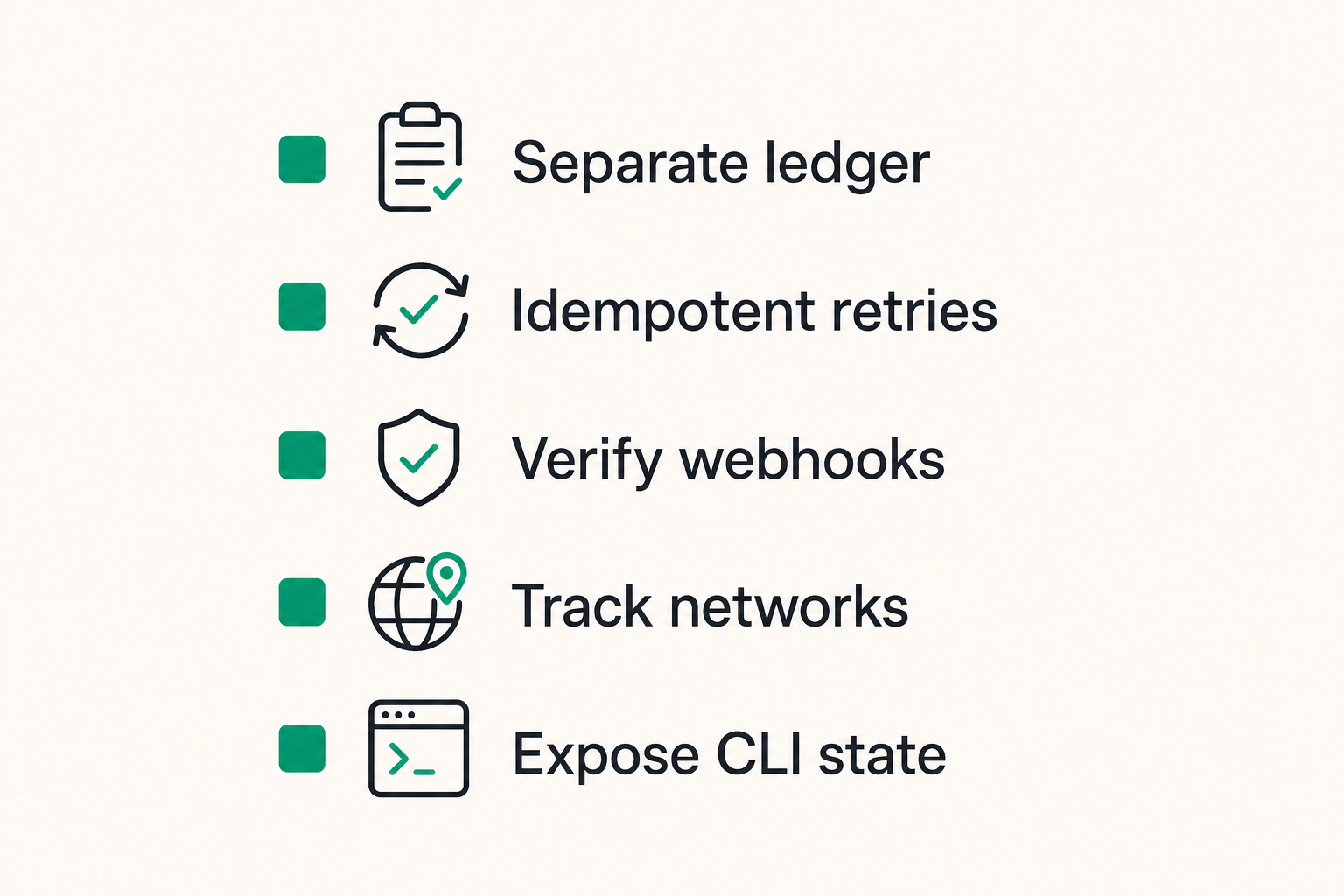
What works
The systems that hold up in production usually share the same boring traits:
- They separate exchange events from internal ledger entries.
- They model payment intent before funds arrive.
- They require idempotency keys for retries.
- They bind asset, network, amount, and expiry to each quote.
- They map worker payouts to DID identities, not loose addresses.
- They reconcile external transaction state before settlement.
- They expose enough CLI output for operators to debug.
None of this is flashy. That is the point. Economic correctness should be boring.
What fails
The systems that break usually fail in predictable ways:
- They treat a deposit as equivalent to job completion.
- They put all balances in one wallet or exchange account.
- They use transaction hashes as the only accounting record.
- They retry withdrawals without idempotency.
- They let webhooks mutate critical state without validation.
- They hide payment state behind a vague
processinglabel. - They ignore partial work and failed validation paths.
The mistake teams make is optimizing for the first successful payment demo. The real work starts after the first failure, refund, duplicate callback, wrong network deposit, or disputed output.
The operator test
Here is the operator test I like: pick any completed job and ask whether an engineer can answer these questions in under two minutes.
- Who requested the job?
- What price was quoted and why?
- What funds were locked?
- Which worker performed the job?
- What proof or validation accepted the output?
- What amount was released?
- What fees were taken?
- Where did the payout go?
- What would happen if the payout retry ran again?
If the answer requires checking five dashboards and guessing, the architecture is not ready.
Practical rule: If support cannot reconstruct the economic story of a job, the payment architecture is incomplete.
Implementation notes for CLI-first builders
Expose payment state in the CLI
CLI-first developers do not need a glossy checkout. They need precise state.
A useful command set might look like:
compute quote infer --model llama --tokens 20000
compute pay status pi_8fj2
compute job status job_91bc --events
compute ledger entries --job job_91bc
compute payout status po_44a1
The output should be structured enough for scripts and readable enough for humans. Include IDs. Include timestamps. Include next actions. Avoid hiding critical state behind a spinner.
A good pay status response should tell the user whether the system is waiting for funds, waiting for confirmations, funded, expired, refunded, or locked to a job. If the user sent the wrong asset or network, say that directly.
Make retries explicit
Retries should not be magic. They should be visible and safe.
For example:
compute payout retry po_44a1 --idempotency-key retry-20260805-a
Behind that command, the settlement service should check whether the payout is retryable, whether it was already completed, whether the destination still matches policy, and whether the idempotency key has been used before.
This is slower to implement than a naive script. It is much cheaper than explaining a double payout.
Design for video and AI edge cases
AI inference and FFmpeg transcoding produce different settlement problems.
For inference, disputes may involve latency, token counts, model identity, prompt handling, output policy, and nondeterminism. You may need signed runtime metadata, rate limits, and validation sampling rather than exact replay.
For transcoding, disputes may involve codec parameters, segment completion, corrupted outputs, bitrate ladders, thumbnails, and storage availability. You may need artifact checksums, probe output, and segment-level settlement.
A single job complete flag is too weak for both. Model the artifact and validation path explicitly.
How c0mpute.com thinks about this layer
The product fit
c0mpute.com is built for technical builders interested in decentralized compute, AI inference, FFmpeg transcoding, and DID-based payments. That means the payment layer is not treated as a checkout widget. It is part of the compute workflow.
The plugin model matters here. Transcode, coinpay, and infernet style modules should share operational primitives: job IDs, identities, events, validation outputs, and settlement records. Builders can explore that modular approach through the c0mpute plugin ecosystem, where payments are treated as infrastructure beside inference and FFmpeg work rather than as an afterthought.
This is not an argument against using a major exchange. It is an argument against letting any exchange become the architecture.
A sane adoption path
If you are building a decentralized compute marketplace in 2026, start with the workflow before the rail:
- Define job states and validation rules.
- Define payment states and ledger entries.
- Bind quotes to asset, network, amount, and expiry.
- Add deposit detection and reconciliation.
- Add escrow or locked balance behavior.
- Add worker DID mapping and payout configuration.
- Add retries with idempotency.
- Add support views and CLI inspection.
- Only then optimize exchange on-ramp and off-ramp paths.
That ordering keeps the Coinbase cryptocurrency exchange in the right place: useful for access and liquidity, not responsible for proving work or deciding settlement.
Closing view on Coinbase cryptocurrency exchange integration
The Coinbase cryptocurrency exchange can be a practical bridge for users who need to acquire assets, manage custody, or move funds into crypto payment rails. For decentralized compute, that is helpful but insufficient.
The real system is the ledger, the state machine, the DID identity layer, the validation workflow, the retry policy, and the operator tooling around it. Get those wrong and the exchange integration will only make failures more expensive. Get them right and the exchange becomes one replaceable rail in a stronger architecture.
Try c0mpute.com
c0mpute.com is for technical builders working on decentralized compute, AI inference, FFmpeg transcoding, and DID-based payments. Try c0mpute.com.