Most teams do not hit infrastructure pain on day one. They hit it when the queue grows, jobs become heterogeneous, GPU costs stop being predictable, and support tickets start with some version of: the job says complete, but the output is wrong.
That is where iaas in cloud computing stops being a procurement category and becomes an architecture problem. You are not just renting CPU, GPU, bandwidth, and storage. You are deciding who controls scheduling, who proves work happened, how failures are retried, and how money moves when compute is delivered by someone else's machine.
Teams think the problem is getting more servers. The real problem is building a compute workflow that can survive unreliable nodes, variable job sizes, payment boundaries, and operational debugging.
That changes the conversation. The practical question is not whether IaaS is public cloud, private cloud, bare metal, or decentralized compute. The practical question is whether your IaaS layer gives builders a clean path from intent to execution to verified result.
Table of contents
- IaaS in cloud computing is a control-plane decision
- The real workload profile in 2026
- Cloud IaaS versus decentralized IaaS
- The minimum architecture for usable IaaS in cloud computing
- A CLI-first workflow for decentralized compute
- Payments, identity, and trust boundaries
- Observability and failure handling
- What works and what fails in production
- Where c0mpute.com fits
IaaS in cloud computing is a control-plane decision
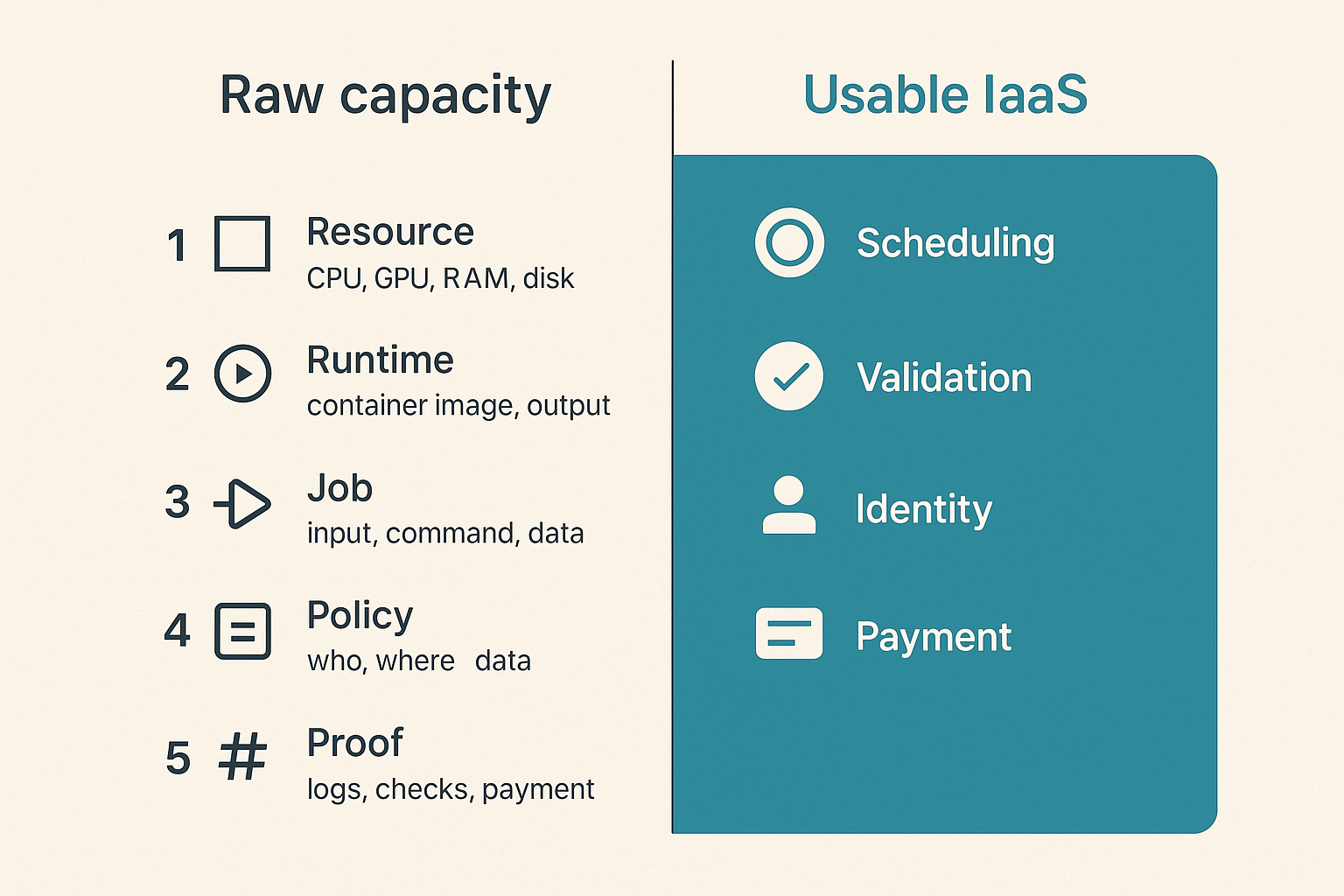
The mistake teams make is treating IaaS like a cheaper server catalog. They compare vCPU, memory, GPU type, disk, bandwidth, and hourly price. Those matter, but they are not enough.
IaaS in cloud computing is the layer where raw infrastructure becomes programmable capacity. In a clean design, users should express what they want done, the platform should place that work, workers should execute it, and the system should return a verifiable result.
The compute resource is only one part
Compute is not just a VM, container, GPU, or bare-metal box. A useful way to think about it is this:
- Resource: CPU, GPU, RAM, disk, network, accelerator type.
- Runtime: container image, FFmpeg build, CUDA version, model runtime, driver compatibility.
- Job: input, command, parameters, expected output, deadline, cost constraints.
- Policy: who can run it, where it can run, what data can move, how retries work.
- Proof: logs, hashes, metrics, output checks, reputation, payment status.
When one of these is missing, operators improvise. Improvisation becomes support load.
The control plane is where teams win or lose
The control plane decides placement, state transitions, quotas, credentials, health, retries, and settlement triggers. If it is weak, the system looks fine in demos and breaks under real workloads.
For example, an AI inference request may need a specific GPU memory profile. An FFmpeg transcode may be CPU-bound for one codec and hardware-accelerated for another. A web3 job may require identity-bound payment before output release. The control plane is where those constraints become executable rules.
Practical rule: do not evaluate IaaS only by available hardware. Evaluate the control plane that turns hardware into reliable work.
Why decentralized compute makes the distinction sharper
In a centralized cloud, the provider owns most of the trust boundary. In decentralized compute, capacity may come from many independent workers. That can improve market flexibility, but it also exposes weak assumptions.
What breaks in practice is not usually the idea of distributed compute. What breaks is missing state: no deterministic job contract, no worker reputation, no output validation, no payment lifecycle, no clean way to debug partial failure.
Related reading from our network: teams building agent and protocol systems face similar contract-design issues, especially around schemas and conventions, in Synonyms of Standards in AI Agent Systems.
The real workload profile in 2026
Cloud IaaS discussions often assume long-running services. Many builders in 2026 are not only deploying web servers. They are running bursts of inference, batch media processing, data preparation, test networks, render jobs, and one-off pipelines.
That changes the architecture. The IaaS layer needs to handle jobs as first-class objects, not just machines as first-class objects.
AI inference is bursty and hardware-sensitive
AI infrastructure builders care about latency, throughput, model loading time, GPU memory, tokenizer overhead, batching, and cold starts. A cheap GPU node is not cheap if it spends too much time loading models or returns inconsistent performance.
For inference, the scheduler needs to understand:
- Model size and quantization.
- Runtime requirements.
- GPU memory and driver compatibility.
- Expected token rate or batch size.
- Warm versus cold execution.
- Timeout and fallback policy.
The practical question is not can this node run inference. It is can this node run this model, with this latency expectation, under this cost ceiling, and provide enough evidence to settle payment.
Video transcoding is pipeline-heavy
Video infrastructure engineers know that transcoding is not one command. It is a pipeline: ingest, probe, normalize, transcode, segment, package, upload, validate, and index.
A simple FFmpeg example hides many decisions:
ffmpeg -i input.mov -c:v libx264 -preset fast -b:v 4500k -c:a aac output.mp4
In production, you also care about codec support, hardware acceleration, target ladder, segment duration, output hash, storage location, and whether the worker can access input without leaking credentials.
Related reading from our network: video and home-media operators run into adjacent pipeline and troubleshooting tradeoffs in Information Technology for Cord Cutters.
Web3 workloads add identity and payment state
Web3 developers often treat compute as a sidecar to on-chain logic. That is risky. Off-chain compute still needs identity, payment, dispute handling, and auditability.
If a worker claims it completed a job, what does that mean? Did it produce the expected file? Did it run the correct model? Did it use the agreed parameters? Did it return the output before or after payment settlement?
In decentralized IaaS, identity and money are not add-ons. They are part of the execution workflow.
Cloud IaaS versus decentralized IaaS
The debate is usually framed badly. Traditional cloud IaaS versus decentralized IaaS is not a moral choice. It is an operating model choice.
Centralized cloud gives you mature primitives. Decentralized compute gives you a market of independent capacity and different trust assumptions. Most serious teams should understand both.
What the traditional model gives you
Traditional cloud IaaS is strong when you need predictable APIs, mature networking, managed identity, regional capacity, compliance workflows, and familiar billing. You can provision VMs, disks, load balancers, firewalls, and observability using known tools.
That model works well for stable services and teams that want one vendor to own most of the substrate.
The tradeoff is concentration. Pricing, capacity, account limits, GPU availability, and policy enforcement are usually controlled by the provider.
What the decentralized model changes
Decentralized IaaS changes the ownership model. Workers can be independent. Capacity can be discovered through a marketplace. Payments can be tied to job completion. Reputation and validation become more important because the platform cannot assume every worker is inside one trusted boundary.
This can be attractive for workloads that are:
- Batch-oriented.
- Verifiable after execution.
- Cost-sensitive.
- Regionally flexible.
- Able to tolerate retries.
- Easy to package as deterministic jobs.
It is less attractive for workloads that require strict low-latency networking, proprietary data residency controls, or tightly coupled stateful services.
Where hybrid patterns are usually safest
The pragmatic approach is hybrid. Keep sensitive state, control APIs, and customer-facing coordination in a stable environment. Push suitable compute jobs into decentralized capacity when they can be packaged, validated, retried, and settled cleanly.
That means decentralized compute is not replacing every cloud primitive. It is expanding the execution layer for specific workload classes.
Practical rule: use decentralized IaaS for jobs you can describe, isolate, verify, and retry. Do not push undefined operational risk into a marketplace and call it architecture.
The minimum architecture for usable IaaS in cloud computing
IaaS in cloud computing becomes useful when the system has enough structure to manage work, not just machines. For decentralized compute, the minimum architecture has three parts: job intent, worker execution, and verified settlement.
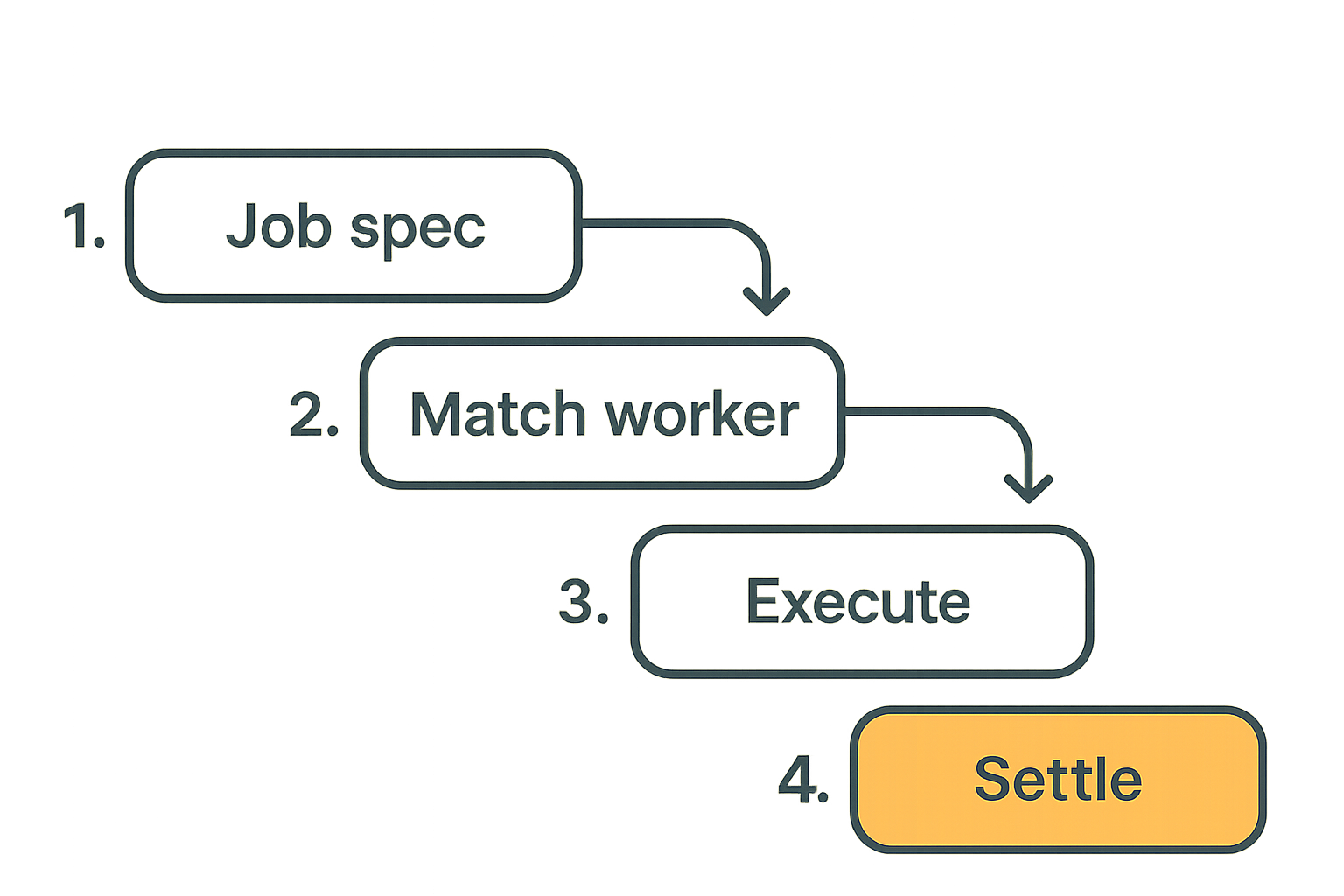
Job intent and scheduling
A job should be a contract, not a vague command. It should state what must run, what inputs are required, what outputs are expected, what resources are acceptable, and how failure is handled.
A minimal job spec might look like this:
kind: transcode-job
input: ipfs://bafy-input-video
runtime: ffmpeg-6
profile: h264-1080p
outputs:
  - format: mp4
  - format: hls
limits:
  max_cost: 12.00
  timeout_seconds: 3600
validation:
  require_output_hash: true
  require_probe_check: true
payment:
  settle_on: verified_output
This is not about YAML specifically. It is about making the job portable enough for a scheduler and worker to reason about without a human in the loop.
Worker execution and isolation
Workers need isolation boundaries. That can mean containers, sandboxed runtimes, restricted file access, network egress controls, and scoped credentials.
For AI inference, the worker may preload models and expose a local runtime. For FFmpeg, it may mount input, run the transformation, and write output to object storage or content-addressed storage. In both cases, the worker should not receive more authority than the job requires.
The mistake teams make is assuming worker honesty is enough. In a marketplace, honest workers still fail. Nodes run out of disk. GPUs reset. Drivers mismatch. Inputs time out. Isolation and health checks are not paranoia; they are operations.
Validation and settlement
Settlement should depend on verification. That does not mean every workload needs a cryptographic proof. Many practical systems start with output hashes, metadata probes, log signatures, duplicate execution for sampled jobs, and reputation-weighted acceptance.
For video, validation may check duration, codec, bitrate range, resolution, segment count, and output hash. For inference, validation may include response format, model identity, latency envelope, and spot checks.
If payment happens before verification, bad outputs become support tickets. If verification is too expensive, good workers wait too long to get paid. The architecture has to balance both.
A CLI-first workflow for decentralized compute
GUI dashboards are useful after the system works. They are not the system. CLI-first workflows force clarity because every step needs explicit inputs, outputs, and state.
For builders, a good CLI is also an API design test. If a command cannot be expressed cleanly, your backend model is probably confused.
Define the job as a contract
Start with a local job file. Make the intent explicit.
c0 job init transcode --input ./demo.mov --profile h264-1080p --out job.yaml
c0 job validate job.yaml
The validation step should catch missing inputs, unsupported profiles, impossible limits, and unsafe defaults before the job enters the network.
For teams evaluating implementation details, the c0mpute CLI docs are the natural place to look for install, identity, worker, transcode, inference, plugin, and health-check workflows.
Submit, watch, and retry deterministically
A practical workflow looks like this:
- Create a job spec with resource, runtime, cost, and validation constraints.
- Sign the job with a developer or service identity.
- Submit the job to a scheduler or marketplace.
- Match the job to eligible workers.
- Stream state changes and logs to the operator.
- Validate outputs when the worker reports completion.
- Settle payment or retry according to policy.
The key is determinism. A retry should not create a different business event unless the policy says it should. The job ID, input hash, payment reservation, and output expectations need to survive retries.
c0 job submit job.yaml
c0 job watch job_8xf2
c0 job artifacts job_8xf2 --verify
Keep humans out of the hot path
Humans should define policies, not babysit jobs. If every failed transcode or inference timeout requires a developer in Slack, the platform is not operationally ready.
A CLI-first system should support:
- Machine-readable errors.
- Idempotent resubmission.
- Exit codes suitable for CI.
- Structured logs.
- Artifact inspection.
- Clear payment state.
Related reading from our network: independent builders packaging technical services run into similar proof-of-work and delivery-system issues in How to Find Freelance Work With No Experience.
Payments, identity, and trust boundaries
Payments are where many decentralized compute designs get vague. They describe a token, but not a settlement workflow. That is not enough.
Compute has state. Payment has state. If those two state machines do not line up, users either overpay, workers get stuck, or disputes become manual.
Why compute payments are not simple checkout
A normal checkout flow sells a known item. Compute sells execution under uncertainty. The job may fail. The output may be wrong. The worker may disappear. The user may cancel. The input may be inaccessible. The cost may depend on runtime.
That means payment should usually include reservation, authorization, escrow or hold, verification, release, refund, and dispute paths.
A useful payment state machine might be:
- quoted
- reserved
- assigned
- running
- completed
- verified
- settled
- refunded
- disputed
If your IaaS platform only has paid and not paid, it is too simple for real compute.
DID-based identities help with accountability
DID-based identity is useful when multiple parties need stable accountability without forcing every actor into one centralized account database. Workers, users, schedulers, and validators can each have identities that sign actions.
This helps with:
- Worker reputation.
- Job submission provenance.
- Artifact signatures.
- Payment authorization.
- Dispute evidence.
- Rate limits per identity.
Identity does not remove the need for validation. It makes validation and reputation attachable to an actor.
Escrow and settlement should follow verification
Settlement should be boring. The worker completes the job, the platform validates output, and payment releases according to the policy. If validation fails, the system should retry, reduce payment, or route to dispute based on predefined rules.
Practical rule: never let payment state depend on an operator reading logs manually. Payment transitions should follow signed events and verification outcomes.
The hard part is not adding a payment method. The hard part is making settlement match compute reality.
Observability and failure handling
Observability is not just dashboards. In decentralized compute, observability is how you know whether a job, worker, payment, or validator is the source of a problem.
What breaks in practice is ambiguity. A user says the job failed. The operator sees a timeout. The worker says input download failed. The payment layer shows funds reserved. Without shared state, everyone is guessing.
What operators need to see
Operators need a timeline, not just logs. For each job, the platform should expose:
- Job creation time.
- Identity that signed submission.
- Input hash and location.
- Scheduler decision.
- Worker assignment.
- Runtime environment.
- State transitions.
- Resource usage.
- Validation results.
- Payment status.
- Artifact links and hashes.
For network-level operations, a public status surface matters too. Builders should be able to distinguish their job bug from network health, and a simple service status page helps keep that conversation grounded.
Common failure modes
Many teams discover the same failure modes after launch:
- Jobs run twice because retries are not idempotent.
- Outputs are overwritten because artifact paths are not content-addressed.
- Workers accept jobs they cannot run.
- Payment releases before validation.
- Logs exist but cannot be correlated across systems.
- Users cannot tell whether a job is queued, running, failed, or disputed.
- Operators cannot reproduce failures locally.
- GPU nodes pass health checks but fail real model loads.
None of these are exotic. They are normal production problems.
Retries need budgets and idempotency
Retries are not free. A retry can consume more GPU time, duplicate outputs, confuse payment state, and hide a systemic issue.
A good retry policy defines:
- Maximum attempts.
- Backoff behavior.
- Whether the same worker can retry.
- Which errors are retryable.
- Whether payment reservation increases.
- How artifacts are named.
- When the job moves to dispute or failed.
Practical rule: every retryable job needs an idempotency key, a cost budget, and a clear terminal state.
What works and what fails in production
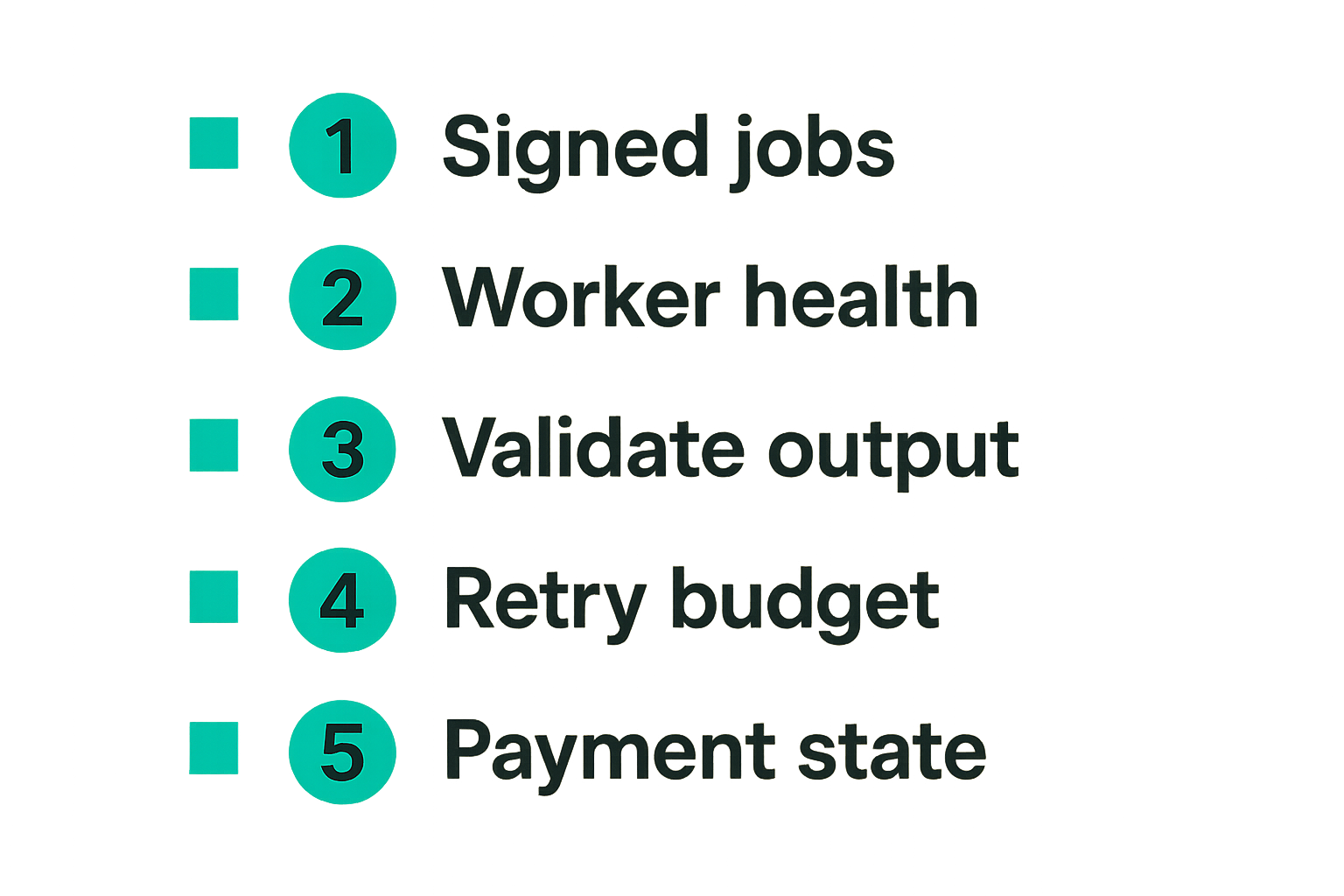
The useful split is not cloud versus decentralized. The useful split is disciplined workflow versus undefined workflow.
A decentralized compute marketplace can work well when the workload fits the model and the architecture respects state. It fails when teams copy a cloud dashboard shape but skip the boring mechanics.
What works
What works is packaging jobs so workers can execute them without guessing.
Good patterns include:
- Content-addressed inputs and outputs.
- Signed job specs.
- Explicit runtime versions.
- Resource constraints in the job contract.
- Worker capability declarations.
- Health checks that test real workloads.
- Validation before settlement.
- Reputation tied to identities.
- Structured events for every state transition.
- CLI commands that map cleanly to API calls.
For AI inference, this might mean model-specific workers with advertised context length, memory, quantization, and throughput. For FFmpeg, it might mean profiles that define codec, bitrate ladder, container, segmenting, and validation probes.
What fails
What fails is treating decentralized compute as anonymous cheap machines.
Bad patterns include:
- Submitting opaque shell commands with no validation rules.
- Trusting worker claims without output checks.
- Mixing payment state with application logs.
- Letting users upload huge inputs without preflight checks.
- Assuming all GPUs with the same name behave identically.
- Allowing unbounded retries.
- Building a GUI before the state machine is stable.
- Hiding failure reasons behind generic failed statuses.
The mistake teams make is optimizing for the happy path. In infrastructure, the unhappy path is the product.
A practical comparison
| Decision area | Weak IaaS implementation | Production-ready implementation |
|---|---|---|
| Job definition | Free-form command | Signed job contract with inputs, outputs, limits, and validation |
| Scheduling | Pick any available worker | Match by capability, reputation, cost, locality, and policy |
| Runtime | Best-effort environment | Versioned runtime with health checks and isolation |
| Validation | Trust worker completion | Verify artifacts, metadata, hashes, logs, or sampled duplicate execution |
| Payment | Pay on submit or completion claim | Reserve funds, release after verification, support refund or dispute |
| Observability | Logs per component | End-to-end job timeline across scheduler, worker, validator, and payment |
| Retries | Run again manually | Idempotent retry policy with budget and terminal states |
The table is not theoretical. It is the difference between a marketplace that can absorb operational noise and one that turns every edge case into a manual support process.
Where c0mpute.com fits
c0mpute.com is built around the idea that decentralized compute should be usable by technical builders, not only infrastructure theorists. The relevant unit is the workflow: submit work, route it to capacity, validate the result, and connect execution to payment.
That is the practical version of iaas in cloud computing for this audience.
A marketplace model for builders
A compute marketplace should make worker supply available without forcing every developer to become a distributed-systems operator. That means exposing enough CLI and network primitives for control, while hiding unnecessary coordination complexity.
For a builder, the ideal path is simple:
c0 identity create
c0 worker health
c0 job submit inference.yaml
c0 job watch job_id
c0 job artifacts job_id --verify
Behind that simple path, the platform still needs scheduling, identity, payment, validation, reputation, and status.
Fit for AI inference and FFmpeg workloads
AI inference and FFmpeg transcoding are good candidates because they can often be packaged as jobs with explicit inputs and outputs. They are not always easy, but they are describable.
Inference jobs can declare model, runtime, memory, token limits, and response format. Transcode jobs can declare source, codec, target profiles, output containers, and validation checks.
The point is not that every job belongs on decentralized compute. The point is that the right jobs can be moved into a marketplace when the control plane handles state properly.
Try c0mpute.com
c0mpute.com is for technical builders interested in decentralized compute, AI inference, FFmpeg transcoding, and DID-based payments. If you are evaluating iaas in cloud computing as a workflow problem instead of just a server catalog, Try c0mpute.com.