IaaS in cloud computing looks simple until your workload stops being simple.
A team starts with a GPU box, a few FFmpeg workers, a queue, and a billing dashboard. Then jobs fail halfway through, inference latency swings by region, workers disappear, customers ask for proof, and finance wants to reconcile compute spend against actual output.
Teams think the problem is getting cheaper virtual machines. The real problem is building a compute control plane that can route work, verify results, meter usage, handle payments, and recover when capacity is unreliable.
That changes the conversation. For web3 developers, AI infrastructure builders, video engineers, and CLI-first operators, IaaS is not a category definition. It is an architecture decision about who owns scheduling, identity, trust, settlement, observability, and support.
Table of contents
- IaaS in cloud computing is a control-plane problem
- The IaaS stack you actually operate
- Centralized IaaS versus decentralized compute
- Workload routing for AI inference and FFmpeg jobs
- Implementation workflow for an IaaS-style compute marketplace
- Metering, settlement, and DID-based payment boundaries
- Observability and validation in decentralized IaaS
- Common failure modes when teams implement IaaS badly
- Choosing the right abstraction level
- Where c0mpute.com fits
IaaS in cloud computing is a control-plane problem
The useful definition for builders
The textbook answer says infrastructure as a service gives you virtualized compute, storage, and networking over an API. That is correct, but not enough to build with.
A useful way to think about IaaS in cloud computing is this: you are buying a programmable substrate. The provider exposes capacity. Your system must decide which capacity to use, when to use it, how to prove it worked, and how to recover when it did not.
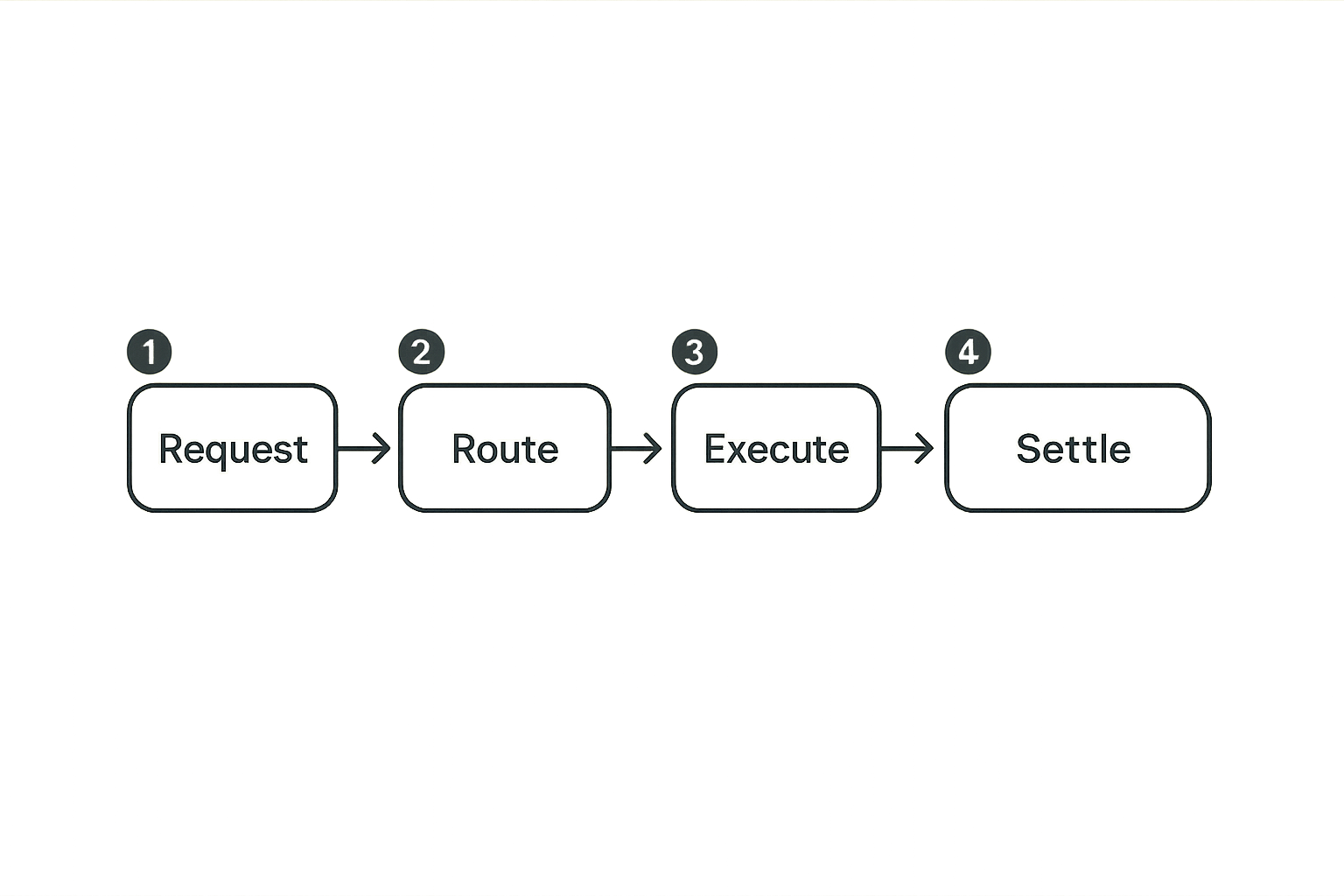
That is why IaaS quickly becomes a control-plane problem. You need a layer that can translate intent into execution. Run this model. Transcode this input. Generate this output profile. Store this artifact. Pay this worker only if the result is valid.
The mistake teams make is treating IaaS as a server procurement shortcut. They move from bare metal to instances, but keep the same operational assumptions. One box becomes ten boxes. Ten boxes become a fleet. Then the hidden problems arrive: placement, retries, quota, network paths, job ownership, pricing, audit trails, and output verification.
Practical rule: If your application sells compute-backed outcomes, do not model IaaS as machines. Model it as a job lifecycle with capacity attached.
What changes in decentralized compute
In decentralized compute, the provider boundary is different. Capacity may come from independent operators, specialized GPU nodes, video workers, regional pools, or temporary contributors. That changes trust.
In a centralized cloud, you assume the provider owns the facility, the hypervisor, the account system, and most of the failure domain. In a decentralized marketplace, you need a protocol-level way to describe work, assign work, validate output, score workers, and settle payment.
The practical question is not whether decentralized compute replaces cloud IaaS. The practical question is which workloads benefit from a more flexible supply side and which control-plane responsibilities move to the marketplace or application.
Batch transcoding, offline rendering, synthetic data generation, embeddings, evaluation runs, and some inference workloads are good candidates because they can be packaged, routed, and verified. Stateful databases and tightly coupled low-latency systems are harder because the coordination cost is higher.
Why 2026 makes this harder
By 2026, many teams are not running one class of workload. They are mixing API inference, background GPU jobs, video processing, agent workloads, payment flows, and data pipelines. The infrastructure surface area keeps expanding.
The old cloud pattern was relatively clean: choose a region, deploy services, attach storage, monitor instances. The current pattern is messier: send the right job to the right kind of compute, at the right cost, with enough proof to pay or reject the result.
Related reading from our network: teams working with public data exposure face similar workflow issues in security public storage CI/CD, where the bucket is not the whole problem and the deployment path matters more than the storage label.
The IaaS stack you actually operate
Compute, storage, network, and identity
For operators, the IaaS stack has four obvious layers and one layer that teams forget.
The obvious layers are compute, storage, networking, and orchestration. Compute runs the workload. Storage holds inputs, outputs, checkpoints, and logs. Networking moves payloads and exposes endpoints. Orchestration decides where and when execution happens.
The forgotten layer is identity. In a decentralized compute market, identity is not just login. It is how a worker proves it is the same worker over time. It is how a buyer attaches reputation to a counterparty. It is how payments map to jobs without making every job a manual accounting exercise.
That is why DID-based payment flows matter. They let infrastructure systems connect identity, authorization, and settlement without pretending every worker is an employee inside one account.
The scheduler is the product
The scheduler is where infrastructure becomes a business. It decides whether a job should run on a cheap CPU node, a high-memory GPU, a region close to input data, or a worker with better historical completion rates.
If the scheduler is naive, your marketplace feels random. Users see slow jobs, failed jobs, duplicate charges, or inconsistent outputs. If the scheduler is too rigid, you waste supply because the system cannot use available capacity.
Good scheduling is not magic. It is a set of policy decisions:
- Which workload types are supported.
- Which node capabilities are required.
- Which workers are eligible.
- Which inputs must be local or cached.
- Which jobs need deterministic validation.
- Which failures trigger retry versus rejection.
- Which price bands are acceptable.
The mistake teams make is building a beautiful marketplace UI before they have a boring, reliable scheduler. The UI can sell the idea. The scheduler delivers the product.
Where payments enter the architecture
Payments should not be bolted on after execution. They are part of the job state machine.
A compute marketplace needs to know when funds are authorized, when work is accepted, when partial progress matters, when outputs are validated, when a worker should be paid, and when a buyer should be refunded. If payment is detached from job state, support becomes manual and expensive.
For adjacent reading, local coordination systems face a similar trust and follow-up problem: Related reading from our network: supreme community as a local network operating system explains how asks, offers, routing, and follow-up become the real system.
Centralized IaaS versus decentralized compute
What centralized IaaS is good at
Centralized IaaS is strong when you want predictable account boundaries, mature networking, managed storage, compliance controls, and large pools of capacity in known regions. It is also easier for teams that already operate inside one provider ecosystem.
If your workload needs tightly integrated databases, private networking, enterprise identity, or region-specific compliance, centralized cloud infrastructure often wins. There is nothing wrong with that. The point is not to force everything into a decentralized model.
The practical question is whether the provider abstraction matches the workload. A stable API service and a bursty video transcoding queue have different infrastructure economics. A production database and a batch embedding job do not need the same trust model.
What decentralized compute changes
Decentralized compute changes the supply side. Instead of assuming one cloud account owns the fleet, the marketplace coordinates capacity across many workers or providers. That can make specialized capacity more accessible, especially for workloads that are portable and easy to package.
But decentralization also moves more responsibility into the protocol and control plane. You need better job descriptions, stronger validation, worker reputation, dispute handling, and payment-state integration.
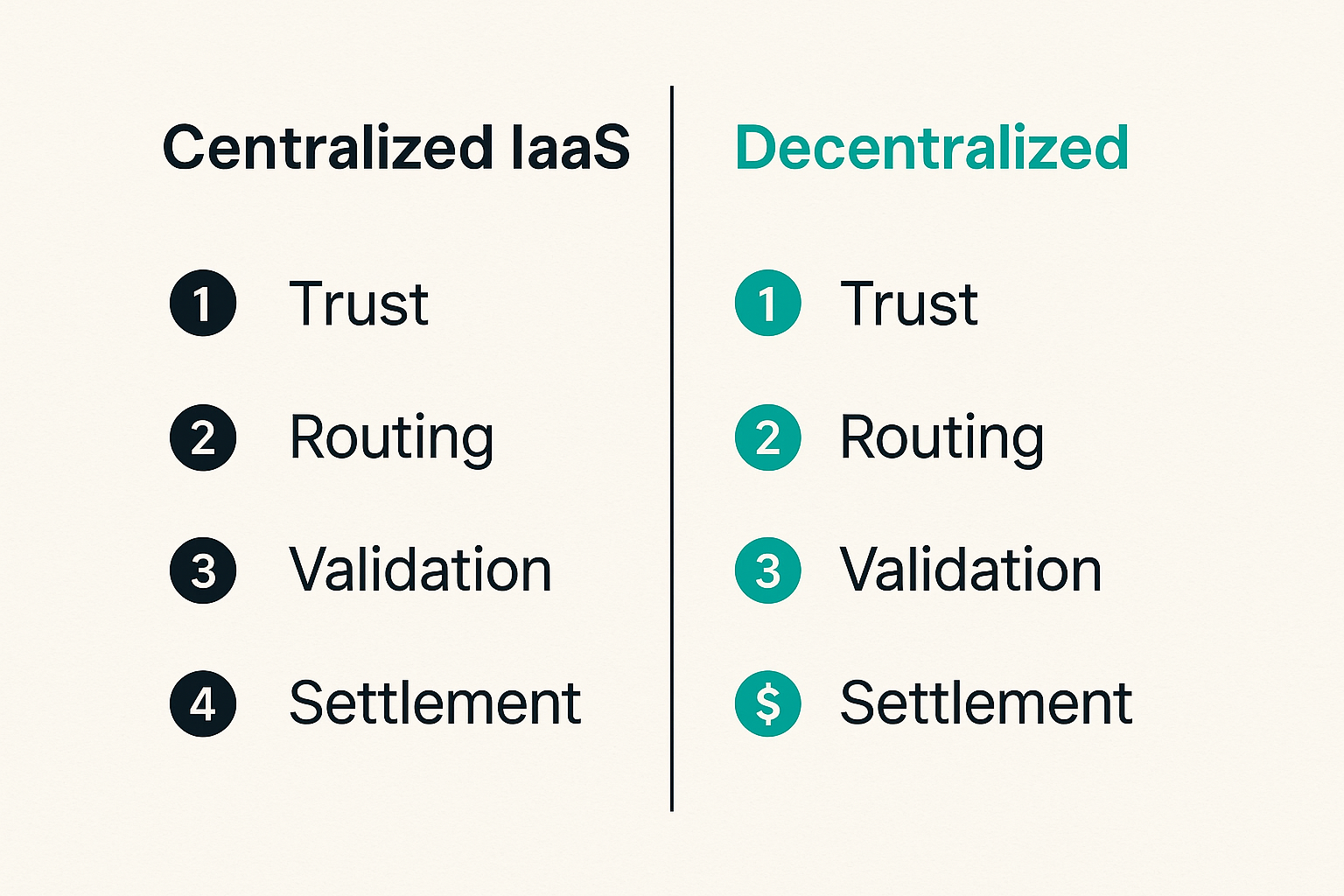
That changes the conversation. The tradeoff is not cloud versus anti-cloud. It is managed trust versus explicit trust. Centralized clouds hide trust inside the provider contract. Decentralized systems make trust part of the workflow.
Comparison table for operators
| Architecture | What works | What fails | Best fit |
|---|---|---|---|
| Centralized IaaS | Predictable regions, mature APIs, integrated storage | Provider lock-in, quota limits, opaque pricing spikes | Stateful apps, enterprise systems, private networks |
| Decentralized compute | Flexible supply, worker competition, portable batch jobs | Weak validation, inconsistent workers, poor dispute flows | AI batches, FFmpeg jobs, rendering, verifiable outputs |
| Hybrid control plane | Uses cloud for state and decentralized workers for execution | Complexity if ownership is unclear | Teams needing reliability plus flexible compute |
Practical rule: Use centralized IaaS for systems of record. Use decentralized compute where work can be packaged, routed, validated, and settled independently.
Workload routing for AI inference and FFmpeg jobs
AI inference routing
AI inference is not one workload. A small text model, a vision model, a batch embedding job, and a long-context generation request all stress infrastructure differently.
Routing should consider model availability, GPU memory, quantization format, cold-start cost, expected latency, and output validation. For interactive inference, latency and availability dominate. For batch inference, throughput and cost matter more.
A simple routing policy might score workers like this:
score = capability_match
      + reputation_weight
      + locality_weight
      - queue_delay
      - price_penalty
      - recent_failure_penalty
Do not overfit this too early. Start with explicit constraints and observable outcomes. If a worker cannot load the model, it is ineligible. If it has failed recent jobs, lower priority. If it is expensive but fast, reserve it for latency-sensitive requests.
FFmpeg transcoding routing
FFmpeg work is often easier to package than inference. Inputs are files or streams. Outputs are profiles. Validation can check duration, codec, bitrate, resolution, audio tracks, and container integrity.
What breaks in practice is data movement. A cheap worker is not cheap if it spends most of the job pulling a large input across a slow path. A fast GPU worker is not useful if the output upload fails or the artifact cannot be verified.
For video infrastructure engineers, the routing policy should include:
- Input size and location.
- Required codecs and hardware acceleration.
- Output ladder requirements.
- Expected duration and timeout.
- Worker disk capacity.
- Network throughput.
- Validation profile.
Related reading from our network: media operators thinking about streaming and home libraries run into adjacent format, routing, and reliability tradeoffs in world wide technology for streaming and torrents.
A practical routing policy
A useful routing policy separates hard constraints from preferences.
Hard constraints are non-negotiable. The worker must have the model, codec, GPU memory, disk, network access, and supported runtime. Preferences are optimizations. Lower price, better reputation, lower queue depth, closer region, or faster historical completion.
Practical rule: Never let a preference override a hard capability constraint. Cheap invalid execution is more expensive than no execution.
Implementation workflow for an IaaS-style compute marketplace
The minimum viable control loop
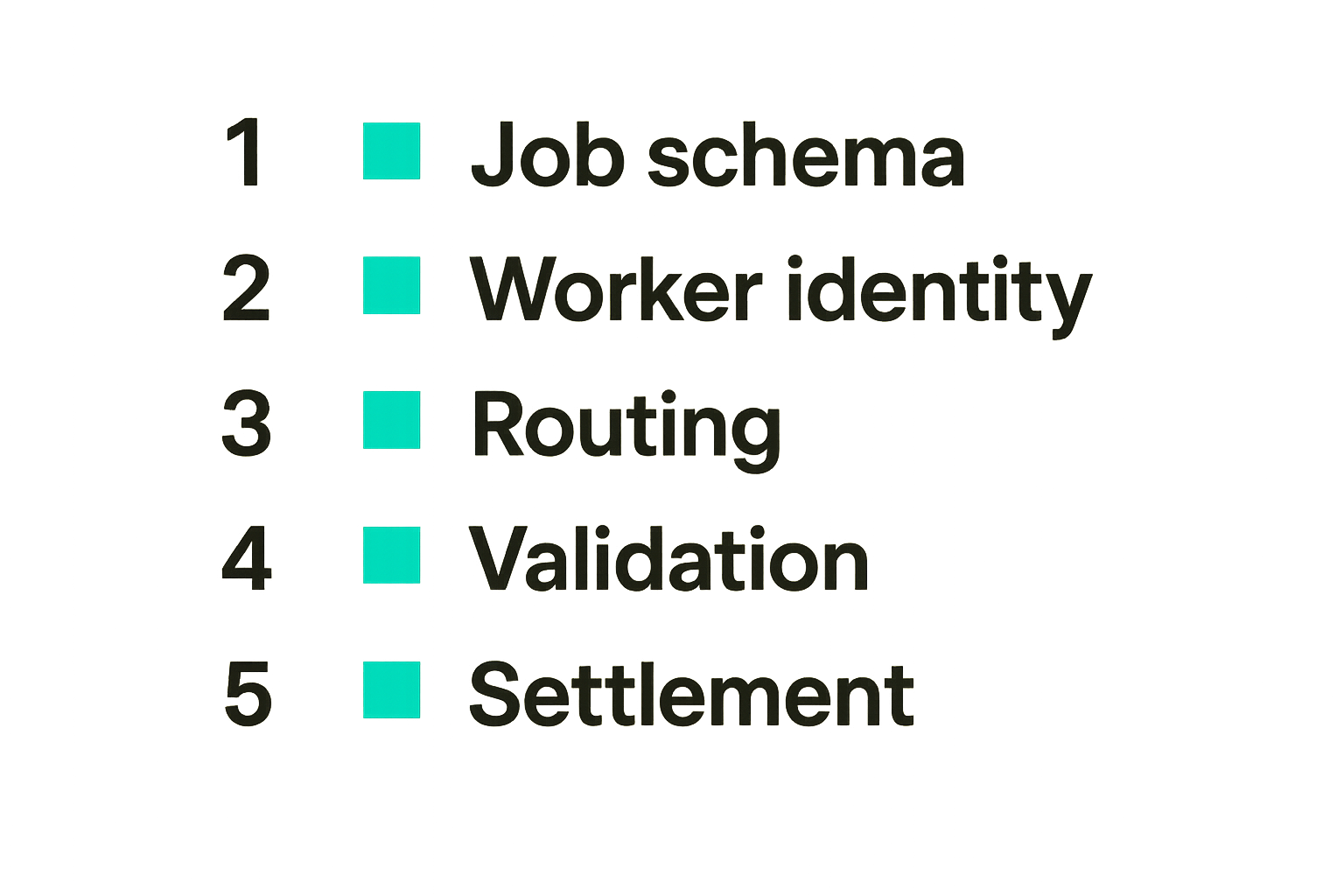
The minimum viable control loop is not a landing page. It is a repeatable path from job request to validated output to payment settlement.
You need a job schema, worker registration, capability discovery, scheduling, execution, status events, validation, settlement, and retry logic. Each step should be observable from a CLI before it is hidden behind a dashboard.
This is where CLI-first development helps. A CLI forces you to expose the actual system primitives. Create identity. Register worker. Submit job. Watch logs. Validate output. Settle payment. Debug failure.
Builders can use the c0mpute docs for install, identity, worker, transcode, inference, reputation, plugin, and health-check flows at c0mpute CLI reference and cookbook when they want to reason from commands instead of screenshots.
A numbered implementation sequence
A practical implementation sequence looks like this:
- Define job types. Start with one inference job or one FFmpeg transcode profile. Avoid generic compute until you can validate specific outputs.
- Define worker capabilities. Capture CPU, GPU, memory, runtime, codec support, model support, disk, bandwidth, and version metadata.
- Register worker identity. Tie each worker to a durable identity and reputation record.
- Submit jobs through a queue. Give every job an idempotency key, input manifest, timeout, price ceiling, and validation policy.
- Match jobs to eligible workers. Filter by hard constraints, then rank by reputation, queue depth, locality, and price.
- Stream status events. Emit accepted, started, progress, artifact uploaded, validation pending, validated, failed, retried, settled.
- Validate outputs. Use deterministic checks where possible and sampling or redundancy where necessary.
- Settle payment. Release payment only after validation rules pass or a dispute policy resolves.
- Record audit data. Store enough metadata to explain what happened without storing sensitive payloads forever.
- Tune routing. Use failure history and performance data to adjust scheduling rules.
The point is not to build everything in one sprint. The point is to keep the lifecycle intact from the beginning.
CLI-first patterns that age well
CLI-first infrastructure tends to age well because it keeps automation honest. If every major action works from a terminal, CI jobs, operators, and power users can compose workflows without waiting for UI changes.
Good CLI patterns include:
compute identity create
compute worker register --gpu a10 --region eu-west --runtime cuda
compute job submit transcode --input input.mp4 --profile hls-1080p --max-price 4.00
compute job watch job_8f31
compute job validate job_8f31
compute settlement inspect job_8f31
The command names matter less than the contract. Commands should be idempotent where possible, machine-readable with JSON output, and safe to retry.
Metering, settlement, and DID-based payment boundaries
Meter what the buyer actually receives
Metering CPU seconds is easy. Metering buyer value is harder.
For FFmpeg, the buyer receives valid output artifacts. For inference, the buyer receives responses, embeddings, classifications, or generated media. For batch jobs, the buyer may care about completed records, not raw runtime.
The mistake teams make is pricing infrastructure inputs while selling application outputs. If you charge for GPU time but the output is invalid, the buyer sees a broken product. If you charge only for completed output but ignore worker cost, the marketplace may attract abusive workloads.
A balanced model separates internal metering from external billing. Internally, track runtime, memory, GPU type, queue time, bandwidth, retries, and validation cost. Externally, bill against the unit the buyer understands: transcode minutes, valid artifacts, inference requests, tokens, images, or completed records.
Keep custody and execution separate
DID-based payments can connect identity and settlement, but custody boundaries still need discipline. Execution workers should not automatically control buyer funds. Payment authorization should be tied to job state and validation, not worker claims alone.
A clean boundary looks like this:
- Buyer authorizes payment for a job or budget.
- Marketplace locks or records the authorization.
- Worker executes the job.
- Validator checks the result.
- Settlement releases payment based on policy.
- Disputes follow a defined path.
This avoids the worst pattern: workers self-report completion and immediately receive funds without independent validation.
Reconciliation is not optional
Reconciliation is where many infrastructure products quietly fail. The system says job completed. The worker says it ran. The buyer says the output is missing. Finance sees a payment event. Support has no shared timeline.
You need a ledger of job state transitions, payment events, validation decisions, and artifact references. It does not need to be complicated, but it must be consistent.
Every job should answer these questions:
- Who requested it?
- Which identity accepted it?
- What inputs and constraints were declared?
- What price or budget applied?
- What events occurred?
- Which artifacts were produced?
- Which validation policy ran?
- What payment decision was made?
Observability and validation in decentralized IaaS
Signals that matter
Observability for decentralized IaaS should focus on job outcomes, not just host metrics.
CPU, GPU, memory, disk, and network data still matter. But the control plane also needs job-level signals: acceptance latency, queue time, start delay, progress interval, artifact upload time, validation duration, retry count, settlement delay, and dispute rate.
A useful dashboard starts with a few operational questions:
- Are jobs getting assigned?
- Are workers starting on time?
- Are outputs passing validation?
- Are retries increasing?
- Are payments settling?
- Are specific worker versions failing?
If you cannot answer those quickly, your IaaS layer is not observable enough for production.
Validation strategies
Validation depends on workload type. FFmpeg outputs can be checked with probes, manifests, duration checks, codec checks, checksums, thumbnails, and sample playback. AI outputs are harder. You may use deterministic tests, schema validation, redundancy, evaluator models, sampling, or user feedback loops.
The key is to classify validation by risk. Low-value batch jobs may tolerate lightweight checks. High-value jobs may need redundancy or multi-party verification. Interactive inference may need fast schema checks first and deeper evaluation later.
Practical rule: Validation cost should scale with job value and failure impact. Do not spend more proving a result than the result is worth.
Health, status, and operator confidence
Operators need to know whether the network is healthy before they blame their own code. Public status, worker health checks, and transparent incident notes reduce support noise.
When evaluating a decentralized compute layer, check whether it exposes service health, queue behavior, and component availability. For example, an operator can sanity-check network availability through the c0mpute status page before debugging local worker configuration.
Status does not replace observability in your own system. It gives you a boundary. If the network is degraded, pause noncritical jobs or shift routes. If the network is healthy, inspect your job schema, worker runtime, credentials, or input artifacts.
Common failure modes when teams implement IaaS badly
What breaks in practice
Bad IaaS implementations usually break at the seams.
The first seam is job ownership. Nobody knows whether the API, scheduler, worker, validator, or payment module owns the next transition. Jobs get stuck in running, failed, or paid states.
The second seam is retries. Teams retry everything without idempotency keys. A video job runs twice. An inference batch bills twice. A settlement event fires after the buyer has already canceled.
The third seam is validation. Outputs are accepted because a worker says complete. Later, the artifact is corrupt, incomplete, or generated with the wrong model.
The fourth seam is support. Logs exist, but not in the same timeline. The worker has local logs. The queue has delivery attempts. The payment system has events. The user sees an error. Nobody can reconstruct the incident.
What works instead
What works is boring and explicit:
- One job state machine.
- Idempotency keys for submission and settlement.
- Capability schemas for workers.
- Retry policies by failure class.
- Validation policies by workload.
- Durable event logs.
- Worker reputation tied to outcomes.
- Payment release tied to validation.
Here is a compact failure-policy example:
failure_policy:
  input_fetch_failed:
    retry: true
    max_attempts: 2
    same_worker: false
  validation_failed:
    retry: false
    pay_worker: false
  worker_timeout:
    retry: true
    max_attempts: 1
    reputation_penalty: medium
  settlement_failed:
    retry: true
    idempotency_required: true
The practical question is not whether failures happen. They will. The question is whether the system knows what type of failure happened and what action is safe next.
Security and public data mistakes
Infrastructure teams often treat public artifacts casually. Inputs, outputs, logs, thumbnails, prompts, model responses, and manifests can leak more than expected.
Do not assume a decentralized worker should receive every secret needed by your application. Package only the data required for execution. Use scoped credentials. Expire URLs. Avoid logging sensitive prompts or payment details. Keep validation metadata separate from raw user data where possible.
The same applies to model weights and proprietary codecs. If a worker needs a runtime, define the boundary. If a model is sensitive, decentralized execution may require enclaves, encryption, trusted workers, or a different deployment pattern.
Choosing the right abstraction level
When raw infrastructure is enough
Raw IaaS is enough when your team can own the full operational loop and the workload benefits from direct control. This includes stable APIs, databases, internal tools, and systems where compliance or network topology matters more than flexible supply.
If your team already has Terraform, Kubernetes, observability, on-call, and cost management working well, do not replace that just because decentralized compute is interesting. Use the simplest architecture that meets the workload.
The mistake teams make is chasing infrastructure novelty instead of reducing operational risk. If the output cannot be packaged or validated, a marketplace will not fix it.
When you need a marketplace
You need a marketplace when supply flexibility matters and the work can be described cleanly. Examples include bursty transcode queues, batch AI jobs, evaluation runs, rendering, embeddings, and other workloads where units of work can move across workers.
The marketplace abstraction becomes valuable when it handles capability discovery, routing, pricing, reputation, validation, and settlement better than your team wants to build from scratch.
This is also where hybrid designs make sense. Keep your control API, customer data, and system of record in a cloud environment. Route portable execution to decentralized workers. Pull validated outputs back into your application.
When to hide the infrastructure
End users usually do not want to think about IaaS in cloud computing. They want the video transcoded, the model response returned, or the batch completed.
Hide infrastructure when it is not part of the buyer decision. Expose infrastructure when it affects price, latency, privacy, region, proof, or trust.
For technical users, exposing a CLI and API can be a feature. For nontechnical users, too much infrastructure detail becomes support burden. The right abstraction depends on who is operating the workflow.
Where c0mpute.com fits
Product fit for technical builders
c0mpute.com is built around the idea that decentralized compute should be usable from practical workflows, not just discussed as a market theory. The relevant pieces are FFmpeg transcoding, AI inference, worker identity, reputation, and DID-based payments.
That fits teams building products where compute is a variable supply problem: video pipelines, AI inference routes, batch processing, and web3-native services that need payment-aware execution.
It is not a replacement for every cloud primitive. It is closer to an execution layer for workloads that can be packaged, routed, validated, and settled. That distinction matters. If you keep your database, user API, and product state elsewhere, you can still use decentralized compute for the expensive or bursty parts.
Architecture principles to keep
Whether you use c0mpute.com, centralized IaaS, or a hybrid model, keep the same architecture principles:
- Treat jobs as state machines.
- Make worker capabilities explicit.
- Separate hard constraints from routing preferences.
- Validate outputs before settlement.
- Keep payment state tied to execution state.
- Design retries with idempotency.
- Observe job outcomes, not just machine metrics.
- Keep sensitive data out of worker payloads unless required.
IaaS in cloud computing is still useful language, but it is too broad by itself. For builders in 2026, the real work is composing infrastructure into reliable execution workflows.
Try c0mpute.com
c0mpute.com is for technical builders interested in decentralized compute, AI inference, FFmpeg transcoding, and DID-based payments. Try c0mpute.com.