Computing in the 1970s looks primitive if you only compare clock speed, memory, and screen resolution. That is the wrong comparison.
A modern decentralized compute network still has the same operational problems: scarce resources, queued work, remote users, failed jobs, trust boundaries, metering, settlement, and support. The machines changed. The workflow did not disappear.
Teams think the problem is adding more GPUs, more workers, or a nicer dashboard. The real problem is building a compute workflow that can survive latency, partial failure, noisy providers, untrusted clients, and jobs that cost real money to run.
That changes the conversation. Computing in the 1970s is not nostalgia. It is a useful architecture lens for builders shipping AI inference, FFmpeg transcoding, DID-based payments, and decentralized compute marketplaces in 2026.
Table of contents
- Computing in the 1970s was not a museum piece
- The real architecture was jobs, terminals, operators, and accounting
- Computing in the 1970s explains why queues still matter
- What breaks when decentralized compute ignores 1970s lessons
- A practical architecture model for compute marketplaces
- Identity, access, and accounting are not optional
- Scheduling lessons for AI inference and FFmpeg transcoding
- Implementation workflow for a 2026 decentralized compute system
- What works and what fails in production
- How c0mpute.com fits this architecture
Computing in the 1970s was not a museum piece
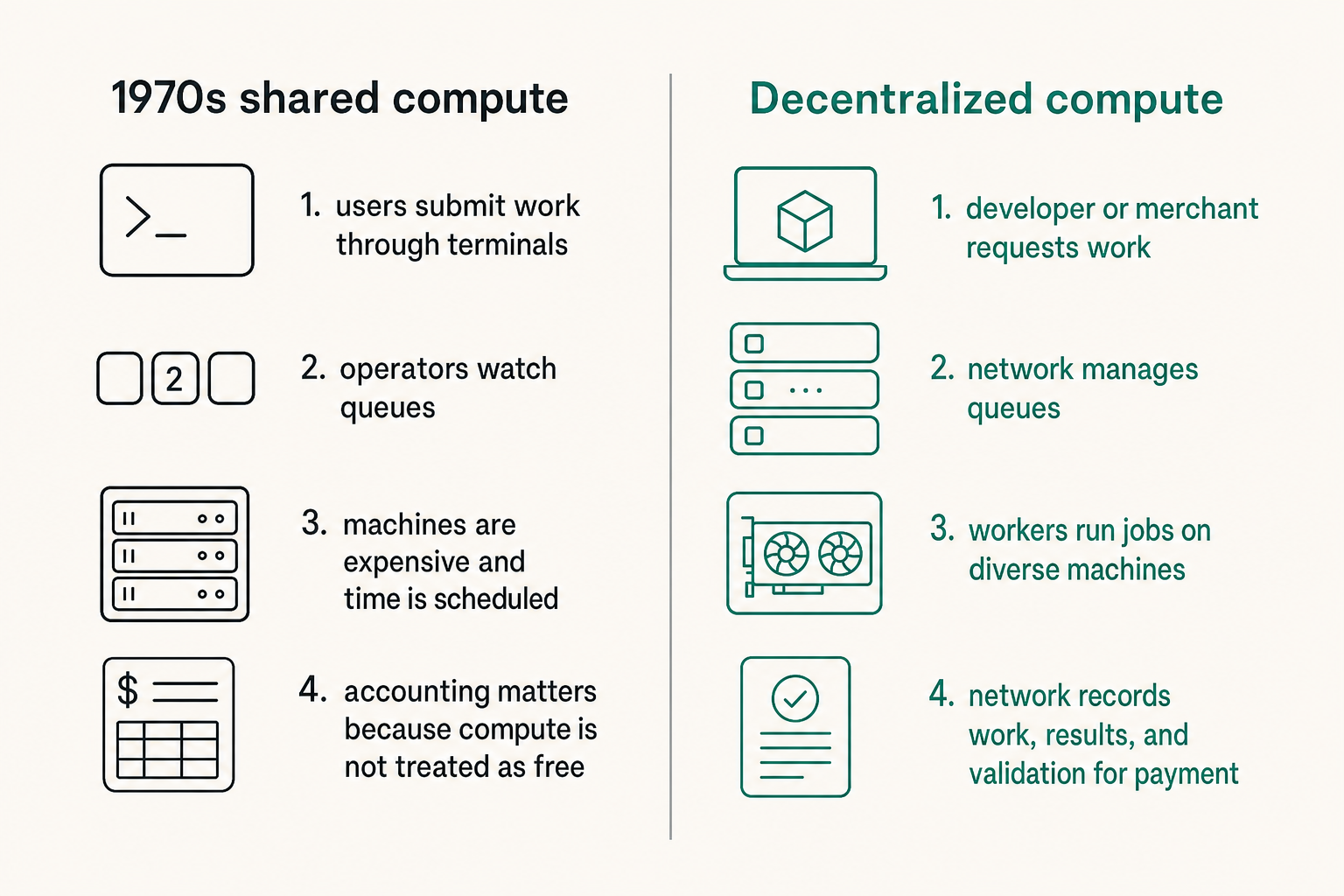
Computing in the 1970s was defined by constraints. Machines were expensive. Time on them was scheduled. Users submitted work through terminals, cards, or command interfaces. Operators watched queues. Accounting mattered because compute was not treated as free.
That sounds old until you run a decentralized compute marketplace. Then it sounds like Tuesday.
A GPU worker has limited memory. A video transcode can run for minutes or hours. An inference request may need low latency, while a batch embedding job can wait. A merchant or developer wants proof that the work completed before payment settles. The network needs to know who requested the job, who ran it, what was produced, and whether the result passed validation.
The scarce-compute mindset
The mistake teams make is assuming scarcity went away because cloud made provisioning easy. Cloud hid scarcity behind accounts, quotas, regions, and billing. Decentralized compute exposes it again.
In a marketplace, capacity is not a single elastic pool. It is fragmented across machines with different CPUs, GPUs, codecs, disk, network links, uptime patterns, and operator incentives. You do not get a magical infinite cluster. You get a market of workers.
Practical rule: Design as if compute is scarce, remote, and billable. If the system still works under that assumption, it will work better when capacity is abundant.
This is why computing in the 1970s is useful. The old model treated compute as a shared economic resource. Jobs were described, queued, executed, observed, and charged. Modern decentralized systems need the same discipline.
Why modern teams should care
AI infrastructure builders care because inference is not one workload. A short chat completion, a long context summarization, a batch image generation job, and an embedding pipeline stress the system differently.
Video infrastructure engineers care because FFmpeg jobs are full of edge cases: bad inputs, missing codecs, variable bitrate, weird containers, partial outputs, and long-running workers.
Web3 developers care because settlement, identity, reputation, and dispute handling become part of the compute path. You are not just running code. You are coordinating economic activity between parties that may not trust each other.
CLI-first developers care because terminals were not a limitation of 1970s computing; they were a forcing function. They encouraged explicit commands, inspectable logs, repeatable jobs, and operator control.
The real architecture was jobs, terminals, operators, and accounting
Computing in the 1970s is often described in hardware terms: mainframes, minicomputers, magnetic tape, punch cards, time-sharing terminals. Useful history, but not the real lesson.
The real architecture was a workflow:
- A user defined work.
- The system accepted or rejected the request.
- The job entered a queue.
- Operators and schedulers allocated resources.
- The machine executed the job.
- Results were returned.
- Usage was recorded.
- Failures were investigated.
That workflow is still the spine of remote compute.
Mainframes were shared services
A mainframe was not a personal device. It was shared infrastructure. Multiple users depended on it. That made isolation, scheduling, and accounting central concerns.
A decentralized compute marketplace has the same shape, except the mainframe is replaced by a network of independent machines. The service boundary moves, but the questions remain:
- Who is allowed to submit work?
- What resources does the job need?
- Which worker should run it?
- What happens if the worker disappears?
- How is output verified?
- When does payment release?
- What evidence exists for support or disputes?
The practical question is not whether a marketplace can expose compute. It is whether the marketplace can coordinate compute without turning every failed job into manual support.
Terminals forced clean interfaces
Terminals made users describe intent in a compact way. A command had arguments. A job had input. Output went somewhere. Logs mattered.
That discipline is still valuable. A CLI command is often a better design test than a dashboard mockup. If a compute job cannot be expressed clearly from a terminal, the API probably has hidden state.
For example, a transcode job should be describable as a contract:
compute transcode submit \
  --input ipfs://source-video \
  --preset h264-1080p \
  --output s3://bucket/out.mp4 \
  --max-price 12.00 \
  --validate duration,codec,checksum
The syntax is not the point. The point is that the system has to know the input, output, constraints, price boundary, and validation requirements before work starts. A UI can help users build that request, but the architecture should not depend on a UI guessing what happened later.
Related reading from our network: teams building marketplace channels face similar dependency problems when one platform owns the workflow, as described in Fiverr alternatives for sellers in 2026.
Computing in the 1970s explains why queues still matter
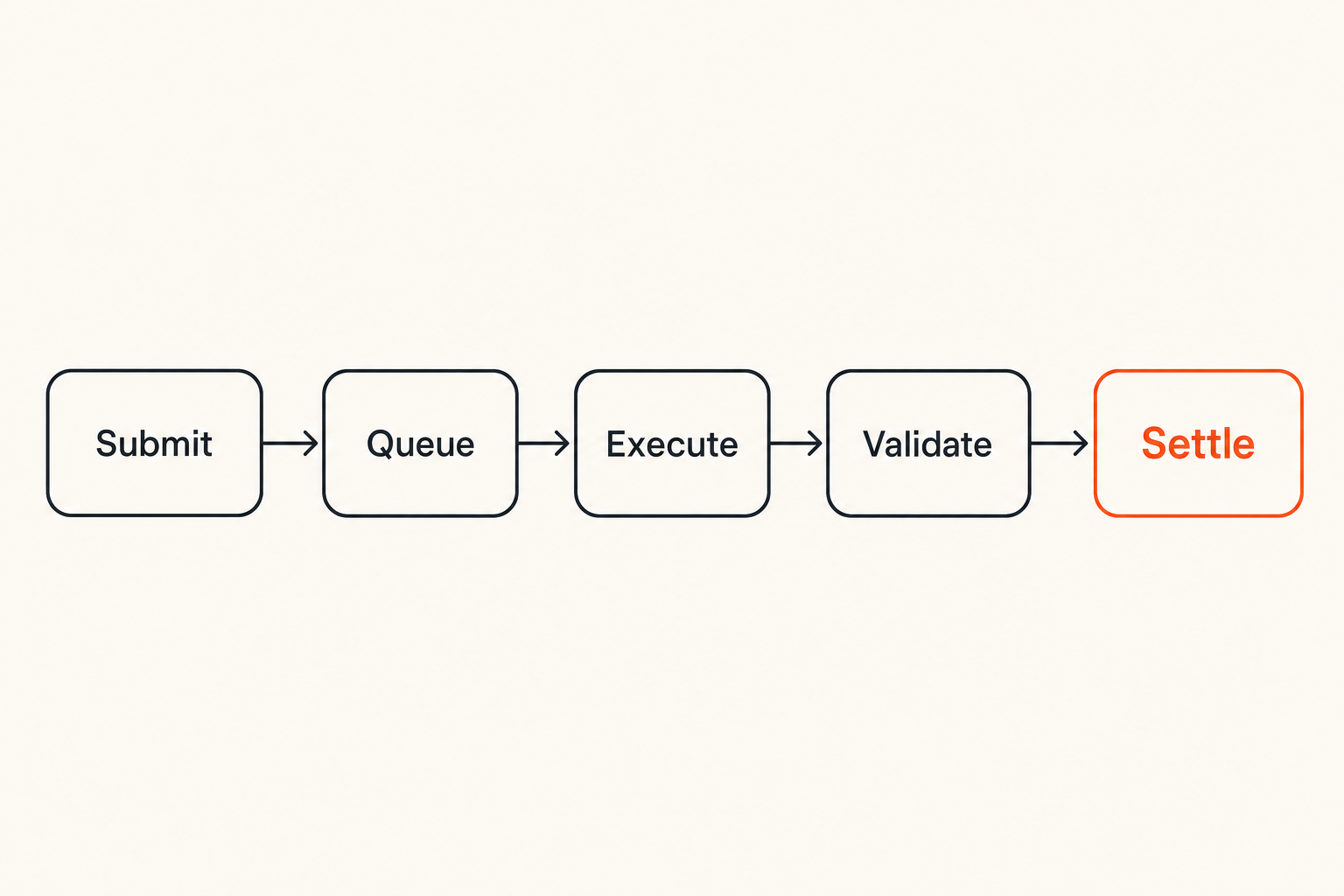
Computing in the 1970s made queues visible. Users submitted jobs and waited. Operators inspected backlogs. Priority mattered. The queue was not an implementation detail; it was the operating model.
Modern teams often hide queues until the system breaks. Then they discover they need retries, dead-letter handling, priority classes, backpressure, cancellation, and status reporting.
Batch jobs map cleanly to decentralized work
Many decentralized compute workloads are naturally batch-oriented:
- Transcode this video into three renditions.
- Generate thumbnails from this media file.
- Run an embedding job over this dataset.
- Render these frames.
- Fine-tune or evaluate a model on a bounded input set.
These jobs can tolerate queueing if the contract is clear. The user needs to know accepted, waiting, running, validating, complete, or failed. The worker needs a lease. The network needs timeout behavior. Payment needs to follow state.
A useful way to think about it is this: the queue is the place where business promises become operational constraints.
Practical rule: If a job costs money to execute, it deserves an explicit lifecycle. Accepted and completed are not enough states.
A minimal lifecycle might look like this:
| State | Meaning | Operator concern |
|---|---|---|
| submitted | Client created the request | Validate schema and funds |
| accepted | Network accepted the job | Lock price and requirements |
| queued | Waiting for capacity | Expose position or estimate |
| leased | Worker claimed the job | Start timeout clock |
| running | Work is executing | Stream logs or heartbeats |
| validating | Output is being checked | Compare result to contract |
| settled | Payment and result finalized | Write durable records |
| failed | Job cannot complete as requested | Preserve error evidence |
That table is not glamorous. It is the system.
Interactive workloads need different promises
AI inference often looks interactive. Users expect low latency. But even inference has multiple modes.
A real-time prompt completion has a different promise than a batch summarization job. A video preview transcode has a different promise than a full mezzanine encode. If the marketplace treats every job the same, either latency-sensitive users suffer or batch workloads starve the network.
The old time-sharing model is relevant here. Interactive users needed quick response. Batch users needed throughput. Systems separated those classes because pretending they were identical made both worse.
For decentralized compute, this means scheduling classes should be explicit:
- interactive inference
- batch inference
- video transcode
- validation-only work
- long-running specialized jobs
- storage-adjacent jobs
What breaks in practice is the single global queue. It is simple to build and painful to operate. Once one workload grows, it dominates everything else.
What breaks when decentralized compute ignores 1970s lessons
The mistake teams make is building a marketplace as if matching buyers and sellers is the hard part. Matching is only the start. The harder problem is maintaining a trustworthy compute workflow after the match.
The UI hides the hard parts
A clean UI can make decentralized compute look solved. Upload a file. Pick a model. Click run. Watch a spinner.
But the UI is not the system. The system is the state behind the spinner:
- Was the input pinned and reachable?
- Did the worker receive the exact job contract?
- Was the job started before the lease expired?
- Are logs tamper-resistant enough for support?
- Did output validation run before settlement?
- Can the client retry without creating duplicate payment?
- Can the worker prove partial execution if the client cancels?
If those answers are unclear, the UI is decoration.
This is also why CLI-first workflows are useful early. They force the team to expose reality. A command either returns a job ID, state, logs, and result, or it does not.
The marketplace becomes an incident generator
A weak compute marketplace does not fail quietly. It creates incidents:
- jobs stuck in running forever
- workers paid for invalid output
- users charged twice after retrying
- providers assigned jobs they cannot run
- support tickets with no logs
- model results returned without provenance
- transcodes completed with wrong codec settings
- payments settled before validation finishes
These are not edge cases. They are normal distributed-system behavior.
Practical rule: Any decentralized compute design that does not model failure states is outsourcing architecture to customer support.
The 1970s lesson is not that everything should be slow or centralized. The lesson is that shared compute needs operating rules. Jobs need ownership. Operators need visibility. Users need predictable state.
Related reading from our network: crypto checkout teams hit the same state and settlement problem in payment flows, especially where webhooks, escrow, and reconciliation matter; see crypto checkout architecture for high-risk merchants.
A practical architecture model for compute marketplaces
A decentralized compute marketplace should not be one big service that accepts work and hopes workers behave. It needs separable planes, explicit contracts, and durable state.
Separate control plane and execution plane
The control plane decides what should happen. The execution plane does the work.
Control plane responsibilities:
- identity and authentication
- job contract validation
- pricing and escrow checks
- scheduling and worker selection
- lifecycle state management
- reputation updates
- settlement decisions
- API and CLI surfaces
Execution plane responsibilities:
- pulling inputs
- running FFmpeg, inference, or custom workloads
- producing outputs
- streaming logs and heartbeats
- reporting resource use
- returning artifacts
- participating in validation
This separation matters because decentralized workers are not fully trusted. The network should not let a worker define the terms of the job after it receives the job. The worker executes a contract it did not author.
A practical control-plane record might include:
job_id: job_7fa3
workload: transcode
input_uri: ipfs://bafy...
output_profile: h264_1080p
max_runtime_sec: 3600
max_price: 12.00
validation:
  - checksum
  - codec
  - duration_tolerance
settlement:
  escrow_id: esc_91b2
  release_on: validation_passed
If that record is durable and queryable, the rest of the system has a source of truth.
Treat every job as a state machine
State machines are boring until you do not have one. Then every incident becomes archaeology.
A job state machine should define:
- allowed transitions
- timeout behavior
- retry limits
- cancellation rules
- settlement triggers
- validation requirements
- event logs
For example, a worker should not be able to move a job from queued to settled. It should move leased to running, then submit output. Validation should move output_submitted to validating, then settled or failed.
This prevents workers, clients, and payment logic from fighting over state.
For builders implementing this directly, the c0mpute CLI reference and cookbook is the natural place to start because install, identity, worker health, transcode jobs, inference calls, reputation, and plugins all need to be testable without hiding behind a dashboard.
Identity, access, and accounting are not optional
Computing in the 1970s had accounts because shared systems needed accountability. A job belonged to someone. Usage mapped to a budget, department, or project. Operators could answer who ran what.
Decentralized compute needs the same property, but the implementation changes.
From account numbers to DIDs
In a decentralized network, identity cannot only mean email and password. Workers, clients, validators, and payment agents need stable identifiers that can sign requests and build reputation over time.
DID-based identity is useful because it can connect job submission, worker claims, validation events, and payment flows without requiring every component to live inside one company account system.
A practical identity model should answer:
- Which DID submitted the job?
- Which DID accepted the worker lease?
- Which DID signed the output receipt?
- Which validator checked the result?
- Which payment identity funded settlement?
- Which keys can rotate without losing reputation?
The point is not ideology. The point is auditability.
Metering has to be auditable
Accounting is where many compute systems get vague. They meter seconds, tokens, frames, bytes, or GPU time, but cannot explain a disputed bill.
For a marketplace, metering should be tied to the job contract. If a client requested an H.264 1080p transcode, billing should not be a mystery number. It should map to accepted price, runtime, output validation, and settlement rules.
For inference, token counts and model class matter. For FFmpeg, duration, preset, resolution, codec, and output count matter. For long-running custom jobs, resource class and wall-clock limits matter.
Practical rule: Do not settle payment from metrics you cannot explain to both sides of the marketplace.
This is where operational status also matters. If the network is degraded, job timing and failure interpretation change. Builders should expose service health clearly, and a public c0mpute network status page is part of that operator contract, not a marketing accessory.
Scheduling lessons for AI inference and FFmpeg transcoding
Computing in the 1970s separated workloads because hardware was scarce and users had different expectations. That same scheduling discipline matters for AI inference and FFmpeg transcoding.
Not all compute jobs are equal
A one-second inference request and a two-hour transcode should not compete blindly.
A practical scheduler should consider:
- workload type
- expected runtime
- memory requirements
- GPU or CPU needs
- codec availability
- input locality
- output destination
- price ceiling
- worker reputation
- validation cost
For FFmpeg, codec support can be the difference between success and immediate failure. For AI inference, model availability and GPU memory dominate. For video, network bandwidth may matter more than CPU if inputs are huge.
The scheduler does not need to be perfect. It needs to be honest. If it does not know whether a worker can run a job, it should not pretend.
Capacity should be explicit
Workers should advertise capacity in machine-readable form. Not vague labels like fast or pro, but capabilities:
worker_id: did:example:worker123
cpu_threads: 32
memory_gb: 128
gpu:
  vendor: nvidia
  memory_gb: 24
ffmpeg:
  codecs:
    - h264
    - hevc
    - vp9
models:
  - llama-3-class
  - embedding-small
max_concurrent_jobs: 3
region_hint: eu-west
A worker can lie, fail, or drift. So advertised capacity should be validated by health checks, job history, and reputation.
Related reading from our network: scheduling and crawl path design have surprising overlap; both reward feedback loops and route selection, which is why ant colony optimization algorithms for AEO is an adjacent mental model for routing work through a network.
Implementation workflow for a 2026 decentralized compute system
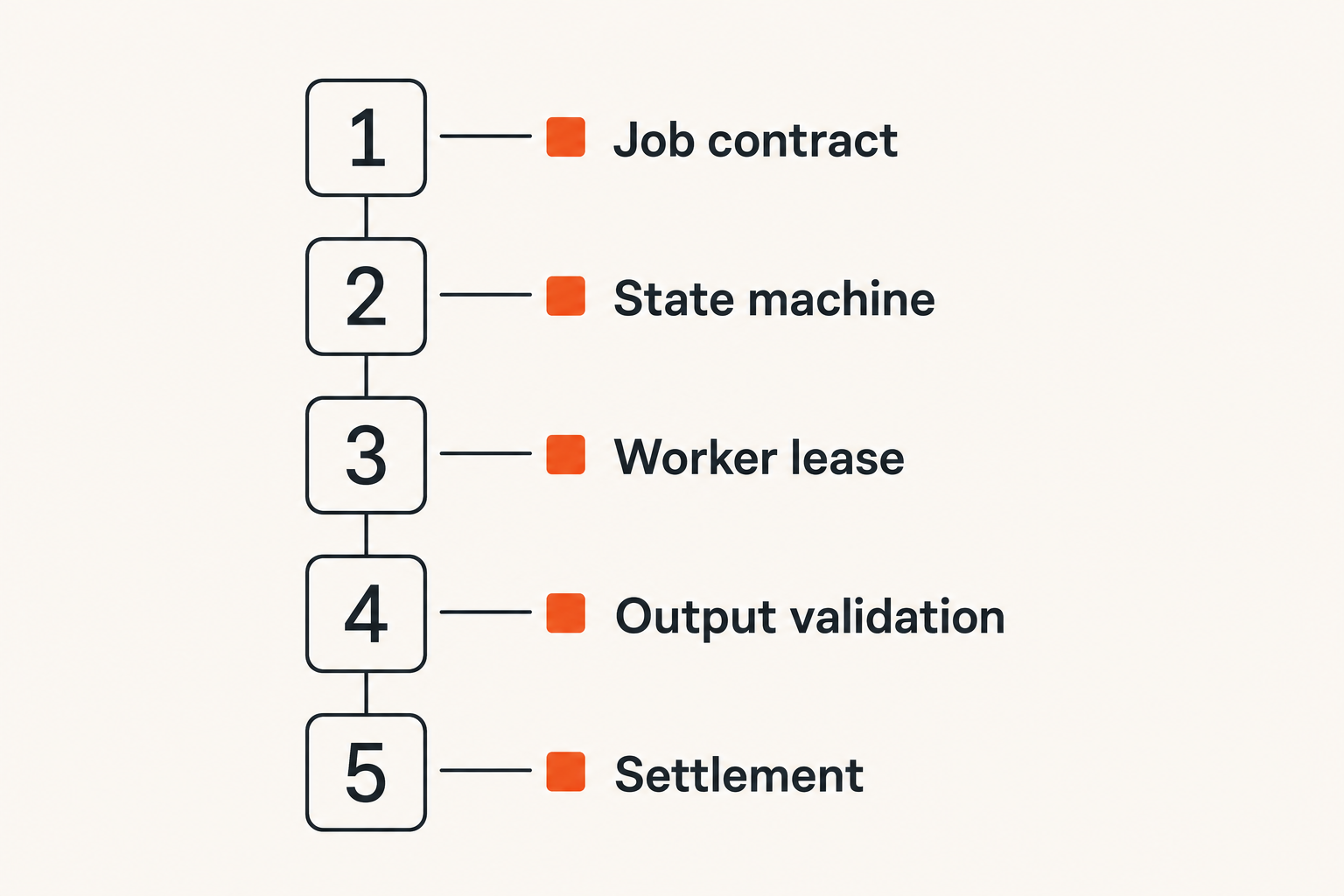
The practical question is how to turn these lessons into something you can build. Start smaller than the whiteboard architecture. Build the job path first.
Start with the job contract
A useful implementation sequence looks like this:
- Define one workload clearly, such as FFmpeg transcode or single-model inference.
- Write the job contract schema before building the UI.
- Create a CLI command that submits the job and returns a durable job ID.
- Store the job as an append-only state record.
- Add worker leasing with expiration and heartbeat rules.
- Run the workload in an isolated execution environment.
- Submit output as an artifact with metadata.
- Validate output against the original contract.
- Release or reject settlement based on validation.
- Expose logs, state, and receipts for support.
This sequence is intentionally plain. It prevents the team from skipping the hard parts.
If the job contract is weak, everything after it becomes conditional. If validation is vague, settlement becomes political. If logs are missing, support becomes guesswork.
Then wire validation and settlement
Validation should not be an afterthought. It is the bridge between execution and payment.
For transcode jobs, validation may check:
- output exists and is retrievable
- duration matches input within tolerance
- codec and container match request
- resolution and bitrate are within bounds
- checksum or perceptual hash is recorded
- error logs are absent or classified
For AI inference, validation is harder because outputs can be probabilistic. Still, the system can validate structure, model identity, token limits, response format, latency class, and signed worker receipt.
Settlement should wait for the validation state that the job contract requires. Some jobs may release automatically. Others may need validator quorum, client acceptance, or dispute windows.
The mistake teams make is attaching payment directly to worker completion. Worker completion is a claim. Validation decides whether the claim should be paid.
What works and what fails in production
There is no universal decentralized compute architecture. But there are patterns that keep showing up in production systems.
What works
What works is explicitness:
- explicit workload classes
- explicit job schemas
- explicit states
- explicit worker capabilities
- explicit validation rules
- explicit retry behavior
- explicit settlement triggers
- explicit operator views
A strong system lets a developer ask simple questions and get precise answers:
compute job inspect job_7fa3
compute job logs job_7fa3 --tail 100
compute worker inspect did:example:worker123
compute job retry job_7fa3 --from failed_validation
The CLI is not just a developer convenience. It is an operational contract. If the command cannot explain the system, the dashboard probably cannot either.
What also works is designing for partial trust. Clients should not fully trust workers. Workers should not fully trust clients. The marketplace should not rely on either side being patient, honest, or online forever.
What fails
What fails is wishful abstraction:
| Approach | Why it looks attractive | What breaks in practice |
|---|---|---|
| One global queue | Simple to implement | Long jobs block urgent jobs |
| Payment on worker done | Easy settlement path | Invalid output gets paid |
| Dashboard-only control | Faster demo | Operators lack scripts and evidence |
| Vague worker tiers | Easy marketing | Scheduler assigns impossible jobs |
| No idempotency | Simpler API | Retries create duplicate jobs or charges |
| Logs as best effort | Less storage | Disputes become unsolvable |
The most common failure mode is pretending the marketplace is a thin layer over compute. It is not. It is a coordination system for work, trust, and money.
Another failure mode is copying cloud UX without cloud control. A centralized cloud provider can hide complexity because it controls hardware, identity, billing, and support. A decentralized network has to expose more of the contract because control is distributed.
That does not mean the user experience should be bad. It means the architecture needs to carry the truth, and the UI should present that truth cleanly.
How c0mpute.com fits this architecture
The reason computing in the 1970s matters for c0mpute.com is simple: decentralized compute is closer to shared, metered, operator-driven infrastructure than to infinite local compute.
A useful decentralized compute network needs to make jobs submit-able, inspectable, repeatable, payable, and verifiable. That is the architecture line that connects old batch systems to modern AI inference, FFmpeg transcoding, and DID-based payments.
A CLI-first compute path
c0mpute.com is built around the idea that compute workflows should be usable from the command line first: submit jobs, run workers, inspect health, transcode media, call inference, and connect payment identity without pretending the UI is the whole system.
That matters for technical builders because the CLI exposes the real contract:
- What did I ask the network to do?
- Which worker claimed it?
- What state is it in?
- What output was produced?
- What validation ran?
- What payment event followed?
The product fit is not that 1970s systems were better. They were not. The fit is that computing in the 1970s forced architectural honesty around scarce shared compute. Decentralized compute needs that same honesty, updated for signed identities, programmable settlement, AI models, video pipelines, and distributed workers.
If you are building a marketplace, a worker network, or a compute-heavy web3 application, the practical lesson is straightforward: design the workflow before the marketplace. Design the state machine before the dashboard. Design validation before settlement.
Try c0mpute.com
c0mpute.com is for technical builders interested in decentralized compute, AI inference, FFmpeg transcoding, and DID-based payments. Try c0mpute.com and build workflows that treat computing in the 1970s as an architecture lesson, not a history exhibit.