Cloud computing services look simple until the first production workload does something expensive, slow, or stateful.
A developer can rent a VM, push a container, call an API, and get a result. That part is not the hard part anymore. The hard part is deciding where the job should run, how trust is established, how outputs are verified, how payment clears, and what happens when the worker disappears halfway through an inference or FFmpeg transcode.
Teams think the problem is choosing cloud computing services. The real problem is designing a compute workflow that survives pricing volatility, GPU scarcity, queue spikes, failed jobs, settlement delays, and support tickets.
That changes the conversation. In 2026, cloud infrastructure is less about buying a box and more about coordinating execution across providers, workers, identities, and payment rails. For web3 developers, AI infrastructure builders, video engineers, and CLI-first operators, the practical question is not whether to use cloud compute. It is which parts of the workload belong in centralized cloud, which parts can move to decentralized compute, and how to make the boundary operationally boring.
Table of contents
- Cloud computing services are now a workflow decision
- The real components of modern cloud computing services
- Centralized cloud versus decentralized compute
- Designing job routing for AI and video workloads
- State, identity, and payments are the hidden cloud layer
- Implementation workflow for decentralized cloud jobs
- What breaks when teams implement cloud computing services badly
- Observability for distributed compute marketplaces
- What works and what fails in production
- Where c0mpute.com fits
Cloud computing services are now a workflow decision
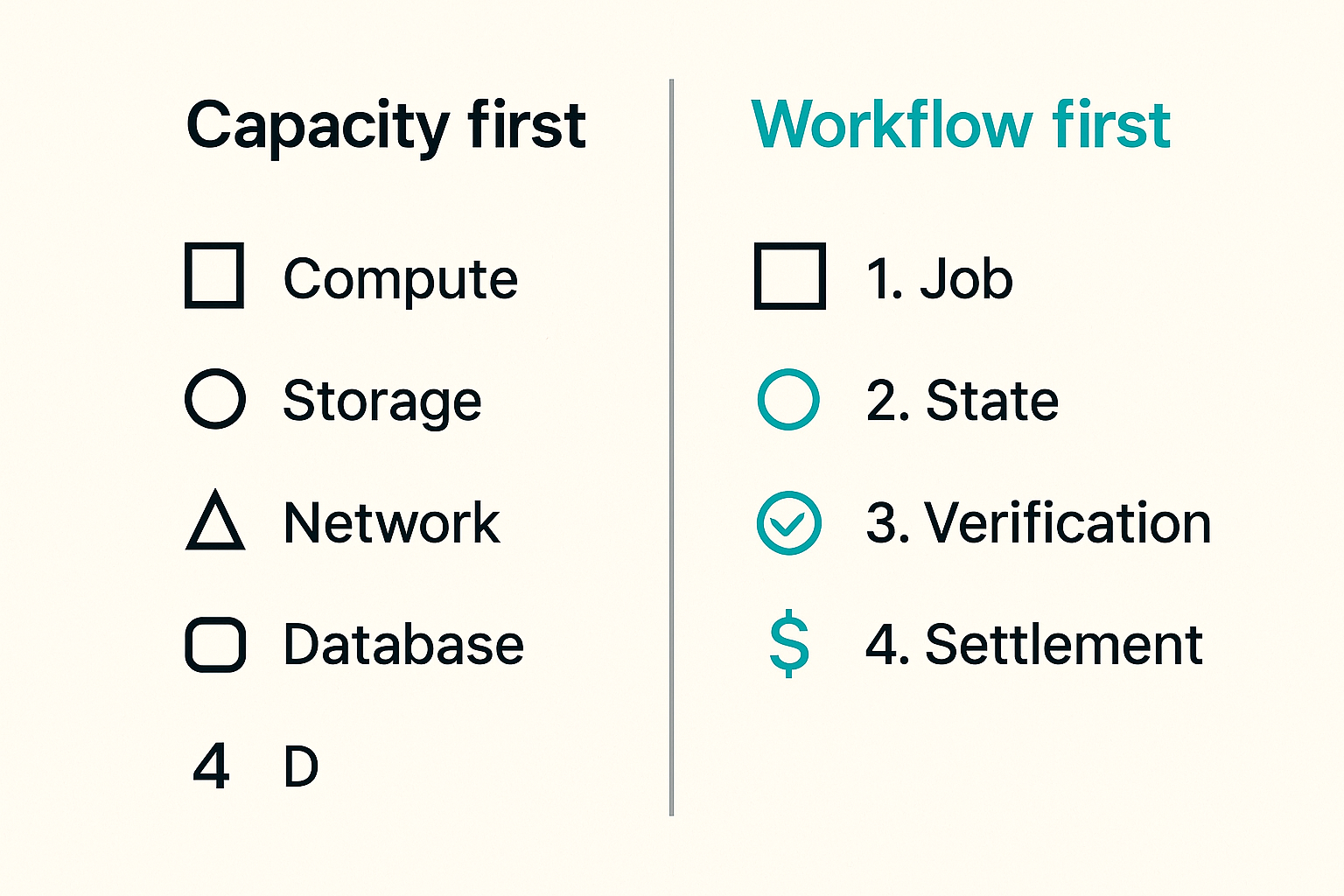
The old model was capacity-first
For years, buying cloud computing services mostly meant selecting capacity: CPU, RAM, disk, network, region, maybe a managed database. The workflow was straightforward. Provision infrastructure, deploy code, monitor it, scale when necessary.
That model still exists, and it is still useful. But it assumes the compute provider is the center of the system. Your application bends around the provider primitives: instances, buckets, queues, IAM, logs, billing, and regions.
The mistake teams make is treating this as the default shape for every workload. It is fine for long-running services. It is less clean for bursty AI inference, one-off video processing, batch rendering, model evaluation, or jobs where the buyer and worker do not belong to the same organization.
The new model is job-state-first
A useful way to think about modern cloud computing services is to start with the job, not the machine.
A job has inputs, constraints, expected outputs, deadlines, cost limits, trust requirements, and payment conditions. It moves through states: created, quoted, assigned, running, uploaded, verified, paid, failed, retried, or disputed.
Once you model compute this way, infrastructure becomes a routing target. A GPU instance, a local worker, a decentralized node, or a managed inference endpoint can all execute the same logical job if they satisfy the policy.
Practical rule: If the job state is not durable outside the worker, the worker owns your reliability model. That is usually the wrong owner.
Where decentralized compute fits
Decentralized compute is not a magic replacement for every cloud platform. It is a different coordination layer.
It makes sense when workloads can be packaged, dispatched, verified, and paid for as discrete units of work. AI inference requests, FFmpeg transcodes, embeddings batches, media normalization, synthetic data generation, and CLI-driven automation are good candidates. A monolithic database with low-latency writes is not.
The practical question is whether your workload can tolerate a marketplace boundary. If it can, you gain access to heterogeneous capacity and programmable settlement. If it cannot, keep it close to the application.
The real components of modern cloud computing services
Control plane
The control plane decides what should happen. It accepts job requests, validates inputs, chooses policies, records state, and coordinates retries. In centralized cloud, this might be a managed queue plus a scheduler. In a decentralized compute marketplace, it also has to reason about worker identity, reputation, price, proof, and payment.
Do not bury this logic inside workers. Workers should execute. The control plane should decide.
For builders exploring c0mpute workflows, the CLI reference and cookbook in the c0mpute docs is the right place to map commands to job lifecycle concepts rather than treating each command as an isolated script.
Execution plane
The execution plane does the work: running inference, transcoding video, processing files, creating embeddings, or executing a containerized task.
This layer should be replaceable. If your application assumes one exact runtime, one exact GPU SKU, one exact region, and one exact output path, you have not built a compute abstraction. You have built provider glue.
Execution workers need clear contracts:
- Accepted input formats
- Resource requirements
- Runtime limits
- Output schema
- Error codes
- Artifact upload rules
- Verification method
Settlement and trust plane
Cloud computing services also need a settlement layer. In traditional cloud, this is hidden inside the provider invoice. In decentralized compute, payment is part of the workflow.
That means compute architecture must answer questions that normal VM provisioning avoids: Who is allowed to claim a job? What prevents a worker from submitting junk output? When is payment released? What happens if the buyer cancels? How are partial failures handled?
Related reading from our network: teams building biotech-style paid compute flows face similar job-state and settlement issues in cloud computing peptide payments architecture, even though the workload domain is different.
Centralized cloud versus decentralized compute
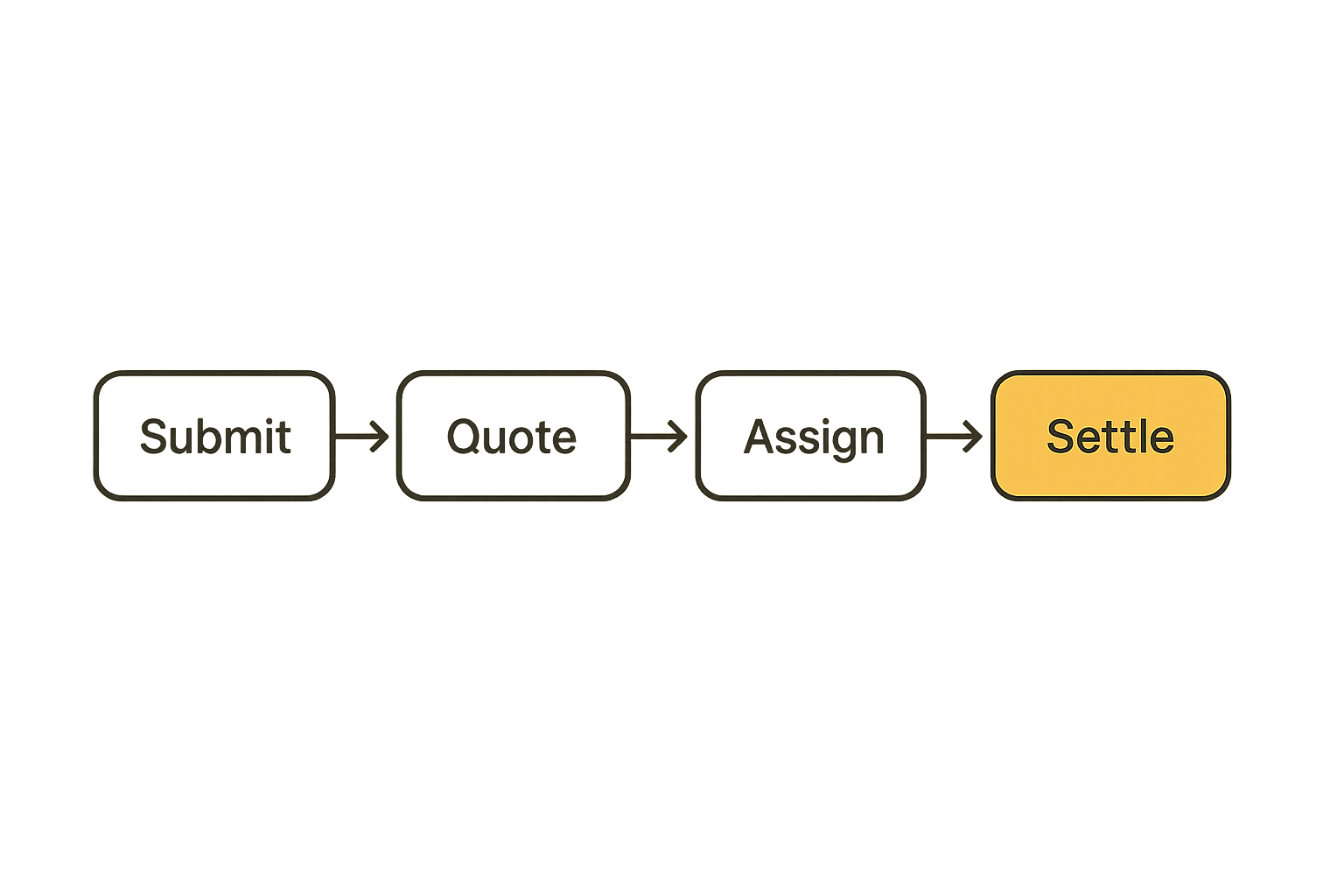
What centralized cloud still does well
Centralized cloud is very good at stable primitives. If you need managed databases, private networking, compliance-heavy account boundaries, low-latency service meshes, or deep integration with a single vendor ecosystem, centralized providers are still the default.
The mistake is not using centralized cloud. The mistake is using it for every workload because procurement and dashboards are familiar.
For many AI and video teams, the expensive part is not the always-on application. It is the burst: transcoding a backlog, running model evaluations, serving unpredictable inference requests, or processing user-uploaded media. Those are job-shaped problems.
What decentralized compute changes
Decentralized compute changes the unit of planning from account-owned infrastructure to market-dispatched jobs.
Instead of asking, how many instances do we reserve, you ask:
- What job types can be safely outsourced?
- Which inputs can leave our boundary?
- What proof do we require before payment?
- How do we route around slow or unhealthy workers?
- What price ceiling makes a job worth running?
That changes the conversation. You are no longer only optimizing infrastructure cost. You are designing a market protocol around execution.
Comparison table
| Dimension | Centralized cloud services | Decentralized compute marketplace |
|---|---|---|
| Primary unit | Instance, container, managed service | Job, task, artifact, quote |
| Trust model | Provider account and IAM | Worker identity, reputation, verification |
| Payment model | Monthly invoice or usage bill | Per-job escrow, settlement, release rules |
| Best fit | Long-running services, databases, private networks | Bursty jobs, AI inference, transcoding, batch work |
| Failure handling | Provider health plus app retries | Job state, reassignment, proof, dispute handling |
| Operational risk | Vendor lock-in, regional outages, cost creep | Worker quality, verification gaps, marketplace liquidity |
Practical rule: Use centralized cloud for tightly coupled state. Use decentralized compute for portable execution units with clear inputs, outputs, and verification.
Designing job routing for AI and video workloads
Classify the workload before routing
AI inference and video transcoding are both compute-heavy, but they do not fail the same way.
An inference job may be small, latency-sensitive, and model-specific. A video transcode may be large, bandwidth-heavy, and tolerant of minutes of delay. An embeddings batch may be cheap per item but expensive when replayed. A media normalization pipeline may require deterministic outputs because downstream packaging depends on them.
Classify jobs on these axes before routing:
- Latency tolerance
- Input size
- Output size
- GPU requirement
- Determinism requirement
- Privacy sensitivity
- Verification cost
- Retry cost
If you do not classify, every job gets routed by the same blunt rule: cheapest available worker. That is how teams create slow support incidents that look like infrastructure savings.
Use policy instead of hardcoded provider logic
Routing should be policy-driven. Hardcoding if GPU then provider A, if video then provider B works for prototypes and becomes painful fast.
A basic policy can include:
- Maximum price per job
- Required runtime or model
- Minimum worker reputation
- Maximum queue wait
- Preferred geography
- Artifact retention period
- Verification mode
The policy does not need to be complicated. It needs to be visible and testable.
Related reading from our network: streaming teams see the same routing tradeoffs around ingest, transcoding, caching, and observability in cloud computing IPTV architecture.
Make retries explicit
Retries are not a boolean. Retrying a failed API call is different from retrying a two-hour transcode or a GPU inference batch that already consumed paid capacity.
Define retry rules per job type:
- Retry immediately for transient network failures
- Retry on a different worker for missing heartbeat
- Do not retry automatically for invalid input
- Retry with lower quality settings only if the user allowed it
- Escalate to manual review when output verification fails twice
Practical rule: A retry without a new state transition is just duplicate work with better branding.
State, identity, and payments are the hidden cloud layer
Every job needs a durable state machine
What breaks in practice is not usually the compute kernel. It is the state around it.
A worker starts a job, uploads half an artifact, loses connectivity, then comes back. Did it fail? Is it still running? Can another worker claim it? If two outputs arrive, which one wins? If payment was reserved, is it still locked?
A durable job state machine prevents these questions from becoming support archaeology.
A simple state model might look like this:
created -> quoted -> funded -> assigned -> running -> submitted -> verified -> paid
                                  |            |             |
                                  v            v             v
                               expired       failed       disputed
The exact states matter less than ownership. Your system needs one authority that records transitions and rejects illegal moves.
DID-based identity changes worker trust
In a traditional cloud account, identity is mostly internal. In decentralized compute, identity is part of the marketplace.
A worker needs to prove it is the same actor over time. Buyers need a way to evaluate reputation and policy fit. Operators need to revoke, rate-limit, or quarantine bad actors without collapsing the whole network.
DID-based identity helps because worker identity is not merely an API key in one vendor account. It can become a portable trust anchor for job history, reputation, and payment authorization.
This does not remove the need for verification. Identity tells you who submitted the output. Verification tells you whether the output is acceptable.
Payments must follow job state
Payment should not be an afterthought bolted onto the end of a compute job. It should track state.
A practical payment flow reserves funds before assignment, releases funds after verification, and defines what happens on timeout, cancellation, or dispute. If payment only happens after the worker says done, the buyer carries less risk but workers may avoid the marketplace. If payment releases too early, buyers inherit fraud risk.
The mistake teams make is treating compute payment like checkout. It is closer to escrow plus workflow automation.
Implementation workflow for decentralized cloud jobs
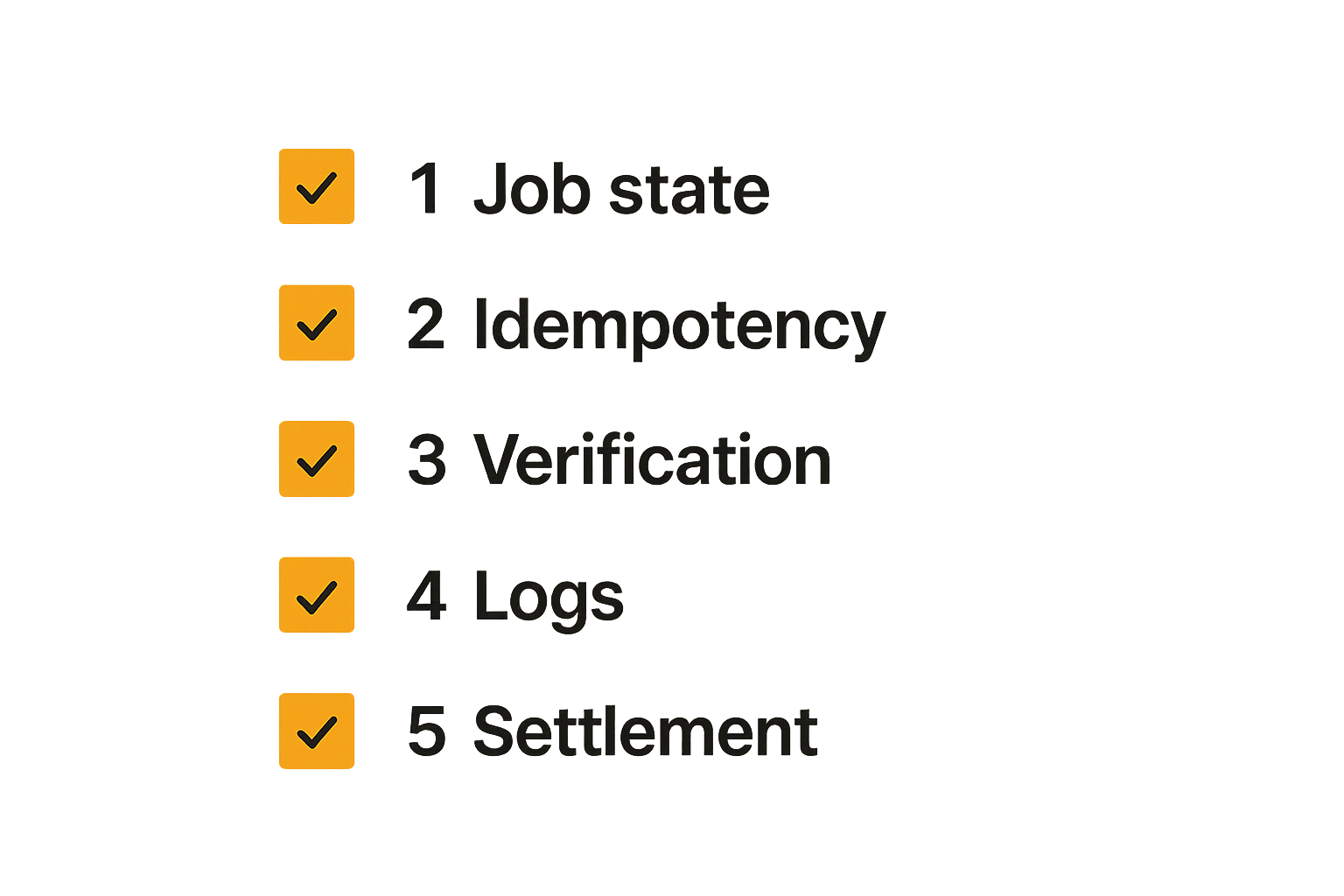
A practical six-step sequence
A production-grade decentralized cloud workflow does not need to start complex. It needs to make the right boundaries explicit.
- Define the job type. Specify inputs, outputs, runtime, resource needs, and verification rules.
- Create the job record. Store durable state before dispatching work.
- Quote and fund the job. Reserve payment according to policy before a worker spends resources.
- Assign the worker. Match by capability, reputation, availability, and price.
- Execute and submit artifacts. Require heartbeats and structured output metadata.
- Verify, settle, or retry. Release payment only after the acceptance path completes.
This is the minimum architecture. You can add auctions, batching, multi-worker verification, streaming outputs, or partial settlement later. Do not start there unless the workload requires it.
CLI-first does not mean ops-last
CLI-first developers often prefer small tools over heavy dashboards. Good. But a CLI is not a substitute for operational state.
A good CLI should let operators inspect queues, tail job logs, retry failed work, verify worker identity, and export artifacts. It should not hide the lifecycle.
Useful commands tend to look like:
compute job create transcode --input s3://bucket/in.mp4 --profile h264-720p
compute job inspect job_123
compute job logs job_123 --follow
compute worker health --min-reputation 80
compute job retry job_123 --reason worker-timeout
The point is not the exact syntax. The point is that every command maps to state the system already understands.
Minimal job spec example
A job spec should be boring and explicit. For a video transcode, you might start with something like:
job_type: ffmpeg_transcode
input:
  uri: ipfs://bafy.../source.mov
  checksum: sha256:abc123
runtime:
  tool: ffmpeg
  profile: h264_720p
limits:
  max_runtime_seconds: 3600
  max_price_usdc: 2.50
verification:
  output_required: mp4
  min_duration_seconds: 300
  checksum_required: true
payment:
  escrow: required
  release: after_verification
This is not glamorous architecture. It is the difference between a marketplace and a pile of scripts.
What breaks when teams implement cloud computing services badly
Failure mode one orphaned jobs
An orphaned job is work nobody clearly owns. The buyer sees pending. The worker sees running. The payment layer sees funded. Support sees a ticket.
This usually happens when teams dispatch work before creating a durable state record, or when worker heartbeats are optional. The fix is not more logging. The fix is a state machine that can expire assignments and requeue safely.
Orphaned jobs are especially painful for large video files and expensive GPU tasks because the wasted cost is visible.
Failure mode two unverifiable outputs
If you cannot verify output, you cannot automate settlement with confidence.
For FFmpeg jobs, verification may include codec, duration, resolution, audio track presence, checksum, and playable container checks. For AI inference, verification is harder. You may validate schema, model identifier, latency, output size, sampling parameters, or use redundant execution for high-value jobs.
Not every output can be proven perfect. But every paid job needs an acceptance policy.
Failure mode three payment disputes
Payment disputes usually come from ambiguous expectations. The worker says the job completed. The buyer says the output is unusable. The system has no clean artifact trail.
Avoid this with clear job specs, immutable input references, timestamped state transitions, artifact metadata, and deterministic release rules.
Related reading from our network: infrastructure teams trying to make cloud content understandable to AI crawlers run into a similar need for validation and machine-readable state, covered in cloud computing answer engine optimization.
Observability for distributed compute marketplaces
Measure job lifecycle events
Do not only measure CPU, GPU, and memory. Those are worker metrics. Marketplace operators need job metrics.
Track:
- Time from created to assigned
- Time from assigned to first heartbeat
- Runtime by job type
- Verification failure rate
- Retry rate by worker and job type
- Payment release latency
- Artifact upload failures
- Queue depth by capability
A chart of GPU utilization can look healthy while buyers are waiting too long for assignment. Job lifecycle metrics reveal marketplace experience.
Track worker health and reputation
Worker reputation should not be a vanity score. It should be derived from operational behavior.
Inputs might include successful completions, timeout rate, verification failures, dispute rate, response latency, supported runtimes, and recent health checks. Weight recent behavior more heavily than ancient history.
Bad reputation systems become either meaningless or punitive. Useful reputation systems help routing make better decisions while giving workers a path to recover.
Expose status without leaking internals
Users do not need every internal trace. They do need credible status.
Expose public or customer-facing status for queue delays, degraded worker pools, payment settlement issues, and artifact storage problems. A status page should reduce tickets, not become another dashboard nobody trusts. The c0mpute status page is the kind of operational surface teams should expect from infrastructure they depend on.
Practical rule: If users have to ask whether their job is stuck, your status model is already late.
What works and what fails in production
What works
What works is boring architecture with sharp boundaries.
- Job specs that define inputs, outputs, and acceptance
- Durable state before dispatch
- Worker identity that persists across jobs
- Policy-based routing instead of provider assumptions
- Heartbeats and assignment expiry
- Artifact metadata and checksums
- Payment release tied to verification
- CLI commands that expose state instead of hiding it
This is not overengineering. It is the minimum needed when compute, trust, and money are separated across actors.
What fails
What fails is treating decentralized compute like a cheaper VM pool.
If you only chase cheap execution, you ignore verification. If you ignore verification, you create payment disputes. If you ignore job state, you create orphaned work. If you ignore worker identity, you cannot build reputation. If you ignore observability, every failure becomes a custom investigation.
The practical question is not whether decentralized compute is cheaper. Sometimes it will be. Sometimes it will not. The question is whether it gives you a better execution market for the jobs your system can safely externalize.
Operator checklist
Before moving a workload into decentralized cloud computing services, answer these questions:
- Can the workload be packaged as a discrete job?
- Are inputs referenced immutably?
- Is output verification defined?
- Is retry cost acceptable?
- Can payment be reserved before execution?
- Can settlement wait for verification?
- Is worker identity meaningful over time?
- Can users inspect job status without support?
If the answer is no across most of this list, keep the workload inside conventional cloud until the boundary is cleaner.
Where c0mpute.com fits
A marketplace view of cloud computing services
c0mpute.com is built around the idea that cloud computing services can be job-oriented instead of account-oriented. The useful abstraction is not another dashboard for generic infrastructure. It is a CLI-first marketplace where developers can dispatch compute tasks, workers can provide capacity, and payment can align with execution.
The architecture lines up around three practical modules: FFmpeg-oriented transcoding, DID-based payments, and AI inference. That combination matters because media, identity, settlement, and inference are usually treated as separate systems. In production, they collide.
You can explore the network entry point at c0mpute.com when you want to think about compute as jobs, workers, and settlement rather than only instances and invoices.
Good fit workloads
Good fit workloads are portable, bounded, and verifiable enough to route through a marketplace.
Examples include:
- Transcoding uploaded video into standard delivery profiles
- Running batch inference jobs against known models
- Generating embeddings for document sets
- Normalizing media assets for downstream packaging
- Running CLI-defined jobs with explicit artifacts
- Testing decentralized payment flows around compute completion
Poor fit workloads include highly sensitive data with no privacy boundary, stateful databases, ultra-low-latency trading paths, and anything where output cannot be validated but payment must be automatic.
Closing the loop
The best cloud computing services architecture in 2026 will not be purely centralized or purely decentralized. It will be selective.
Keep tightly coupled state close. Move portable execution into a market when the job boundary is clean. Tie identity and payment to state. Verify before settlement. Expose enough status that developers can debug without opening a ticket.
That is the practical path. Not hype, not blanket replacement, and not another layer of dashboard abstraction. Just a better workflow for jobs that should not require owning all the machines.
Try c0mpute.com
c0mpute.com is for technical builders interested in decentralized compute, AI inference, FFmpeg transcoding, and DID-based payments. Try c0mpute.com.