If you are looking for an Akash network alternative, you probably already know the easy part: renting compute should not require a hyperscaler account, a procurement cycle, and a monthly bill that surprises you later.
The hard part starts after the demo. Your AI inference job needs a specific GPU. Your FFmpeg transcode needs predictable codecs. Your payment flow needs to survive retries. Your users do not care that the provider is decentralized if the artifact is missing, the callback never fires, or nobody owns the failed job.
Teams think the problem is finding a cheaper compute marketplace. The real problem is designing a workload lifecycle that can survive untrusted operators, partial failure, variable hardware, and settlement boundaries.
That changes the conversation. An Akash network alternative is not just a network comparison. It is an architecture decision about scheduling, validation, payments, identity, observability, and support. The practical question is not which logo replaces Akash. It is which workflow lets your application ship jobs, verify results, pay the right party, and recover when the network behaves like a real distributed system.
Table of contents
- Start with workload ownership, not marketplace branding
- Akash network alternative criteria that matter in production
- Compare the workload classes before you compare networks
- What breaks when teams choose the wrong alternative
- Design a decentralized compute workflow instead of a one-off deployment
- Payments, identity, and settlement are part of the compute system
- Akash network alternative comparison table for builders
- Implementation sequence for testing an Akash network alternative
- Security, privacy, and trust boundaries
- Where c0mpute.com fits as an Akash network alternative
Start with workload ownership, not marketplace branding
What you actually need to place
A useful way to think about it is this: you are not placing compute. You are placing responsibility.
For a web3 developer, that responsibility may be a containerized worker that signs results and emits a callback. For an AI infrastructure builder, it may be a GPU inference call with model version, prompt hash, latency target, and output validation. For a video engineer, it may be an FFmpeg command that turns mezzanine input into HLS renditions and writes a manifest that downstream players can trust.
Those are different jobs. They fail differently. They have different proof surfaces. They require different retry behavior. A marketplace that looks good for one can be awkward for another.
Practical rule: evaluate decentralized compute by the job lifecycle you need to operate, not by the deployment primitive the network advertises.
If your only question is whether a provider can start a container, you will miss the parts that create support tickets: uploads, timeouts, missing logs, under-specified GPUs, partial outputs, duplicate charges, and settlement disputes.
Why 2026 changed the evaluation
In 2026, more teams are pushing AI inference, media processing, and automation workloads outside traditional cloud boundaries. Some are doing it for cost. Some are doing it for censorship resistance. Some are doing it because GPU supply is uneven and regional. Some simply want programmable markets instead of fixed vendor accounts.
But the requirements are stricter now. A toy benchmark is not enough. Builders want CLI-first flows, reliable job state, predictable artifacts, and payment mechanics that make sense for machine-to-machine work.
The mistake teams make is assuming that decentralized compute is one category. It is not. There is a big difference between a general-purpose deployment market, a batch job network, a GPU inference router, and a workflow-specific marketplace.
For a broader comparison of decentralized compute options, our previous Akash Network alternatives architecture guide breaks down scheduling, validation, payments, and operator ownership across multiple approaches.
The architecture question behind Akash network alternative
When someone asks for an Akash network alternative, translate the question into five operational questions:
- What exact workload needs to run?
- Who accepts the job and proves completion?
- How are inputs, secrets, and artifacts handled?
- When does payment become final?
- What happens when the happy path fails?
That framing removes a lot of noise. A network can be excellent at long-running deployments and still be a poor fit for short-lived transcoding jobs. Another can be strong for batch workloads and weak for stateful services. Another may offer attractive GPU supply but leave validation, callbacks, and dispute handling to the application team.
Akash network alternative criteria that matter in production
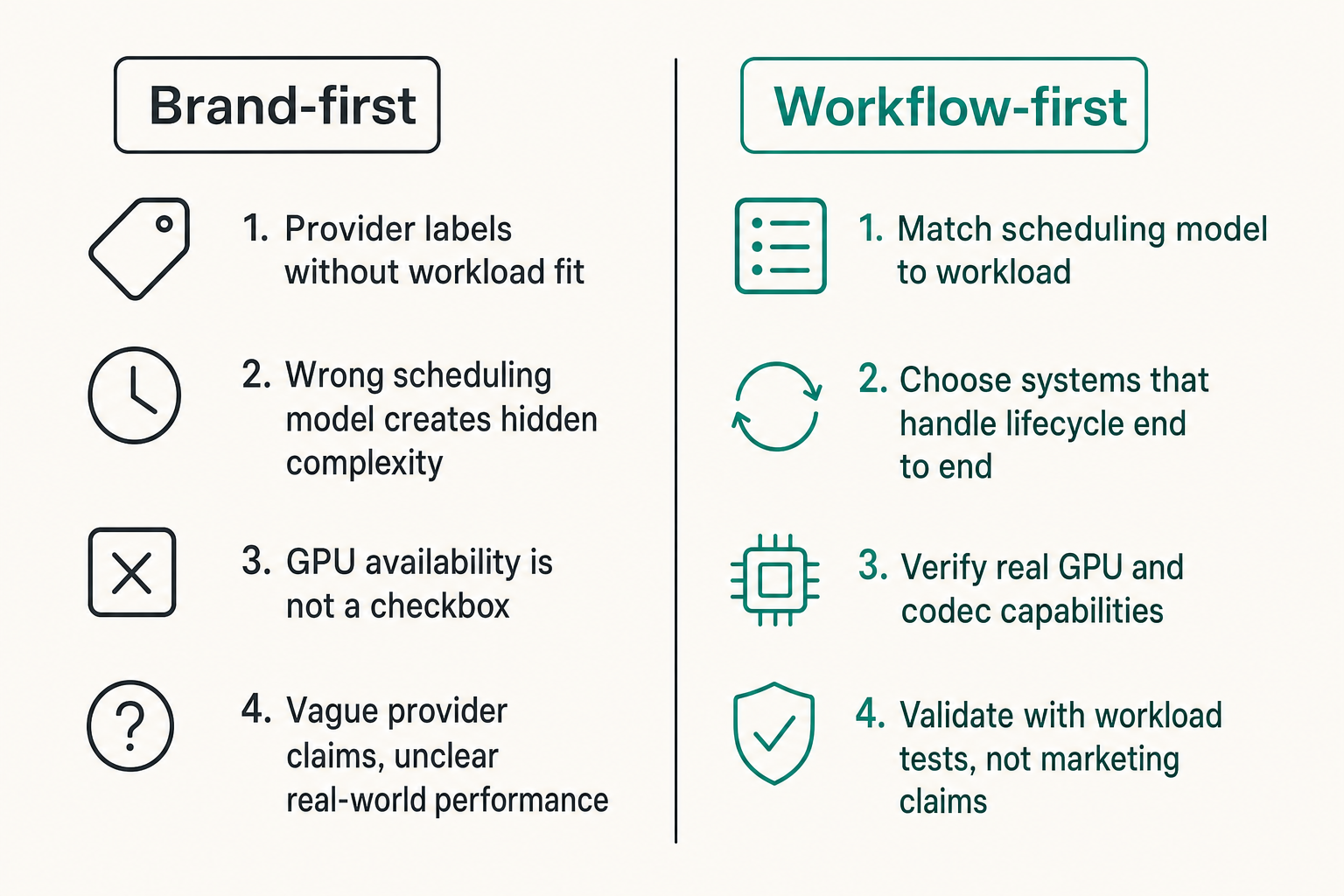
Scheduling model
Scheduling is where many decentralized compute designs look similar in documentation and very different in production.
Ask whether the network schedules services, jobs, tasks, or requests. A long-running container service needs health checks, restarts, networking, and versioned deployments. A batch job needs queue semantics, deadlines, retries, and artifact collection. Inference needs low-latency routing, model placement, concurrency limits, and backpressure.
The wrong scheduling model creates hidden complexity. If you run batch media jobs on a deployment-oriented system, you may end up building your own queue, timeout manager, result collector, and retry engine. If you run latency-sensitive inference on a slow bidding system, the user experience suffers before the model ever runs.
Practical rule: if you need to build a scheduler next to the marketplace, treat that scheduler as part of the real cost.
GPU and codec availability
GPU availability is not a checkbox. For AI inference, the difference between a high-memory GPU and a commodity card can decide which model runs at all. For transcoding, the important question may be NVENC support, codec licensing assumptions, FFmpeg build flags, or whether a worker can handle 10-bit HEVC input without silently falling back to CPU.
A vague provider label like GPU available is not enough. You want a resource description that maps to your job requirements:
- GPU model or capability class
- VRAM floor
- driver and runtime compatibility
- CUDA or ROCm expectations
- FFmpeg encoder support
- disk and network throughput
- maximum job duration
- concurrency limits
For video infrastructure engineers, codec availability is often more important than peak theoretical compute. For AI builders, model fit and memory pressure matter more than headline TFLOPS.
Verification, retries, and support
Verification is the difference between paying for work and paying for hope.
Not every workload needs cryptographic proof. Some need deterministic output checks. Some need checksum verification. Some need human review. Some need multi-worker redundancy. The important part is to define the validation boundary before money moves.
What breaks in practice is the gap between job completion and business completion. A worker may report success while the output file is corrupt. A model response may return but violate schema. A transcode may finish but miss audio tracks. A settlement may finalize before the application confirms the artifact.
Support also matters. If your user opens a ticket, can you answer with job ID, worker ID, input hash, output hash, logs, payment state, and retry history? If not, the decentralized part will not save you from the operational mess.
Compare the workload classes before you compare networks
AI inference has different failure semantics
AI inference is not just compute. It is a request-response system with model identity, prompt handling, token limits, latency expectations, safety rules, and output validation.
A decentralized inference workflow usually needs:
- model version pinning
- input hashing or request signing
- provider capability matching
- timeout and fallback routing
- schema validation for structured output
- cost estimation before dispatch
- logs that do not leak sensitive prompts
The failure mode is often not total failure. It is slow response, wrong model, incomplete stream, malformed JSON, or provider drift. Retrying blindly can multiply cost or produce inconsistent user experiences.
If you are building agents or backend automation, you need to decide when a response is acceptable, when to route to another worker, and when to fail closed.
FFmpeg transcoding is batch, measurable, and painful to retry
FFmpeg jobs are different. They can be large, long-running, and artifact-heavy. Inputs may sit in object storage. Outputs may include multiple renditions, thumbnails, subtitles, manifests, and checksums. The job may consume serious GPU time but produce results that are easy to validate if you define the checks.
A decent transcode workflow should track:
- input URI and checksum
- command template or preset ID
- expected output ladder
- worker capability
- progress events
- output manifest
- rendition checksums
- duration and bitrate checks
- final artifact location
This is where generic compute abstractions often struggle. Starting a container is easy. Moving large media inputs, producing predictable outputs, and recovering from partial artifacts is the real work.
Related reading from our network: teams designing media pipelines face adjacent concerns around network paths, streaming reliability, and troubleshooting in Lumen Technologies for torrent, IPTV, and home media workflows.
Generic containers still need operational boundaries
Generic containers are powerful because they let developers bring their own runtime. They are dangerous for the same reason.
If every workload is an arbitrary container, the platform still needs boundaries: resource limits, network policy, log capture, input access, output paths, and billing rules. Without those boundaries, your application inherits every sharp edge.
A container marketplace can be a good Akash network alternative when you need flexibility and can own the surrounding workflow. It is a poor fit when you need a productized job lifecycle and do not want to build the missing control plane yourself.
What breaks when teams choose the wrong alternative
The job gets accepted but not completed
The most frustrating failure is not rejection. Rejection is clean. The painful state is accepted-but-stuck.
A worker accepts a job, downloads input slowly, runs out of disk, hits a codec mismatch, loses network, or never uploads the final artifact. Your application waits. The user refreshes. The provider may think the job is still running. The payment layer may be in limbo.
This is why job leases matter. A decentralized compute workflow should not let a worker hold responsibility forever. The system needs deadlines, heartbeats, progress updates, and takeover rules.
Good systems make stuck work visible. Bad systems turn it into archaeology.
Payments clear before trust is earned
Payment finality is useful only when it lines up with business finality.
If funds release on worker-reported completion, the application can pay for bad output. If funds release only after manual review, operators may wait too long and liquidity suffers. If refunds require social coordination, support load grows.
A better pattern is staged settlement:
- user or application locks funds for a defined job
- worker accepts with capability and price
- worker submits output plus evidence
- application validates against agreed rules
- escrow releases, disputes, or retries
That pattern is not hype. It is basic distributed systems hygiene applied to money.
Observability stops at deployment
Many teams can tell you a container was deployed. Fewer can tell you whether the business task succeeded.
For decentralized compute, observability needs to follow the job, not just the worker. You want correlated events:
- job created
- bid received
- worker assigned
- input fetched
- execution started
- progress emitted
- output uploaded
- validation passed
- payment released
- callback delivered
Without this, every incident becomes a Slack thread and every support ticket starts with please send the transaction hash. Related reading from our network: private operational workflows have similar sprawl problems, especially when identity, attachments, and records are scattered, as covered in IRS secure messaging in 2026.
Design a decentralized compute workflow instead of a one-off deployment
A minimum viable job lifecycle
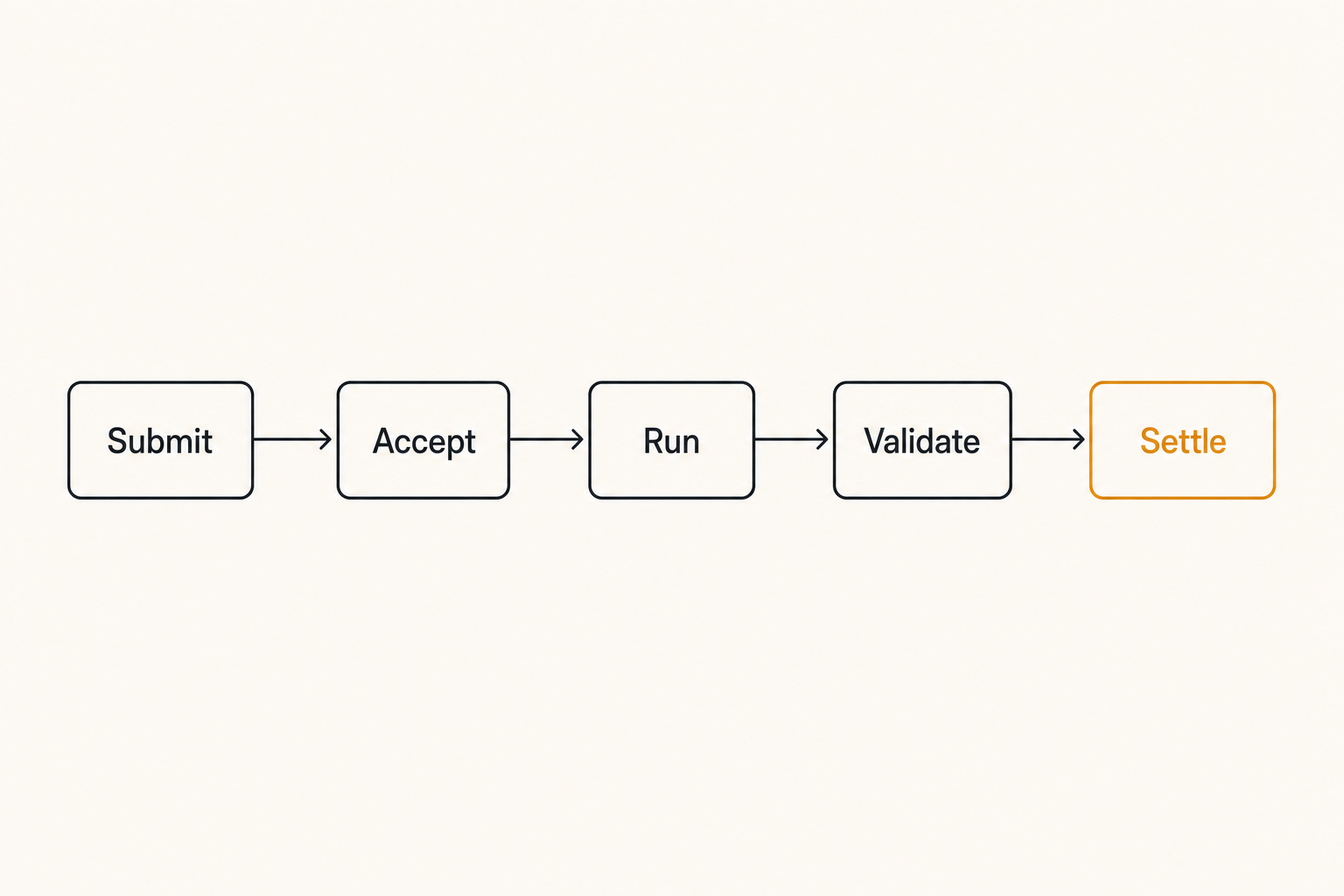
A practical decentralized compute workflow needs a state machine. It does not have to be complicated, but it has to exist.
A minimum lifecycle looks like this:
created- the client defines inputs, requirements, budget, and validation rules.listed- the job becomes available to eligible workers.accepted- a worker claims responsibility for a lease period.running- the worker emits progress and logs.submitted- outputs and evidence are uploaded.validated- the requester or validator checks the result.settled- payment releases or the job enters dispute.closed- artifacts, logs, and records are retained according to policy.
The important detail is that every transition has an owner. The requester owns job creation. The network owns matching or listing. The worker owns execution. The validator owns acceptance. The payment module owns settlement.
Practical rule: never let a job state change without recording who caused it, when it happened, and what evidence supports it.
Idempotency and retries
Retries are where clean demos become expensive bugs.
If a client submits the same job twice because a CLI timed out, should it create two payable jobs or return the existing one? If a worker uploads the same artifact twice, should settlement run twice? If a webhook fails, should the application reprocess the event or ignore the duplicate?
Use idempotency keys everywhere a request can be retried:
job_key = hash(requester_did + input_hash + preset_id + nonce)
artifact_key = hash(job_id + output_manifest_hash)
settlement_key = hash(job_id + validation_result + payee)
The exact format matters less than the rule: retries should be safe by default. The worst outcome is a system where users learn not to retry because retrying may double-charge them.
Artifact handling and result validation
Artifacts are part of the compute contract.
For inference, the artifact may be a response body, a JSON object, a tool call, or an embedding vector. For transcoding, it may be a directory of renditions and manifests. For generic compute, it may be a file, a signed message, or a database update.
Define artifacts explicitly:
- where inputs are fetched from
- who is authorized to fetch them
- where outputs are written
- how output integrity is checked
- how long artifacts are retained
- what counts as completion
For FFmpeg, validation can include ffprobe, duration checks, stream count checks, bitrate thresholds, and manifest parsing. For AI inference, validation may include JSON schema, model identifier, token usage, and application-level acceptance tests.
Payments, identity, and settlement are part of the compute system
Why wallet address is not enough
A wallet address can receive funds. It does not automatically answer who performed the work, which job the work relates to, what terms were accepted, or whether the same operator is allowed to run future jobs.
For machine-to-machine compute, identity needs more context. DID-based identity can help connect requesters, workers, policies, and payment records without forcing every workflow into a single centralized account system.
This matters when you want to build reputation, enforce allowlists, route work to known operators, or prove that a payment belongs to a specific job. It also matters for support. Nobody wants to debug a failed transcode by comparing raw wallet addresses in a spreadsheet.
Escrow and release conditions
Escrow is not just a payment feature. It is a coordination primitive.
A job escrow can encode the basic terms of work: price, worker, deadline, validation rule, and release condition. It reduces ambiguity. The worker knows funds exist. The requester knows payment should not release until the agreed condition is met.
Release conditions should match workload type:
- inference: valid response before timeout, optional schema pass
- transcode: complete output ladder, checksum match, duration match
- batch compute: expected result file and exit code
- human-reviewed work: validator signature or approval event
Escrow does not remove disputes, but it gives disputes a structured object. That is better than arguing over chat logs and screenshots.
Operator records and reconciliation
Reconciliation is boring until it breaks. Then it becomes the only thing anyone cares about.
Every job should leave a record that connects compute events to payment events. At minimum:
- job ID
- requester identity
- worker identity
- input hash
- output hash or manifest hash
- agreed price
- escrow transaction
- validation result
- settlement transaction
- timestamps
Related reading from our network: decentralized compute markets have the same coordination problem as local trust networks, where asks, offers, routing, and follow-up need an operating model, as explained in how to run a local community network.
Akash network alternative comparison table for builders
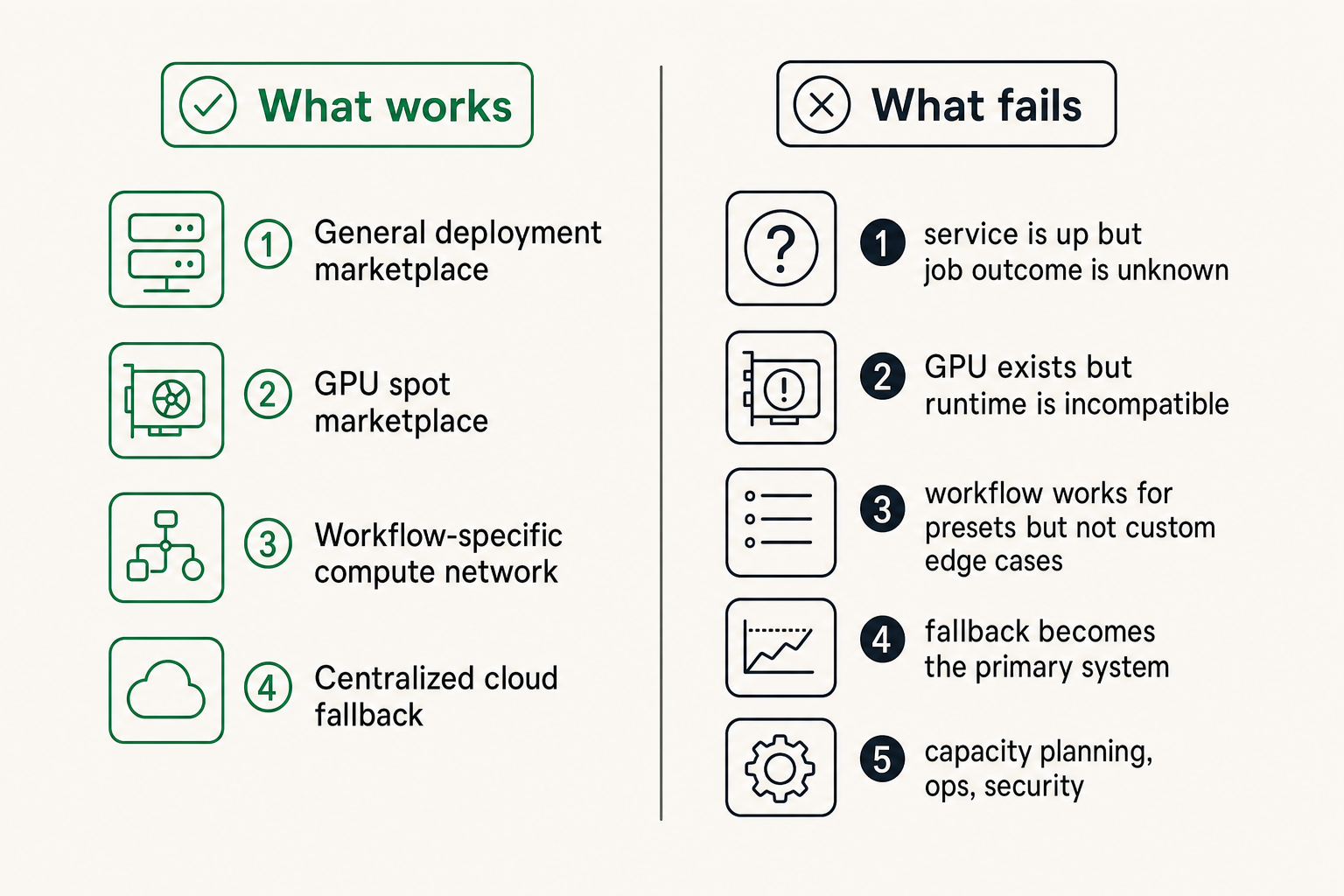
What works
The best Akash network alternative for your team is the one that reduces the amount of infrastructure you have to invent around the job.
If you are running long-lived services, a deployment marketplace with mature networking and provider competition may work well. If you are running repeatable media or inference jobs, a workflow-specific system can be more useful because it bakes in the lifecycle you would otherwise build yourself.
Here is the practical comparison.
| Approach | Best fit | What you still own | Failure mode to test |
|---|---|---|---|
| General deployment marketplace | long-running containers, web services, custom stacks | app-level queueing, validation, payment mapping | service is up but job outcome is unknown |
| GPU spot marketplace | model experiments, burst inference, training jobs | provider selection, model placement, retries | GPU exists but runtime is incompatible |
| Workflow-specific compute network | FFmpeg, inference, repeatable batch jobs | presets, validation policy, artifact rules | workflow works for presets but not custom edge cases |
| Centralized cloud fallback | strict SLAs, regulated workloads, managed support | vendor cost, account control, portability | fallback becomes the primary system |
| Self-hosted worker pool | predictable internal workloads | capacity planning, ops, security, billing | underutilization or operator burnout |
What fails
What fails is choosing the most flexible option and then pretending flexibility is the same as product fit.
A generic container runtime can do almost anything, but that does not mean your team should own everything around it. You may end up maintaining bid logic, worker scoring, retries, object storage conventions, progress reporting, webhook delivery, and payment reconciliation.
The opposite failure also happens. Teams choose a narrow workflow tool, then discover they need arbitrary networking, custom runtimes, or long-running stateful services. The tool is not wrong. The workload was misclassified.
How to read the table
Use the table to decide what you want to outsource to the network.
If the network only provides placement, your application owns the rest. If the network provides a job lifecycle, you give up some generality but reduce integration work. If the network provides payment and identity primitives, you can build stronger operator workflows but must design around those primitives from the start.
The practical question is: where do you want the complexity to live?
Implementation sequence for testing an Akash network alternative
Step 1 Define a real job
Do not benchmark with hello world. Pick one job that resembles production.
For AI inference:
model: llama-family-or-other-target
input: realistic prompt payload
max_latency_ms: application threshold
output: strict JSON schema
budget: max acceptable cost
retry_policy: one fallback worker
For FFmpeg:
input: 4k source with audio tracks
preset: hls-1080p-720p-480p
requirements: gpu-encode preferred
validation: ffprobe plus manifest check
budget: max per minute of source video
retry_policy: retry on worker failure, not on validation failure
The point is to test the workflow, not the marketing claim.
Step 2 Run it under failure
Once the happy path works, break it deliberately.
- Submit the same job twice with the same idempotency key.
- Kill the worker mid-job or simulate a timeout.
- Upload an invalid artifact and confirm validation fails.
- Drop the callback endpoint and test webhook retry.
- Run with insufficient GPU or missing codec support.
- Force payment settlement to wait for validation.
- Confirm logs are enough to explain the incident.
A network that only works when every component behaves perfectly is not production-ready. It may still be useful, but you should know what you are buying.
Step 3 Measure owner effort
Track how much code your team writes outside the network.
If you need 2,000 lines of queueing, retries, validation, artifact management, and settlement glue, include that in your comparison. If your operators need manual steps to recover failed jobs, include that too. If your support team cannot answer basic questions from logs, the system is not done.
When testing, keep an eye on public health and availability signals. Even a simple status page can help your runbook, which is why builders often check c0mpute network status before separating application bugs from infrastructure problems.
Security, privacy, and trust boundaries
Data minimization
Decentralized compute does not magically make sensitive workloads safe. In many cases, it expands the trust boundary because external workers may see inputs, logs, or outputs.
Minimize what you send. For inference, avoid sending secrets inside prompts. For transcoding, avoid embedding private tokens in source URLs. For batch jobs, separate public inputs from confidential configuration.
Use short-lived signed URLs when possible. Scope worker access to one job. Expire credentials quickly. Treat logs as potentially visible unless the platform gives you strong guarantees.
Secrets and model access
Secrets are a common weak point.
If a worker needs access to a private model, private bucket, license key, or API token, decide whether the decentralized compute network is actually the right execution environment. Some workloads are better split: public compute runs externally, private post-processing runs internally.
For AI inference, model access can also be a commercial boundary. If the model weights are proprietary, you may not want arbitrary workers to load them. In that case, the alternative is not a public marketplace. It may be a permissioned worker set with DID identity and explicit operator agreements.
Dispute handling
Disputes are not a sign of failure. They are a sign that real money and real work are involved.
Define disputes before launch:
- who can open one
- what evidence is required
- how long the response window is
- whether partial payment is possible
- who can override settlement
- how abusive requesters or workers are handled
Without this, your support process becomes the court of last resort. That does not scale, and it is unfair to both sides.
Practical rule: if a job can move money, it needs an evidence trail good enough for a tired operator to make a decision later.
Where c0mpute.com fits as an Akash network alternative
The plugin model
c0mpute.com is built around a more workflow-specific view of decentralized compute. Instead of treating every workload as only a generic deployment, the system is organized around modules that map to real builder jobs: FFmpeg transcoding, DID-based payments, and AI inference.
That matters because the UI is not the system. The system is the CLI flow, job state, worker capability, validation boundary, payment record, and artifact lifecycle.
The plugin ecosystem is a useful entry point if you want to inspect how these workflows are separated: c0mpute plugins covers transcode for FFmpeg GPU video encoding, coinpay for DID identity and escrow payments, and infernet for AI LLM inference.
The goal is not to replace every possible compute primitive. The goal is to make common decentralized compute jobs easier to operate without pretending that scheduling, validation, and settlement are somebody else’s problem.
Good fit and bad fit
c0mpute.com is a good fit when your workload looks like a job with clear inputs, outputs, ownership, and payment conditions.
Good fits include:
- GPU-assisted FFmpeg transcoding
- batch media processing
- AI inference requests
- CLI-driven compute jobs
- DID-linked payment workflows
- escrow-backed worker compensation
- builder experiments that need visible job state
It is not the right fit for every workload. If you need a full Kubernetes-like environment, long-running stateful databases, heavy private data processing, or strict enterprise support contracts, a different architecture may be better.
That is the honest way to evaluate an Akash network alternative. Start with the workload. Decide who owns each transition. Then choose the network that removes the most operational burden without hiding the parts that still matter.
Try c0mpute.com
c0mpute.com is for technical builders interested in decentralized compute, AI inference, FFmpeg transcoding, and DID-based payments. If you are evaluating an Akash network alternative, start with a real job and test the workflow end to end: Try c0mpute.com.